

Field Employee Scorecards: How to Measure Performance Fairly
A field employee scorecard looks simple: pick a few metrics, score each rep, rank the team. In practice, it’s one of the easiest ways to demotivate good people. A rep covering a spread-out rural territory gets compared with one who has 12 customers within a 3 km radius. Someone with an easy route tops the leaderboard while a high performer in a tough area gets flagged.
This guide explains what a field employee scorecard is, which metrics belong on it, and how to design one that your team will trust. It also shows how field force management software can feed the scorecard with reliable data.
What Is a Field Employee Scorecard?
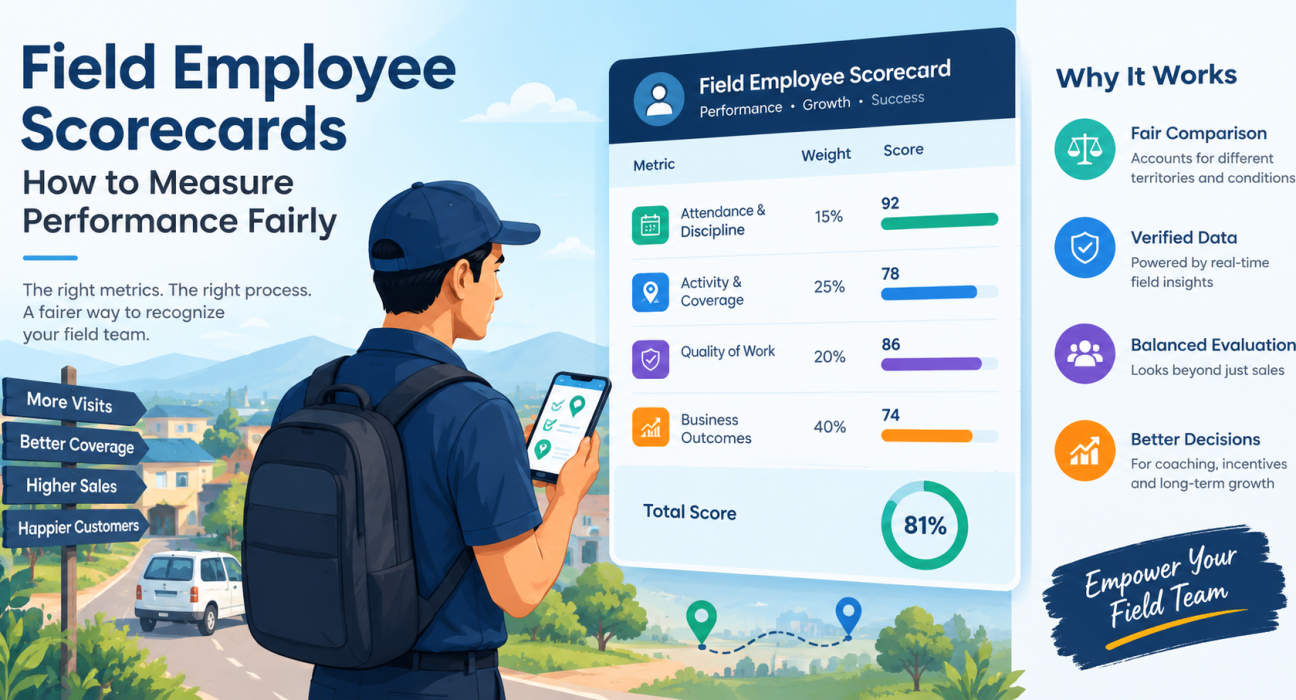
A field employee scorecard is a structured framework that scores each field employee against a fixed set of weighted metrics, such as attendance, visit completion, task quality, sales outcomes, and customer feedback, over a defined period.
Instead of judging performance by gut feeling or a single number like sales, a scorecard combines several indicators into one view. Managers use it to compare performance consistently, spot coaching needs, and link incentives to measurable behavior.
A good scorecard has four parts:
- Metrics: what you measure
- Targets: what “good” looks like for each metric
- Weights: how much each metric contributes to the final score
- Review cycle: how often scores are calculated and discussed
Why Field Teams Need a Different Kind of Scorecard
Office performance reviews rely on direct observation. Field work doesn’t allow that. Managers can’t see most of what their reps do, so they lean on whatever data is easiest to get, usually sales numbers or a rep’s own report.
That creates three common problems:
- Outcome bias: Only end results are measured, ignoring the effort and conditions behind them.
- Unverified data: Visit counts and activity reports are self-reported, so they can’t be fully trusted.
- Unequal conditions: Territory size, travel distance, customer density, and traffic differ widely between reps.
A well-designed field team performance scorecard addresses all three: it uses verified data, balances activity with outcomes, and adjusts for conditions that reps can’t control.
What to Measure: Core Field Employee KPIs
Pick metrics across four categories. Most teams do well with 6 to 10 metrics in total. More than that dilutes focus.
1. Attendance and Discipline
- Punch-in compliance and on-time start
- Working hours in the field versus planned hours
- Attendance verified by location (geofenced punch-in)
2. Activity and Coverage
- Planned visits versus completed visits (visit compliance)
- Beat or route adherence
- Number of customers or outlets covered against target
- Time spent per visit
3. Quality of Work
- Proof of visit captured (photo, signature, OTP)
- Checklist or form completion rate
- SLA compliance for service or delivery jobs
- First-time resolution for service tasks
4. Business Outcomes
- Sales or order value against target
- Collections achieved against due amounts
- Lead conversion or new customer additions
- Customer feedback or NPS
Which of these matter most depends on the role. A sales executive and a service technician should never be scored on the same sheet.
| Role | Metrics to Prioritize |
|---|---|
| Field sales executive | Visit compliance, orders, new outlets, collections |
| Service technician | SLA compliance, first-time resolution, customer feedback |
| Collection agent | Collection vs. target, visit proof, follow-up completion |
| Merchandiser / auditor | Outlet coverage, checklist completion, photo proof |
| Delivery executive | On-time delivery, proof of delivery, route adherence |
How to Build a Field Employee Scorecard: Step by Step
- Define the goal. Decide whether the scorecard is for coaching, incentives, promotions, or all three. This shapes which metrics matter.
- Segment by role. Create a separate scorecard for each job type.
- Choose 6–10 metrics. Mix activity, quality, and outcome measures.
- Set targets for each metric. Use historical data and territory conditions, not a single company-wide number.
- Assign weights that total 100%. Give more weight to what the role is actually accountable for.
- Decide the scoring method. Convert each metric to a 0–100 or 1–5 score, then calculate a weighted total.
- Set the review cycle. Weekly for operational metrics, monthly or quarterly for incentives and reviews.
- Share the scorecard before you use it. Reps should know exactly how they’ll be measured.
Example Weighted Scorecard (Illustrative)
The weights below are an example only. Adjust them to your business.
| Metric | Weight | Target | Rep Result | Score |
|---|---|---|---|---|
| Attendance and on-time punch-in | 10% | 95% | 92% | 9.7 |
| Visit compliance | 20% | 90% | 88% | 19.6 |
| Proof-of-visit completion | 15% | 100% | 96% | 14.4 |
| Order value vs. target | 30% | 100% | 85% | 25.5 |
| Collections vs. target | 15% | 100% | 100% | 15.0 |
| Customer feedback | 10% | 4.2 / 5 | 4.0 | 9.5 |
| Total | 100% | 93.7 |
How to Measure Field Performance Fairly
Fairness is what makes a scorecard useful. If your team believes the system is rigged, they’ll either game it or ignore it. These practices help.
Score Against Each Rep’s Own Targets
Set targets that reflect territory potential, customer count, and travel distance. A rep with a far-flung territory shouldn’t be held to the visit count of someone in a compact area. Normalize wherever you can.
Balance Effort Metrics and Outcome Metrics
Outcomes like sales can swing with factors outside a rep’s control. Effort metrics like visit compliance and proof capture reflect what they can control. A balanced scorecard rewards both.
Use Verified Data, Not Self-Reported Data
Visits confirmed by GPS location, geofence check-in, and photo or OTP proof are far more reliable than manually reported ones. When everyone is measured on the same verified data, disputes drop sharply.
Look at Trends, Not Single Days
One bad week shouldn’t define a rep. Use rolling averages over 4 to 12 weeks to smooth out leave, festivals, weather, and one-off disruptions.
Account for Exceptions
Build in a way to flag approved leave, vehicle breakdowns, customer closures, and local holidays so they don’t count against the rep.
Keep It Transparent
Give reps access to their own score and the formula behind it. Hold regular one-on-one reviews and allow a simple process to raise a dispute.
Use Scores to Coach, Not Just to Rank
A leaderboard motivates some people and discourages others. Pair rankings with coaching conversations that focus on the one or two metrics each rep can improve next.
Common Scorecard Mistakes to Avoid
- Too many metrics. Reps can’t focus on 20 things.
- One scorecard for every role. Different jobs need different measures.
- Measuring only sales. This rewards territory luck and ignores the work that builds future revenue.
- Changing the formula mid-cycle. It destroys trust.
- Ignoring data quality. A precise formula built on unreliable inputs is still unreliable.
- Using the score only for punishment. This pushes reps to hide problems rather than fix them.
How Software Makes a Field Employee Scorecard Practical
Manual scorecards, built from spreadsheets, WhatsApp updates, and paper reports, take hours to compile and are hard to verify. By the time the numbers are ready, the month is over.
Field force management software solves this by capturing the underlying data automatically as work happens:
- Attendance: server-timestamped, geofenced punch-ins
- Visits: check-ins tied to location, with photo, signature or OTP proof
- Tasks and SLAs: assignment, completion status, and timers
- Routes: planned versus actual movement
- Money: expense claims and collections tracked end to end
- Reporting: dashboards that roll up activity across the team
When the data comes from one system, scoring becomes faster and far less open to dispute.
How FieldExecutives Can Support Your Scorecard
Businesses looking to simplify these processes can use field force management software such as FieldExecutives. It doesn’t replace your judgment about what to measure, but it provides the verified data a scorecard depends on.
Based on the platform’s published features, FieldExecutives supports scorecard inputs in several ways:
- Geofenced, server-time attendance with mock-location detection, so attendance data is reliable.
- Proof of visit through photo, signature, and OTP capture before a job closes.
- Task and SLA tracking with checklists and timers to measure quality and timeliness.
- Real-time KPIs and leaderboards for managers, with KPI targets configurable by the business owner.
- AI route and beat-plan optimization to compare planned and actual coverage.
- Expense and collection tracking to include financial discipline in the review.
- Customer feedback and NPS to add the customer’s view of service quality.
- Custom forms and workflows, so you can capture the data points specific to your industry.
Teams in FMCG, field service, logistics, pharma, collections, and many other sectors can configure these to match their own roles and targets.
Best Practices: Rolling Out a Scorecard Without Pushback
- Pilot first. Test with a small group for one cycle and refine.
- Explain the “why.” Present the scorecard as a tool for fair recognition and coaching.
- Communicate the formula. No hidden metrics.
- Review the metrics every quarter. Business priorities change.
- Recognize improvement, not only top scores. This keeps average performers engaged.
Conclusion
A fair field employee scorecard comes down to a few principles: measure what each role actually controls, verify the data, set realistic targets, and use the results to coach. When reps trust the system, the scorecard becomes a tool for improvement instead of a source of conflict.
The practical challenge is data. Without reliable records of attendance, visits, tasks, and outcomes, even a well-designed scorecard falls apart. Field force management software such as FieldExecutives captures that data at the source, so managers spend less time compiling reports and more time coaching their teams.