

Introduction
Most PG owners say they listen to their tenants. In practice, “listening” often means whoever complains loudest gets a reply, and everyone else stays silent until the day they give notice. By then, the feedback arrives in the form of an empty bed.
A PG tenant feedback system fixes that. It gives you a regular, low-effort way to hear what tenants think, sort it into things you can act on, and show people that speaking up changes something. This guide covers how to build one, from the questions to ask to the habits that keep it alive. If you already use PG and hostel management software, you can connect feedback with complaint records and tenant details so nothing gets lost in chat groups.
What Is a PG Tenant Feedback System?
A PG tenant feedback system is a simple, repeatable process for collecting tenant opinions, recording them, acting on them and telling tenants what changed. It can be as basic as a short monthly conversation and a notebook, or as organized as an online form plus a complaint log.
The tool matters less than the loop: ask, record, act, report back.
Why Most PG Feedback Efforts Fail
Plenty of owners try feedback once and give up. Here’s usually why.
- They ask too rarely. A yearly survey tells you about problems that are already old.
- They ask too much. A two-page form gets ignored.
- Tenants don’t feel safe. If speaking up has caused trouble before, people stay quiet.
- Nothing happens afterwards. Tenants stop giving feedback once they see it goes nowhere.
- It’s mixed up with complaints. A broken tap needs a repair. A comment about the menu needs a discussion. Treating both the same way loses both.
- Nobody owns it. If the task belongs to “everyone,” it belongs to no one.
A system that works avoids these traps by staying small, regular and visibly useful.
Step 1: Decide What You Want to Learn
Before you ask anything, decide what you’d do with the answers. Otherwise you’ll collect opinions you can’t use.
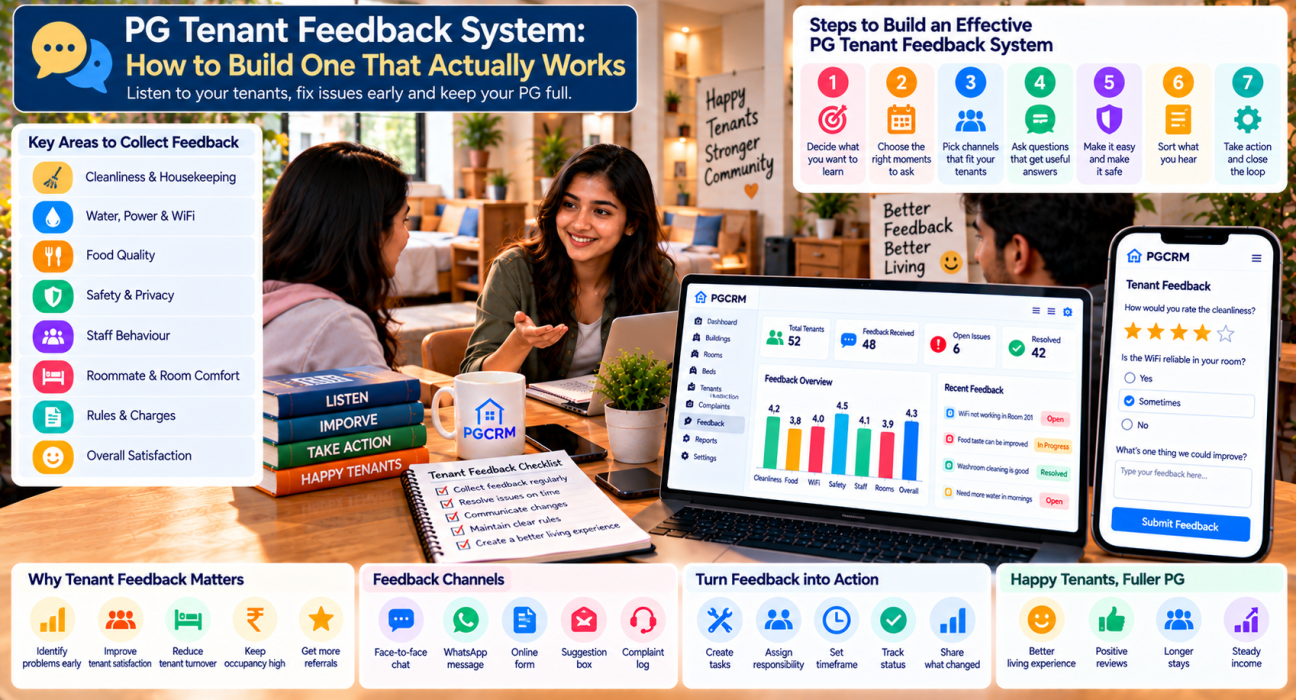
Typical areas worth asking about:
- Cleanliness and housekeeping
- Water, power and WiFi
- Food, if you serve meals
- Safety and privacy
- Staff behaviour
- Roommate and room comfort
- Rules and charges
- Overall satisfaction and whether they’d recommend you
Pick three or four per round. A short, focused question gets better answers than a long list.
Step 2: Choose the Right Moments to Ask
Timing matters as much as the questions. Tenants have different things to say at different points in their stay.
| Moment | What to ask | Why it helps |
|---|---|---|
| After the first week | How was move-in? Anything confusing or missing? | Catches early problems before they turn into a decision to leave |
| After about a month | How’s daily life: food, cleanliness, WiFi, roommates? | By now they’ve seen the routine |
| Every few months | A short check-in on the main areas | Spots slow changes you’d otherwise miss |
| After a complaint is closed | Was it fixed properly? | Shows whether repairs actually worked |
| At move-out | What could we have done better? | Often the most honest feedback you’ll get |
If you only pick two, choose the first-week check and the exit conversation. They cost almost nothing and teach you a lot.
Step 3: Pick Channels That Fit Your Tenants
Don’t force a method that tenants won’t use. Match the channel to your PG.
| Channel | Works well when | Watch out for |
|---|---|---|
| Face-to-face chat | Small PGs, owners on site | Tenants may hold back in front of you |
| WhatsApp message | Tenants already use it daily | Messages get buried and lost |
| Simple online form | Tech-comfortable tenants, larger PGs | Low response if it’s long |
| Paper form or suggestion box | Tenants who want to stay anonymous | Needs someone to collect and read it |
| Complaint log | Specific problems that need fixing | Doesn’t capture general opinions |
Many PGs do best with a mix: a quick conversation for warmth, a short form for structure and the complaint log for repairs.
Step 4: Ask Questions That Get Useful Answers
“Any feedback?” gets a shrug. Specific questions get real answers.
Questions that work
- “What’s one thing we could fix this month?”
- “How would you rate the cleanliness of the washrooms, from 1 to 5?”
- “Is the WiFi reliable in your room?”
- “Do you feel safe and comfortable in the PG?”
- “Is there anything about the rules or charges that’s unclear?”
- “Would you recommend this PG to a friend? Why or why not?”
Questions to avoid
- Leading ones, like “Don’t you think the food is good?”
- Double-barrelled ones, like “How are the food and the cleaning?”
- Vague ones, like “Are you happy?”
Mix a rating with one open question. The number helps you compare over time. The open answer tells you why.
Step 5: Make It Easy, and Make It Safe
People give honest feedback when it’s quick and when they trust nothing bad will follow.
- Keep it under five minutes. Shorter is better.
- Offer an anonymous option for sensitive topics such as safety, staff behaviour or roommates.
- Say clearly that feedback won’t affect how they’re treated. Then make sure it doesn’t.
- Don’t argue in the moment. Thank them, note it down and respond later.
- Protect privacy. Don’t share one tenant’s comments with others.
If tenants fear a reaction, they’ll only speak when they’re leaving. Safety is the whole foundation.
Step 6: Sort What You Hear
Not all feedback is the same. Sorting it saves you from treating a small suggestion like an emergency or a serious complaint like a passing remark.
- Urgent issues: safety concerns, water or electrical hazards, harassment. Act immediately.
- Complaints: a specific problem with a specific fix, such as a leaking tap. Log it, assign it and close it.
- Suggestions: ideas to improve, such as a new menu item or laundry timing. Review them monthly.
- Praise: note what’s working so you don’t accidentally change it.
For the second group, a proper complaint record matters. PGCRM lets you log complaints, set priority and keep a clear status trail until each is closed. That gives repairs an owner and a deadline, instead of leaving them in a chat thread.
Step 7: Act and Tell Tenants What Changed
This is the step most feedback systems skip, and it’s the one that makes tenants keep talking.
- Fix what you can, quickly. Even small visible changes build trust.
- Explain what you can’t fix. “We can’t change the water supply timings, but we’ve added a tank” is better than silence.
- Share a short update. A notice board or group message saying “You said / we did” is enough.
- Thank people. A plain thank-you goes a long way.
- Follow up after changes. Ask if it worked.
Tenants don’t need everything fixed. They need to see that someone heard them.
Step 8: Track Patterns and Review Monthly
One comment is an opinion. The same comment from several people is a pattern. A simple record helps you tell the difference.
A simple feedback log
| Date | Tenant / room | Topic | Type | Action taken | Status |
|---|---|---|---|---|---|
| 5 Nov | Room 203 | WiFi slow at night | Complaint | Router moved, plan upgraded | Closed |
| 9 Nov | Room 101 | Add more vegetarian options | Suggestion | Discussed with cook | Pending |
| 12 Nov | Room 305 | Staff entering without knocking | Urgent | Staff briefed | Closed |
(These entries are made-up examples to show the format.)
A 20-minute monthly review
- Read the month’s feedback and complaints together.
- Count which topics came up more than once.
- Pick the top one or two to fix.
- Check last month’s actions. Did they work?
- Share a short update with tenants.
You can keep this log in a notebook or spreadsheet. PGCRM keeps tenant records, complaints and occupancy reports in one place, so you can compare feedback against who’s staying, who’s left and which complaints are still open. It doesn’t list a built-in survey or feedback form on its site, so the opinion side of your system will be your own forms or conversations, linked with the records you already keep.
Common Mistakes to Avoid
- Asking only when something goes wrong. Regular check-ins catch problems early.
- Using long forms. Short and frequent beats long and rare.
- Ignoring negative feedback. It’s the most useful kind.
- Getting defensive. Tenants stop sharing if they get arguments in return.
- Promising what you can’t deliver. Be honest about limits.
- Letting feedback sit in chat groups. Write it down in one place.
- Never reporting back. Silence teaches tenants it’s pointless.
- Treating one loud voice as everyone’s view. Look for patterns across tenants.
FAQ
How do I collect feedback from PG tenants?
Use a mix of short methods: a first-week check-in, a brief monthly or quarterly form, regular conversations, a complaint log and an exit chat. Keep questions specific, offer an anonymous option and record everything in one place so you can spot patterns over time.
How often should I ask PG tenants for feedback?
Ask after the first week, after about a month, then every few months, plus after a complaint is closed and at move-out. Frequent short check-ins work better than one long yearly survey. Avoid asking so often that tenants get tired of it.
What questions should I ask PG tenants?
Ask specific questions about cleanliness, water, power, WiFi, food, safety, staff behaviour and rules or charges. Pair a 1–5 rating with one open question like “What’s one thing we could improve?” Also ask whether they’d recommend your PG to a friend, and why.
How do I get honest feedback from tenants?
Keep it short, easy and safe. Offer an anonymous option, don’t react defensively and make sure feedback never affects how a tenant is treated. Most importantly, act on what you hear and tell tenants what changed. People speak honestly when they see it makes a difference.
What is the difference between a complaint and feedback?
A complaint reports a specific problem that needs a fix, like a leaking tap or a broken light. Feedback is broader opinion or suggestion, like asking for a different menu or better laundry timing. Complaints need tracking until closed, while suggestions are usually reviewed and decided monthly.
Can software help with tenant feedback in a PG?
Software can help you keep tenant details, log and close complaints and view occupancy in one place, which gives feedback context. PGCRM supports complaint logging with priority and status, though it doesn’t list a built-in survey feature, so collect opinions through your own forms or chats.
Conclusion
A good PG tenant feedback system is small, regular and honest. Ask at the right moments, keep questions specific, make speaking up safe, sort what you hear, act on it and tell tenants what changed. Do that consistently, and you’ll hear about problems long before they become move-outs.
Organised records make the follow-through much easier. If you’d like tenant details, complaints and occupancy in one place, explore PGCRM to simplify your PG and hostel management.