

Introduction
Before you put lakhs into a new building, beds, furniture and a kitchen, one question matters more than any other: how long will it take to get your money back? That’s your PG business payback period. Plenty of owners guess it based on what a friend told them, then find out a year later that the numbers don’t match.
The good news is that you can estimate it with simple math and an honest look at your costs and occupancy. This guide shows you how to do it step by step, with a worked example, and explains why occupancy and clean records change the answer more than most people expect. If you already run a PG, PG and hostel management software can give you the real numbers to plug in.
What Is the PG Business Payback Period?
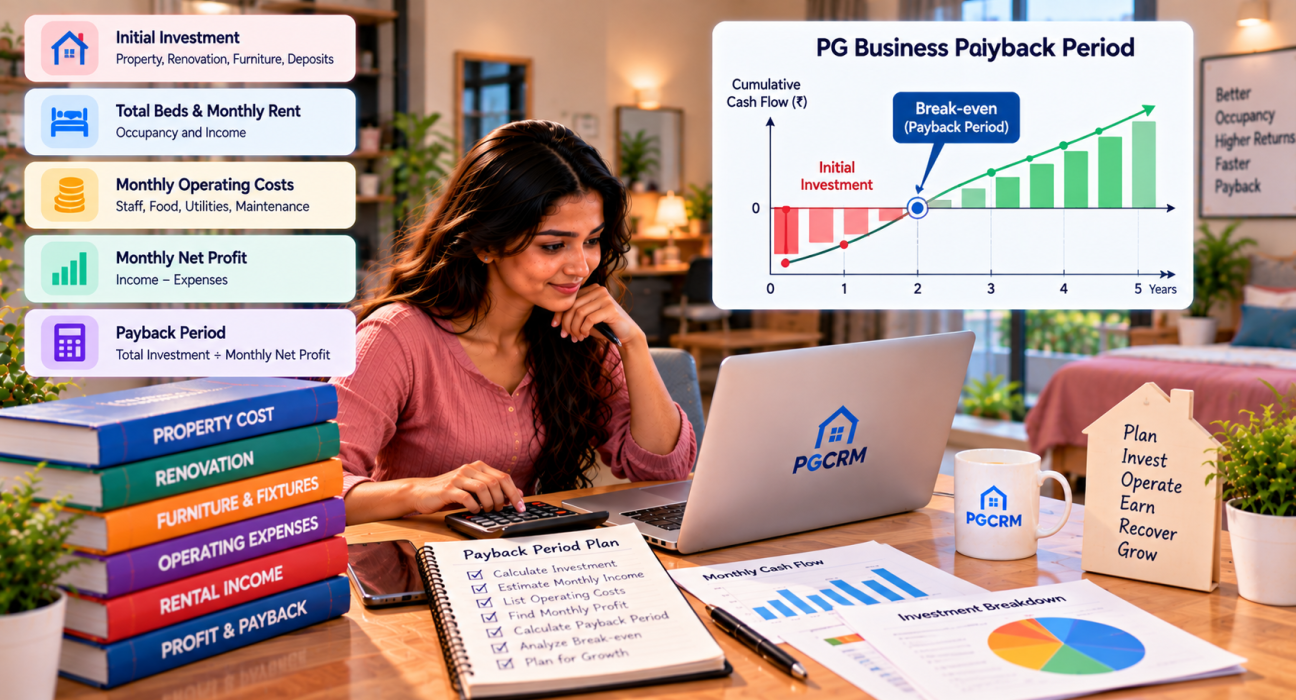
The PG business payback period is the time it takes for your monthly profit to recover the money you invested to start the PG. If you spent ₹8.5 lakh on setup and earn ₹32,500 a month in profit, you’ll recover your investment in about 26 months.
The basic formula is
Payback period (in months) = Total initial investment ÷ Monthly net profit
It’s a simple method, and that’s why owners like it. It answers a plain question: when do I start making money, and when does the PG start paying for itself?
Step 1: Add Up Your Total Initial Investment
Start with everything you spend before the first tenant pays rent. Don’t leave anything out, because small items add up.
Common setup costs for a PG
- Security deposit to the landlord, if you’re renting the building
- Beds, mattresses, cupboards and study tables
- Kitchen equipment, water purifier, geysers and fans
- Wi-Fi, CCTV and basic security
- Interior work, painting and repairs
- Licences and registrations, where they apply to your area
- Branding, signboard and early marketing
- Working capital to cover the first few months of expenses
Local rules and licences vary by city, so check with your local authority for what applies to you.
One thing to note: the landlord’s deposit is usually refundable, but that money is still locked up. For payback purposes, most owners count it as part of the investment because it’s cash you can’t use elsewhere.
Step 2: Estimate Your Monthly Income Honestly
This is where most estimates go wrong. Owners multiply the number of beds by the rent and assume every bed is full all year.
Use this instead:
Monthly income = Number of beds × Rent per bed × Expected occupancy
A 30-bed PG charging ₹7,000 per bed would earn ₹2,10,000 a month at 100% occupancy. At 85% occupancy, that’s around ₹1,78,500.
Why you should plan for less than full occupancy
Beds stay empty between tenants. Some months are slower, especially around exam seasons, college breaks or job cycles. New PGs also take time to fill up.
When estimating, use a realistic number, not your best month. If you already run a PG, check your actual occupancy over several months instead of guessing.
Step 3: List Every Monthly Expense
Now subtract what it costs to run the place. Be thorough here, because missing a cost makes your payback look shorter than it really is.
Typical monthly expenses include:
- Building rent
- Electricity and water
- Food and groceries, if you provide meals
- Cook, cleaner and helper salaries
- Manager’s salary, if you have one
- Internet and cable
- Repairs and maintenance
- Software and admin costs
- Any other regular expenses
Don’t forget the small things, like gas cylinders, cleaning supplies and bulb replacements. They look minor, but they repeat every month.
Step 4: Work Out Your Monthly Net Profit
Monthly net profit = Monthly income − Monthly expenses
This is the number that actually pays back your investment. Revenue alone doesn’t.
A Worked Example (Illustrative Numbers)
Let’s put it all together. These numbers are only an example to show the method. Your own costs will be different.
Imagine a 30-bed PG in a rented building.
| Setup cost | Amount |
|---|---|
| Landlord security deposit | ₹3,00,000 |
| Beds, mattresses and furniture | ₹3,00,000 |
| Kitchen, water purifier, geysers, fans | ₹1,50,000 |
| Wi-Fi, CCTV and setup work | ₹50,000 |
| Branding, licences and miscellaneous | ₹50,000 |
| Total investment | ₹8,50,000 |
| Monthly item | Amount |
|---|---|
| Rent per bed | ₹7,000 |
| Occupancy | 85% (about 25.5 beds) |
| Monthly income | ₹1,78,500 |
| Building rent | ₹45,000 |
| Electricity and water | ₹15,000 |
| Food and groceries | ₹40,000 |
| Cook and helper salaries | ₹25,000 |
| Wi-Fi | ₹3,000 |
| Maintenance | ₹8,000 |
| Manager and miscellaneous | ₹10,000 |
| Monthly expenses | ₹1,46,000 |
| Monthly net profit | ₹32,500 |
Payback period = ₹8,50,000 ÷ ₹32,500 ≈ 26 months
So in this example, the owner gets their money back in a little over two years.
How Occupancy Changes Everything
Here’s the part many first-time owners miss. Most PG costs stay fixed whether beds are full or empty. Rent, salaries and electricity don’t drop because a few rooms are vacant. That means a small change in occupancy has a big effect on profit.
Using the same example, with expenses kept the same for simplicity:
| Occupancy | Monthly income | Monthly profit | Approx. payback |
|---|---|---|---|
| 95% | ₹1,99,500 | ₹53,500 | About 16 months |
| 85% | ₹1,78,500 | ₹32,500 | About 26 months |
| 75% | ₹1,57,500 | ₹11,500 | About 74 months |
A drop from 85% to 75% pushes payback from just over two years to more than six. In real life, some costs like food would fall a little with fewer tenants, so the gap wouldn’t be quite this sharp. But the lesson holds: occupancy is the biggest lever in a PG’s payback.
This is why tracking occupancy bed by bed matters. Knowing which beds are empty, and for how long, shows you where money is slipping away.
Things That Make Your Payback Longer Than Expected
Even a careful estimate can miss a few things. Watch out for these.
The ramp-up period
A new PG rarely starts at 85% occupancy. It may take a few months to fill. During that time, you’re paying full expenses with partial income. Add these early months to your estimate.
Unpaid and late rent
Rent that you earned on paper but didn’t collect isn’t real profit. If tenants regularly pay late or skip months, your actual cash flow is lower than your plan. A clear record of who has paid and who is pending helps you catch this early.
Repairs and replacements
Mattresses wear out. Geysers fail. Furniture needs replacing. If you don’t set aside money for this, it will hit your profit when it happens.
Deposits and refunds
Tenant deposits are not your income. They’re money you’ll have to return. Don’t count them as profit.
Rent hikes and rising costs
Your costs rise over time, and so can your rent. A simple payback calculation uses today’s numbers, so treat the result as an estimate, not a promise.
A Quick Note on the Limits of This Method
The payback period is easy to calculate, but it’s not perfect. It doesn’t account for the time value of money, the value of the property itself if you own it, or what happens after you recover your investment.
If you’re buying a building rather than renting one, the numbers look very different, and you may want to speak to a financial advisor or chartered accountant. For most small PG setups with rented buildings, though, the simple payback is a practical first check.
How to Shorten Your PG Payback Period
If your estimate looks too long, you have a few options.
- Raise occupancy. Fill empty beds faster, and reduce the gap between one tenant leaving and the next one joining.
- Collect rent on time. Use reminders and track pending payments, so cash flow stays steady.
- Control recurring costs. Review electricity, food and maintenance every month.
- Start smaller, then expand. You can open with fewer beds and add more once the first ones fill.
- Avoid overspending on setup. Good-quality basics often matter more than fancy interiors.
- Keep honest numbers. You can’t improve what you don’t measure.
Using Software to Track the Numbers That Matter
Once your PG is running, the payback estimate stops being a guess. You can measure it. But that only works if your income, expenses and occupancy are recorded properly.
PGCRM helps with the day-to-day side of this. You can see which beds are occupied and which are free, collect rent by cash or UPI with every payment tagged to a tenant, and track expenses by category. Reports show occupancy, income and expenses, so month-end figures are easier to check.
With clean numbers, you can compare your real profit against your original plan and see how close you are to your payback target.
Frequently Asked Questions
What is a good payback period for a PG business?
There’s no single right answer, because it depends on location, rent, setup cost and occupancy. Many owners aim to recover their investment within a few years, but your own numbers matter more than a general target. A shorter payback usually means lower risk, but check it against your realistic occupancy.
How do I calculate the payback period for a PG?
Divide your total initial investment by your monthly net profit. For example, if you invested ₹8,50,000 and earn ₹32,500 a month after all expenses, your payback period is about 26 months. Use realistic occupancy and include every monthly expense for an honest result.
What costs should I include in a PG investment?
Include the landlord deposit, furniture, beds, kitchen equipment, Wi-Fi, security, repairs, licences, branding and some working capital for the early months. Missing small items can make your payback look shorter than it really is, so list everything you pay before the first tenant arrives.
How does occupancy affect PG profit?
Most PG costs are fixed, so when beds sit empty, your expenses stay the same while income drops. Even a 10% fall in occupancy can reduce monthly profit sharply and stretch your payback by many months. Tracking occupancy regularly helps you act before the gap grows.
Is a PG business profitable?
It can be, but profit depends on location, occupancy, pricing, running costs and how well you manage operations. Some PGs recover their investment in a couple of years, while others struggle with empty beds and late rent. A realistic estimate before you start helps you decide with open eyes.
How long does a new PG take to fill up?
It varies by location, pricing and demand, and no one number fits every PG. Plan for a ramp-up period in which expenses run at full cost while occupancy is lower. Include these early months in your payback estimate so you’re not surprised.
Conclusion
Estimating your PG business payback period comes down to four honest numbers: total investment, realistic income, full monthly expenses and net profit. The most important variable is occupancy, because a few empty beds can quietly double your payback time.
Once your PG is running, replace estimates with real numbers. Track who has paid, which beds are filled and where the money goes. Explore PGCRM to simplify your PG and hostel management and keep those numbers in one place.