


Introduction
A leaking tap looks like a ₹200 job. Ignore it for three weeks and it becomes a damp wall, a peeling paint patch, an unhappy tenant and a ₹6,000 repair. That’s how PG maintenance costs get out of hand: not through one big failure, but through small problems left to grow.
The good news is that most repair bills are predictable, and most can be reduced. This guide shows you how to understand where the money goes, fix small issues before they get expensive, deal with vendors sensibly and keep a clear monthly record. If you already use PG and hostel management software, you can track complaints and expenses in the same place.
Why PG Maintenance Cost Keeps Rising
A PG gets heavy daily use. Many people share the same bathrooms, switches, doors and beds, and they don’t treat them the way they’d treat their own home. Wear and tear is normal, but a few habits turn it into a larger expense.
The usual causes:
- Complaints noticed late or noted on WhatsApp and then forgotten
- Quick temporary fixes that fail within weeks
- No regular inspections, so problems stay hidden
- Paying whatever a repair person asks, with no comparison
- Poor-quality fittings that need replacing again and again
- Tenant misuse or damage that isn’t recorded
- No record of what was repaired, when and at what cost
If a few of these sound familiar, the problem isn’t the building. It’s the process.
Step 1: Know Where Your Maintenance Money Goes
Before cutting anything, find out what you actually spend. Collect the last six months of repair bills and sort them into categories.
Common categories:
- Plumbing (taps, pipes, flush tanks, leaks, blockages)
- Electrical (switches, wiring, fans, lights, geysers)
- Furniture (beds, mattresses, cupboards, tables)
- Civil work and painting
- Appliances (ACs, water purifiers, washing machines, fridges)
- Pest control and deep cleaning
- Doors, locks and windows
Then answer two simple questions:
- Which category costs the most?
- Which problems keep coming back?
A repeating problem is a signal. If the same bathroom tap gets repaired four times in six months, the fix isn’t working, and replacing it properly will probably cost less.
Calculate cost per bed
Maintenance cost per bed = total monthly maintenance spend ÷ total number of beds
Here’s an example with assumed figures:
| Amount | |
|---|---|
| Monthly maintenance spend | ₹24,000 |
| Total beds | 48 |
| Maintenance cost per bed | ₹500 |
This number lets you compare months, buildings and years fairly, even when your size changes.
Step 2: Choose Between Preventive and Reactive Maintenance
Preventive maintenance means checking and servicing things on a schedule so small issues are fixed before they turn into expensive failures. Reactive maintenance means repairing things only after they break. Reactive feels cheaper because you spend nothing until something fails. It’s often costlier because failures happen at the worst time and need urgent, higher-priced fixes.
| Preventive | Reactive | |
|---|---|---|
| When you act | On a schedule | After a failure |
| Typical cost | Small, regular | Irregular, often larger |
| Tenant experience | Fewer disruptions | Breakdowns and waiting |
| Risk | Low | Damage spreads before you notice |
| Planning | Easy to budget | Hard to predict |
You don’t have to choose one. Use preventive checks for things that fail slowly (plumbing, ACs, wiring, pumps) and reactive repair for random, low-cost issues.
Step 3: Build a Simple Preventive Maintenance Routine
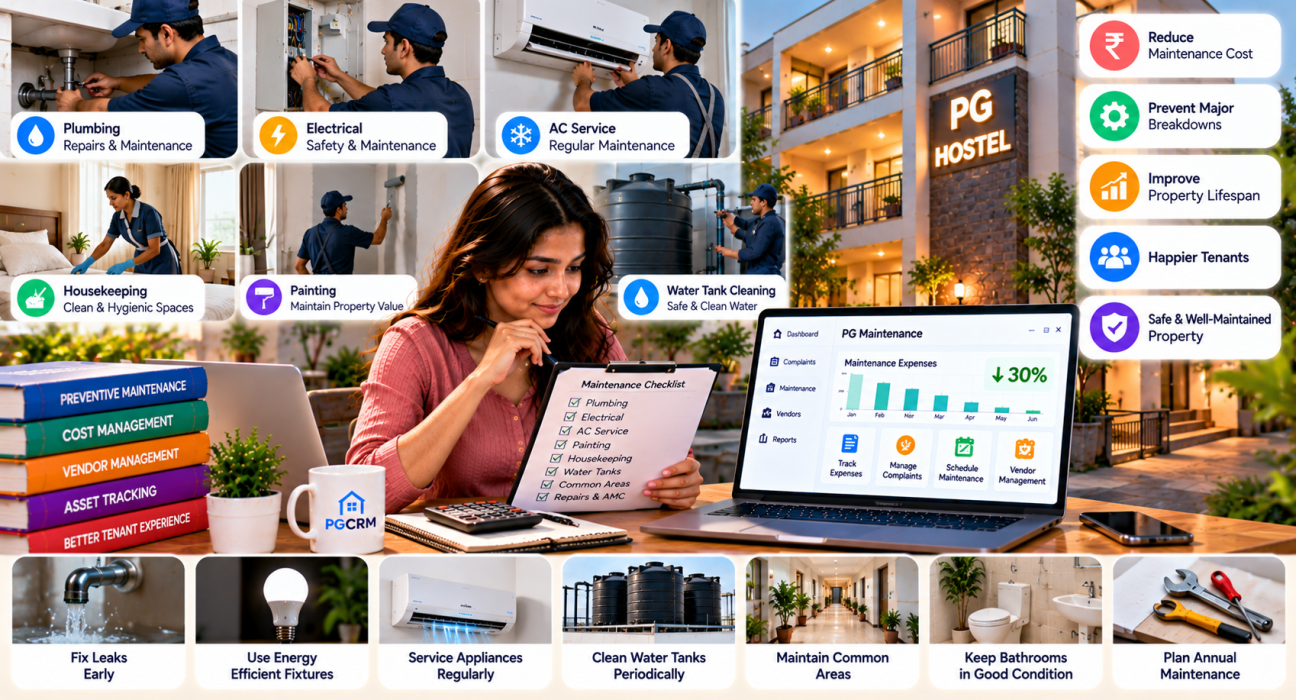
You don’t need a complicated system. A basic checklist done at regular intervals catches most problems early.
Weekly checks
- Walk through corridors, stairs and common areas
- Look for leaking taps, running flush tanks and dripping pipes
- Check that lights, fans and switches work
- Confirm gate locks and room locks are fine
Monthly checks
- Inspect bathrooms for blocked drains, slow water flow and damp patches
- Test geysers, water purifiers and pumps
- Look at ceilings and walls for stains or cracks
- Check furniture for loose parts and damaged mattresses
Before and after the monsoon
- Check the roof and terrace for cracks and blocked drainage
- Look at outside walls and window frames for seepage
- Inspect electrical points near damp areas
During room turnover
Every time a tenant moves out, inspect the room before the next one moves in. Note anything broken or missing; fix it and record it. This is also the best time to separate normal wear from tenant damage.
Step 4: Handle Complaints Quickly and Keep a Record
Slow response is one of the main reasons small faults get expensive. A loose connection or a leaking pipe usually gets worse each day it’s left alone.
A simple complaint process:
- Record every complaint. Note who reported it, the room, the date and the problem.
- Set a priority. Water leaks, electrical hazards and security problems come first. A squeaky door can wait a day or two.
- Assign it to someone. A complaint that belongs to nobody gets ignored.
- Set a target time. Even a rough one helps.
- Close it with a note. Record what was done and what it cost.
- Check back with the tenant. A quick confirmation avoids repeat complaints.
When you review these records, patterns show up. If the second-floor bathroom accounts for half your plumbing complaints, you have a root problem to fix, not a series of small ones.
PG management software can help here. PGCRM lets you log complaints, set priority and keep a clear status trail until each one is closed.
Step 5: Manage Vendors and Repair Costs
How you buy repairs matters as much as what you repair.
- Get at least two quotes for any job that’s more than a small fix.
- Build a short list of reliable people. A good plumber, electrician and carpenter who know your building are worth more than the cheapest one-time quote.
- Agree on the scope and price first. Write down what’s included, including materials.
- Buy common parts yourself if it’s cheaper, such as taps, bulbs and switches, but only if you can choose the right type.
- Ask for bills or written notes for every job and keep them.
- Check the work before paying. Test the tap, switch or door yourself.
- Track who did what. If the same repair person keeps redoing the same fix, move on.
Repair or replace?
Repeated repairs on an old item can cost more than a new one. A simple rule of thumb: if the total repair spend over the year is approaching the price of a replacement, replace it. Do the math for each case, as the right call depends on the item’s age and condition.
Step 6: Choose Durable Fittings and Reduce Damage
What you buy at the start affects what you spend later. Cheap fittings often need replacing again and again, especially in bathrooms and common areas.
Where it’s worth spending a bit more:
- Taps, flush systems and shower fittings
- Switches, sockets and wiring
- Door locks and hinges
- Mattresses and bed frames
- Waterproofing in bathrooms and on the terrace
Where basic is fine:
- Decorative items
- Rarely used fixtures
- Low-traffic rooms
Reduce damage and misuse.
- Set clear house rules about damaging property, covering what’s normal use and what counts as damage.
- Do a move-in inspection with the tenant. Note existing marks and damage in writing, and add photos if you can.
- Explain deposit deductions at move-in. Be clear about what’s deducted for damage and what’s normal wear.
- Record damage when it happens. Note the date, the room and the cost, so deposit settlements are fair and easy to explain.
Step 7: Review Your PG Maintenance Cost Every Month
A monthly review keeps small problems from becoming big expenses. It only takes a short time if the records are clear.
What to review
- Total maintenance spend
- Spend by category (plumbing, electrical, furniture and so on)
- Cost per bed
- Number of complaints and how many are still open
- Repeat problems in the same room or area
- Large repairs coming up (ACs, pumps, painting)
Set aside a maintenance fund.
Rather than treating every big repair as a surprise, set aside a fixed monthly amount for maintenance. Base it on your past spending and the age of your building. Older buildings usually need more. Even a modest fund makes large repairs easier to handle.
If you manage several buildings, track each one separately. With a tool like PGCRM, you can record expenses by category and building and look at expense reports, so it’s easier to see which property is costing you the most.
Common Mistakes That Increase PG Maintenance Cost
- Fixing symptoms, not causes. Patching a damp wall without finding the leak means you’ll pay again.
- Delaying small repairs. Small faults grow, and so does the bill.
- Having no record of repairs. You can’t spot patterns you never wrote down.
- Never comparing quotes. You might be overpaying without knowing it.
- Buying the cheapest fittings. Low price now often means replacement soon.
- Skipping move-in and move-out inspections. Without them, damage disputes are hard to settle.
- No maintenance fund. Big repairs then hit your cash flow all at once.
FAQ
How much should I budget for PG maintenance?
There’s no fixed figure, because it depends on your building’s age, size and condition. Review the last six to twelve months of repair bills, work out your cost per bed and use that as a starting point. Older buildings and heavy-use areas usually need a larger monthly allowance.
How can I reduce maintenance costs in a PG?
Fix small problems early, run weekly and monthly checks, keep a record of every complaint, compare quotes for larger jobs and choose durable fittings. Track your spending by category each month so you can see what’s costing the most and which problems keep coming back.
What is preventive maintenance in a PG?
Preventive maintenance means checking and servicing things on a schedule, such as plumbing, wiring, geysers, ACs and pumps, before they fail. It reduces emergency repairs and tenant complaints. A simple weekly and monthly checklist is usually enough to get started.
Who pays for damage in a PG, the owner or the tenant?
Normal wear and tear is generally the owner’s responsibility, while damage caused by misuse can be charged to the tenant. Make this clear in your rental agreement and do a move-in inspection. Rules and practices can vary, so check your agreement and local norms.
Should I repair or replace old appliances in a PG?
Compare the total repair cost over the year with the price of a replacement. If you keep repairing the same appliance and the spending is close to a new one, replacement usually makes more sense. Also consider how old it is and how much power it uses.
How do I track maintenance expenses in a PG?
Record every repair with the date, room, category, vendor and cost, and keep the bill if you have one. Review it monthly. You can use a notebook or spreadsheet, or PG management software that lets you log complaints and record expenses by category and building.
Conclusion
Controlling PG maintenance costs comes down to a handful of habits. Know where your money goes, check things regularly, fix small problems early, handle complaints quickly, compare vendors and review your numbers every month. Small, steady attention costs far less than large, sudden repairs.
Clear records make each of these steps easier. If you’d like complaints, expenses and occupancy in one place, explore PGCRM to simplify your PG and hostel management.