

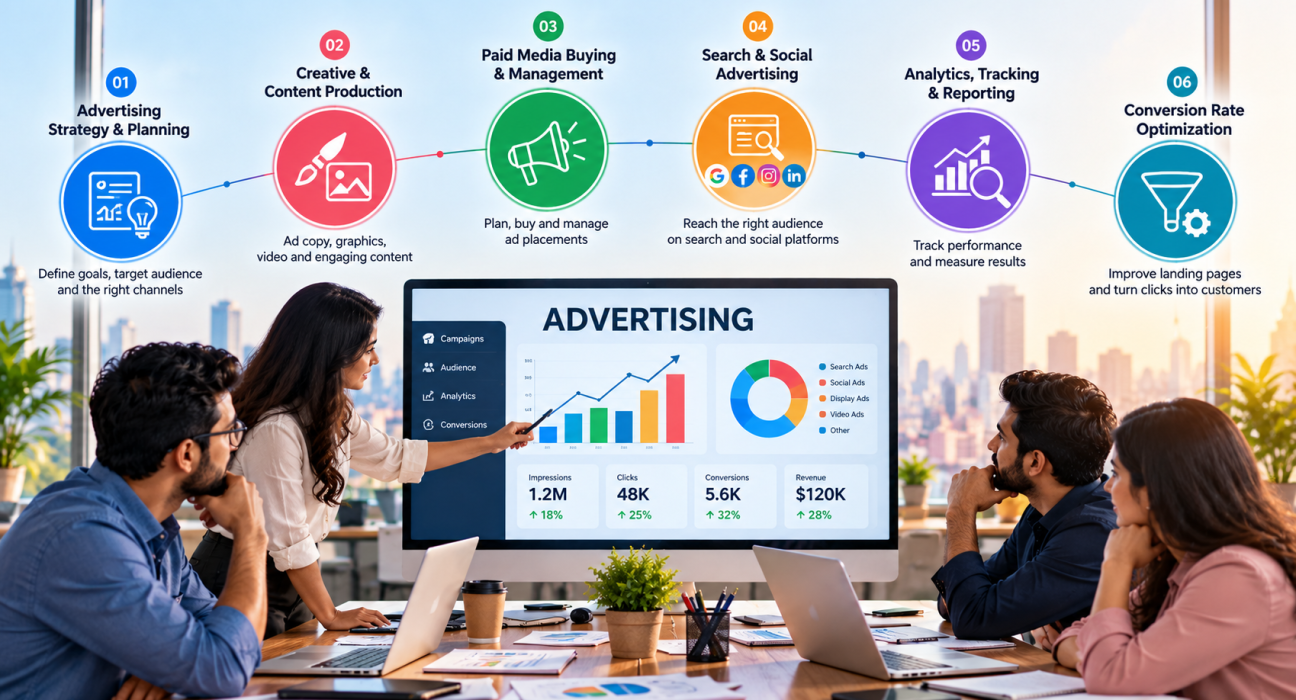
Most businesses need a mix of six core advertising services: strategy and planning, creative production, paid media buying, search and social advertising, analytics and tracking, and conversion optimization. You rarely need all of them at once. The right combination depends on your goals, budget, and how mature your marketing already is.
This guide explains what each of these advertising services does, which ones matter most at different business stages, and how to choose a provider. It is written for founders, marketing managers, and business owners who want to spend their ad budget on things that work.
What Are Advertising Services?
Advertising services are professional services that help a business plan, create, publish, and measure paid promotional campaigns across digital and traditional channels. They can be delivered by a full-service agency, a specialist firm, a freelancer, or an in-house team.
Advertising services differ from broader marketing services. Marketing covers the whole customer journey, including content, email, SEO, and brand. Advertising focuses on paid placements: search ads, social ads, display, video, native, out-of-home, print, and broadcast.
In practice the two overlap. Many agencies offer both, which is why it helps to be clear about what you are actually buying.
The Core Advertising Services Businesses Need
1. Advertising Strategy and Campaign Planning
Strategy is the foundation. Without it, even well-made ads tend to underperform.
A solid planning service typically covers:
- Defining campaign goals, such as leads, sales, app installs, or brand awareness
- Identifying the target audience and their buying triggers
- Choosing channels based on where that audience actually spends time
- Setting a budget and deciding how to split it across channels
- Defining success metrics before launch
Who needs it most: Startups running their first campaigns and businesses entering a new market. If your last campaign “didn’t work” but you can’t say why, weak planning is often the cause.
2. Creative and Content Production
Creative is what people actually see: the copy, images, video, and landing page message. Good creative services include:
- Ad copywriting and headline testing
- Graphic design and banner creation
- Video production and short-form social video
- Brand messaging that stays consistent across channels
- Creative variations for A/B testing
Creative fatigue is a real issue. Audiences stop responding to the same ad over time, so ongoing creative refreshes matter more than a single polished launch.
3. Paid Media Buying and Management
Media buying is the work of purchasing and managing ad placements. This includes setting bids, controlling budgets, choosing placements, and adjusting campaigns based on results.
Depending on your goals, this may cover:
- Search engine advertising
- Social media advertising
- Display and programmatic advertising
- Video advertising
- Connected TV and streaming ads
- Local, print, radio, or out-of-home placements
Who needs it most: Businesses with a clear offer and some budget but limited time or platform expertise. Day-to-day campaign management is easy to underestimate, and small mistakes can burn budget quickly.
4. Search and Social Advertising
These two deserve their own mention because they are the starting point for most small and mid-sized businesses.
Search advertising places your ads in front of people actively looking for something. It suits businesses where customers already know what they need, such as plumbers, software vendors, or legal services.
Social advertising places ads in feeds where people are browsing. It suits businesses that create demand through visuals and storytelling, such as consumer products, apps, and events. It also works well for retargeting people who already visited your site.
A common mistake is choosing a channel because competitors use it. Choose based on how your customers find and decide on products like yours.
5. Analytics, Tracking, and Reporting
You cannot improve what you cannot measure. Tracking services make sure ad spend can be tied to real outcomes. They typically include:
- Setting up conversion tracking and tagging
- Connecting ad platforms to analytics and CRM tools
- Building dashboards for spend, leads, and revenue
- Attribution analysis to understand which channels contribute
- Regular reporting with clear recommendations, not just numbers
Be cautious of reports that highlight clicks and impressions but never mention cost per lead, customer acquisition cost, or revenue. Those vanity metrics can hide poor results.
6. Conversion Rate Optimization and Landing Pages
An ad only earns its cost if the next step works. Conversion optimization improves what happens after the click:
- Landing page design and copy
- Form and checkout improvements
- Page speed and mobile usability
- A/B testing of headlines, offers, and layouts
For many businesses, improving a landing page produces better returns than increasing the ad budget. Sending more traffic to a weak page just makes the waste bigger.
Which Advertising Services Do You Need First?
The services you need first depend on your stage and your biggest gap. Here is a practical way to think about it.
| Business Situation | Services to Prioritize | Why |
|---|---|---|
| New startup, limited budget | Strategy, search or social ad management, basic tracking | Focus on one or two channels and learn what works |
| Growing SMB with steady leads | Creative production, media management, landing page optimization | Scale what already works and improve efficiency |
| E-commerce business | Social and search shopping ads, retargeting, creative testing, analytics | Product visibility and repeat purchasing drive results |
| B2B or SaaS company | Search ads, LinkedIn or industry ads, landing pages, CRM tracking | Longer sales cycles need lead quality tracking |
| Enterprise or multi-market brand | Full-service planning, programmatic, brand and performance mix, advanced attribution | Complex campaigns need coordination and governance |
If you can only fix one thing, start with tracking. Many businesses run ads for months before realizing they cannot say which campaigns produced customers.
Traditional vs. Digital Advertising Services
Digital channels are easier to measure and adjust, but traditional channels still matter in some cases.
- Digital advertising offers precise targeting, flexible budgets, and fast testing. It suits most businesses, especially those selling online.
- Traditional advertising, such as radio, print, billboards, and TV, can build local awareness and trust. It suits businesses with a geographic customer base, though results are harder to track.
Many businesses combine both. A local restaurant group might use social ads for promotions, search ads for “near me” queries, and a billboard for brand presence.
In-House vs. Agency vs. Freelancer
Choose based on volume, complexity, and budget.
- In-house team: Best for businesses with constant campaign activity and enough budget to justify salaries. You get close brand knowledge but may lack specialist skills.
- Agency: Best when you need a range of skills in one place, such as strategy, creative, and media buying. Costs are usually higher, but you gain structure and experience across industries.
- Freelancer: Best for focused tasks like copywriting, a single platform, or short-term projects. Flexibility is high, but capacity and continuity can be limited.
- Hybrid: Many companies keep strategy in-house and outsource creative or media buying.
How to Choose an Advertising Services Provider
Look for evidence that a provider can achieve your specific goals, not just a polished pitch. Use this checklist.
- Define your goals first. Know whether you want leads, sales, or awareness, and how you will judge success.
- Check relevant experience. Ask for work in your industry or with similar budgets and sales cycles.
- Ask how they measure results. A good provider talks about cost per acquisition, return on ad spend, and lead quality, not only impressions.
- Understand their process. How often do they report, test, and optimize? Who will actually manage your account?
- Clarify pricing. Ask whether fees are flat, percentage of ad spend, or performance-based, and whether ad spend is billed separately.
- Confirm account ownership. Your business should own the ad accounts and data, so you can leave without losing history.
- Speak with past clients. References reveal communication quality and honesty about results.
- Watch for red flags. Guaranteed results, vague reporting, and pressure to sign long contracts quickly deserve caution.
Researching several providers side by side makes this easier. Directories such as GoFirms let businesses research and compare digital marketing agencies and other service providers by services offered, so you can build a shortlist before starting conversations.
Common Mistakes When Buying Advertising Services
- Starting without clear goals. “More visibility” is not a measurable goal.
- Spreading the budget too thin. Running five channels badly is worse than running two well.
- Ignoring the landing page. Great ads cannot fix a confusing website.
- Judging too early. Most campaigns need a learning period before results stabilize.
- Never refreshing creative. Performance usually declines when audiences see the same ad repeatedly.
- Treating the agency as a black box. Stay involved in strategy, approvals, and review.
A Simple Way to Get Started
If you are unsure where to begin, follow these steps:
- Write down one primary goal and one target number, such as cost per lead.
- Pick one or two channels that match how your customers search or browse.
- Set up tracking before spending anything.
- Launch small, test several creative variations, and review results every week or two.
- Scale what works and pause what does not.
- Add services like creative support or conversion optimization as your needs grow.
Frequently Asked Questions
What are the main types of advertising services?
The main types include advertising strategy, creative production, media buying, search advertising, social media advertising, display and video advertising, analytics and reporting, and conversion optimization. Some providers also offer traditional services such as print, radio, television, and outdoor advertising.
How much do advertising services cost?
Costs vary widely by provider, channel, scope, and location. Fees may be flat monthly retainers, hourly rates, project-based pricing, or a percentage of ad spend. Your ad budget is usually separate from service fees. Request detailed quotes from several providers to compare accurately.
Do small businesses need advertising services?
Not always. A small business can run simple search or social campaigns on its own. Outside help becomes valuable when campaigns grow complex, results stall, or the owner lacks time. Even then, a freelancer or short consulting engagement may be enough.
What is the difference between advertising and marketing services?
Advertising focuses on paid promotion through channels like search, social media, and broadcast. Marketing is broader and includes strategy, content, SEO, email, public relations, and brand building. Advertising is one part of a marketing plan, and many agencies provide both.
How long does it take for advertising to show results?
Digital campaigns can generate traffic within days, but meaningful performance usually takes several weeks of testing and optimization. Brand awareness campaigns often take longer. Set expectations with your provider and agree on the metrics you will review at each stage.
How do I know if an advertising agency is right for my business?
Look for relevant experience, transparent reporting, clear pricing, and a process that matches your goals. Ask for references and examples of similar work. A good agency explains how it will measure success and gives you ownership of your ad accounts and data.
Should I choose digital or traditional advertising?
Most businesses start with digital because it is measurable and flexible. Traditional advertising can support local awareness or reach audiences less active online. Choose based on where your customers spend their time, then combine channels only when you can track their impact.
Conclusion
The advertising services your business needs come down to a few essentials: a clear strategy, strong creative, skilled media management, the right channels, reliable tracking, and a landing page that converts. Start with your goal, fix measurement first, and add services as your campaigns mature.
When you are ready to look outside your team, take time to compare providers on experience, process, pricing, and transparency. You can research and compare digital marketing agencies and related service providers on GoFirms to build a shortlist that fits your goals and budget.