


Introduction
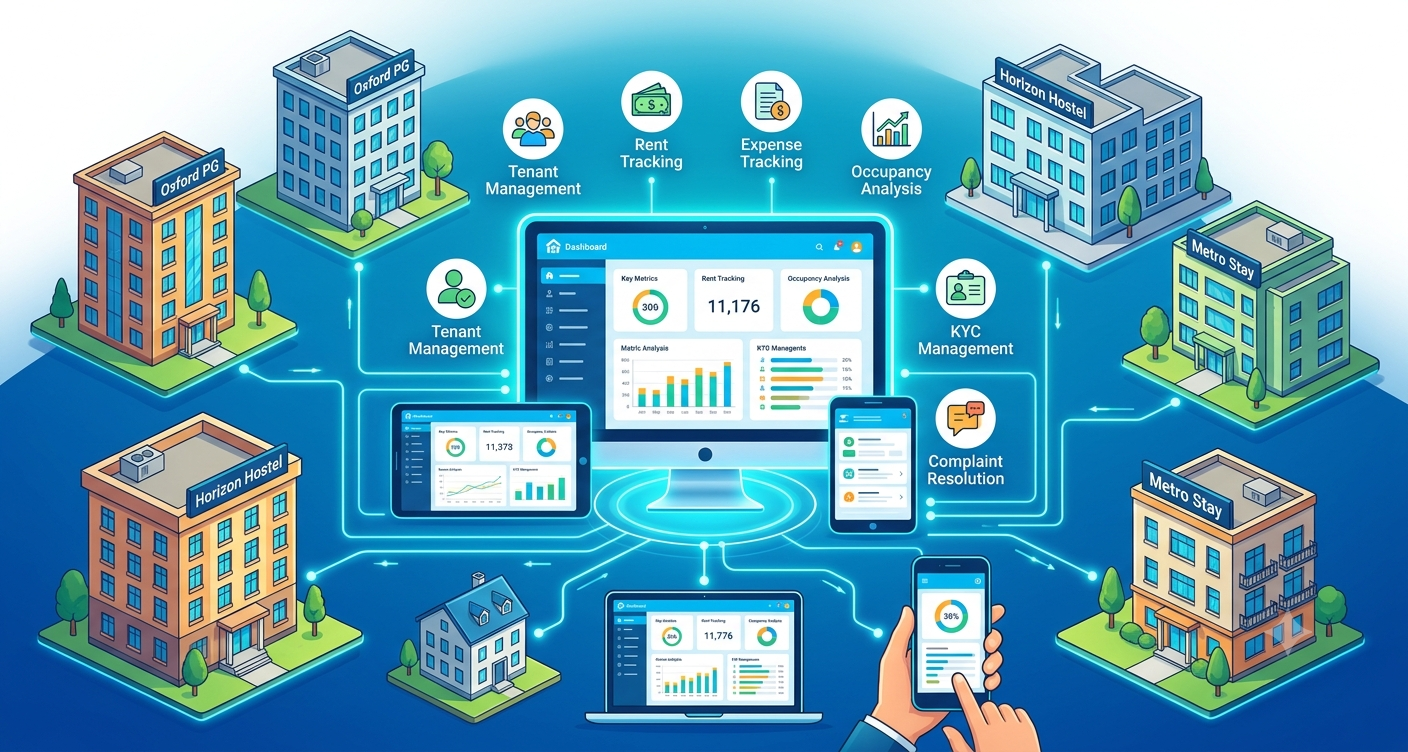
Running a PG or hostel used to mean registers full of handwritten entries, in-person rent collection, and relying on memory to track who’s moved in or out. That approach worked when properties were small, but it struggles once tenant numbers grow. PG and hostel management technology has changed how owners handle these responsibilities, shifting daily operations from scattered manual effort to centralised, structured systems. A PG and hostel management software now allows owners to track tenants, rent, occupancy, and complaints in one place instead of juggling multiple manual methods.
This article explores the specific role technology plays in modern PG and hostel management, which operational areas benefit most, and how owners can think about adopting it effectively.
What PG and Hostel Management Technology Actually Covers
Direct answer: PG and hostel management technology refers to digital tools that help owners track tenant records, rent payments, occupancy status, complaints, and expenses in a centralised system, replacing manual registers, spreadsheets, and informal tracking methods.
It’s not a single tool but a category of software addressing the recurring administrative tasks that come with running a PG or hostel tasks that become harder to manage manually as a property scales.
Why the Shift Toward Technology Is Happening
PG and hostel operations have grown more complex over time, driven by a few consistent patterns:
- Rising tenant turnover, especially in cities with large student and working-professional populations.
- Mixed payment preferences, with cash and UPI often used side by side.
- Increasing tenant expectations for quick complaint resolution and clear communication.
- Growing competition, making operational efficiency more important for retaining tenants.
These pressures make manual tracking methods harder to sustain, which is why more owners are turning to structured digital systems.
Key Areas Where Technology Plays a Role
1. Tenant Management
Direct answer: Tenant management technology centralises contact details, move-in and move-out dates, and lease information, replacing scattered notes or physical registers with a searchable digital record.
This becomes especially useful when managing several tenants with different agreement dates and terms, where manual tracking easily leads to confusion.
2. Rent Collection and Tracking
Rent tracking is often the most immediately valuable area of PG and hostel management technology. It allows owners to:
- Record rent payments as they come in, regardless of payment method.
- Send automated reminders before due dates.
- Instantly check which tenants have pending or overdue rent.
This reduces the ambiguity that often leads to missed payments or disputes under manual tracking.
3. Occupancy and Room/Bed Management
Technology provides real-time visibility into which beds are occupied, vacant, or reserved. This is particularly important in shared-room PG setups, where occupancy can change frequently as different tenants move in and out on different schedules.
4. KYC and Document Management
Storing tenant identity documents digitally reduces the risk of losing physical copies and makes verification faster when needed — a common requirement for PG operators managing tenant compliance.
5. Complaint and Maintenance Tracking
Complaints logged informally are easy to forget. Digital complaint tracking creates a record of each issue along with its resolution status, helping ensure tenant concerns don’t go unaddressed.
6. Expense Tracking and Financial Visibility
Technology allows owners to track recurring costs like utilities and maintenance alongside rent income, offering a clearer picture of actual profitability instead of relying on rough manual estimates.
7. Reports and Data-Driven Decisions
With centralised data, owners can review occupancy trends, rent collection patterns, and expenses over time — supporting more informed decisions than intuition or memory alone.
Traditional PG Management vs Technology-Enabled Management
| Operational Area | Traditional Approach | Technology-Enabled Approach |
|---|---|---|
| Tenant records | Physical registers or notebooks | Centralised digital records |
| Rent tracking | Manual collection and tally | Digital tracking with reminders |
| Occupancy | Manual updates, prone to errors | Real-time visibility |
| Complaints | Verbal, often forgotten | Logged and tracked to resolution |
| Documents | Physical storage | Digital, searchable storage |
| Financial visibility | Rough manual estimates | Structured expense and income tracking |
| Decision-making | Based on memory or intuition | Supported by reports and data |
How Technology Supports Different Stages of PG Growth
Early-Stage PGs
For owners just starting out, technology helps establish good habits early: accurate tenant records, consistent rent tracking, and organised occupancy data before manual shortcuts become ingrained.
Growing PGs
As tenant numbers increase, technology becomes less of a convenience and more of a necessity. Features like rent reminders and complaint tracking help maintain consistency that would otherwise require significant manual effort.
Multi-Property Operations
Owners managing multiple PGs or hostels benefit from centralised property information, allowing them to oversee several locations from a single system rather than maintaining separate manual records for each.
How to Approach Technology Adoption Practically
Step 1: Identify Recurring Operational Pain Points
Before adopting any tool, pinpoint what’s actually causing friction: missed rent, lost documents, unclear occupancy, or unresolved complaints.
Step 2: Start With Core Features
Focus first on tenant management, rent tracking, and occupancy tracking, since these typically address the most common daily challenges.
Step 3: Expand Gradually
As your PG grows, additional features like complaint management, KYC tracking, and expense reporting become more relevant.
Step 4: Maintain Consistent Use
Technology only delivers value when used consistently; regularly updating occupancy, logging complaints, and reviewing rent records keeps the system accurate and useful.
How PG Management Software Supports This Role
Using PG management software such as PGCRM can help owners centralise tenant records, rent tracking, occupancy information, and daily operations, bringing together the areas where manual methods often create the most friction.
Commonly relevant capabilities include:
- Tenant management and KYC management, keeping records organised and accessible.
- Rent tracking and rent reminders, reducing missed or delayed payments.
- Room and bed management, maintaining accurate occupancy visibility.
- Complaint management, ensuring issues are tracked and resolved.
- Expense tracking and reports, supporting clearer financial decisions.
Rather than replacing the owner’s judgement, technology reduces the manual effort required to stay organised as operations grow.
Common Barriers to Adopting PG and Hostel Management Technology
- Comfort with familiar manual methods, even when they’re inefficient at scale.
- Uncertainty about which features are genuinely necessary.
- Limited digital literacy among staff or caretakers, requiring some onboarding time.
- Hesitation about switching away from registers or spreadsheets that “have always worked.”
These barriers are common but tend to ease once owners experience the reduced manual workload firsthand.
Frequently Asked Questions
What is PG and hostel management technology? It refers to digital tools that help owners track tenant records, rent payments, occupancy, complaints, and expenses in one centralised system, replacing manual registers, spreadsheets, and informal tracking methods used traditionally.
Why is technology becoming more important in PG and hostel management? Rising tenant turnover, mixed cash and UPI payment preferences, and growing tenant expectations for quick communication have made manual tracking harder to sustain, pushing more owners toward centralised digital systems.
Is PG and hostel management technology only useful for large properties? No, even small PGs benefit from basic digital tracking of rent and tenant records, since manual methods can become error-prone as tenant turnover increases, regardless of how many beds are involved.
What’s the most valuable technology feature for PG and hostel owners? Rent tracking with automated reminders is often the most immediately valuable feature, since missed or delayed payments directly affect cash flow. Combined with occupancy tracking, it addresses two of the most common operational challenges.
Does technology help with tenant complaint resolution? Yes, digital complaint tracking creates a record of each issue and its resolution status, reducing the chances of complaints being forgotten, which is a common problem with informal, verbal reporting.
How difficult is it to switch from manual methods to PG management technology? The transition is usually manageable, especially when starting with core features like rent tracking and tenant records. Most owners find the initial adjustment period worthwhile once they experience reduced manual effort.
Conclusion
Technology’s role in modern PG and hostel management has shifted from a convenience to an operational necessity, helping owners centralise tenant records, rent tracking, occupancy, and complaints instead of relying on manual, error-prone methods. As tenant expectations and competition grow, this shift supports more consistent, efficient daily operations. Explore PGCRM to simplify your PG and hostel management, and see how centralised tracking can reduce the manual workload of running your property.