

Field Collection Management: How to Track Payments From the Field
Chasing payment updates from field agents over phone calls and WhatsApp messages rarely gives you an accurate picture of your outstanding collections. By the time a payment gets recorded in your books, days may have already passed — and mistakes or missed follow-ups can quietly eat into your cash flow.
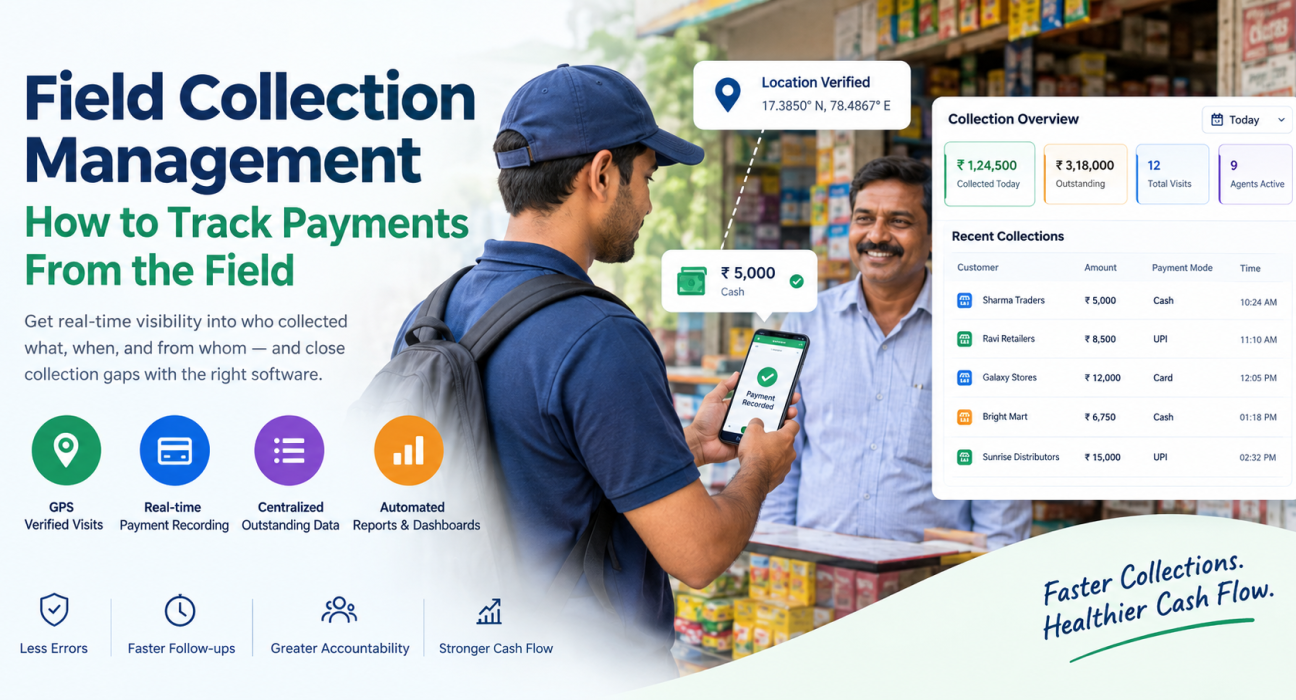
This is the core problem field collection management software is built to solve. It replaces manual, error-prone collection tracking with real-time visibility into who collected what, when, and from whom.
In this article, you’ll learn what field collection management actually involves, the common challenges businesses face while tracking field payments, and how the right software can help you close collection gaps, reduce delays, and improve accountability across your field team.
What Is Field Collection Management?
Field collection management refers to the process of tracking, recording, and reconciling payments collected by field agents, sales executives, or delivery staff who visit customers directly — as opposed to payments made through digital channels or in-office transactions.
It typically involves:
- Recording cash, cheque, or digital payments collected on-site
- Tracking outstanding dues against specific customers
- Verifying collection visits
- Reconciling collected amounts with actual deposits
- Reporting collection status to finance and management teams
Businesses in industries like FMCG distribution, pharmaceuticals, financial services, dairy, and B2B supply chains rely heavily on field collections, since a large share of their revenue is collected directly from retailers, dealers, or customers on the ground.
Why Tracking Field Payments Is Harder Than It Looks
On paper, collection sounds simple: an agent visits a customer, collects payment, and reports back. In practice, several things can go wrong along the way.
Common Challenges in Field Collection Tracking
1. Delayed or inaccurate reporting Agents often report collections at the end of the day, or sometimes days later, making it difficult for finance teams to know the real-time collection status.
2. Lack of visibility into agent activity Without location tracking or visit verification, businesses have no reliable way to confirm whether a collection visit actually happened as reported.
3. Manual reconciliation errors When collections are recorded on paper or spreadsheets, mismatches between collected amounts and deposited amounts are common — and hard to trace back.
4. Cash handling risks Cash collected in the field carries a higher risk of loss, delay in deposit, or misreporting compared to digital payments.
5. No centralized outstanding data Sales and finance teams frequently work with outdated customer outstanding data, leading to duplicate follow-ups or missed collections.
6. Poor accountability Without a system to log who collected what and when, it becomes difficult to hold specific agents accountable for delays or discrepancies.
These challenges compound as a field team grows. A business with 5 field agents can manage collections manually. A business with 50 or 500 agents cannot.
What Good Field Collection Management Looks Like
Before evaluating software, it helps to understand what an efficient field collection process actually looks like.
Best Practices for Field Collection Management
- Maintain a centralized outstanding ledger so every agent and manager sees the same, up-to-date customer dues.
- Assign collection tasks systematically based on route, territory, or customer priority instead of ad-hoc visits.
- Verify every collection visit with location or check-in data rather than relying solely on agent self-reporting.
- Record payments in real time, at the point of collection, rather than at the end of the day.
- Reconcile collections daily against bank deposits or digital wallets to catch discrepancies early.
- Set clear SLAs for collection follow-ups on overdue accounts.
- Review collection performance regularly by agent, territory, and customer segment.
Businesses that follow these practices manually using spreadsheets and calls often hit a ceiling — the process works until the field team scales, at which point errors and delays increase.
How Field Collection Management Software Helps
Field collection management software digitizes this entire workflow, connecting field agents, managers, and finance teams on a single system.
Core Capabilities to Look For
| Capability | What It Solves |
|---|---|
| Real-time collection recording | Eliminates end-of-day reporting delays |
| Outstanding payment tracking | Gives finance teams live visibility into dues |
| GPS-verified visit tracking | Confirms collection visits actually took place |
| Digital collection receipts | Reduces disputes and improves transparency |
| Automated reports and dashboards | Removes manual reconciliation work |
| Route and beat planning | Ensures agents follow efficient, prioritized visit plans |
| Task assignment | Assigns overdue accounts systematically instead of randomly |
How It Works, Step by Step
- Customer outstanding data is uploaded or synced into the system, giving agents a clear list of pending dues.
- Collection tasks are assigned to field agents based on territory, route, or priority accounts.
- Agents visit customers and record the collected amount directly through a mobile app, along with the payment mode.
- The visit is verified, typically using location data, so managers can confirm the collection happened at the customer’s actual location.
- Collection data updates in real time, syncing with dashboards visible to sales and finance teams.
- Reports are generated automatically, showing collection status by agent, territory, or customer, without manual data entry.
This structure removes the reporting lag between when money is collected and when the business actually knows about it.
Benefits of Using Field Collection Management Software
- Improved cash flow visibility — Finance teams see real-time collection data instead of waiting for manual updates.
- Reduced reconciliation errors — Digital records minimize mismatches between collected and deposited amounts.
- Better accountability — Every collection is tied to a specific agent, time, and verified location.
- Faster follow-ups on overdue accounts — Outstanding data is centralized and always current.
- Reduced dependency on manual reporting — Agents log collections on the go instead of at day’s end.
- Data-driven performance reviews — Managers can evaluate collection efficiency by agent or territory objectively.
Businesses looking to simplify these processes can use field force management software such as FieldExecutives, which brings collection tracking together with visit verification, task management, and real-time reporting in one platform — helping field teams and finance teams work from the same, accurate data.
Field Collection Management vs. Manual Collection Tracking
| Factor | Manual Tracking | Field Collection Management Software |
|---|---|---|
| Reporting speed | End-of-day or delayed | Real-time |
| Visit verification | Not possible | GPS/location-based |
| Reconciliation | Manual, error-prone | Automated |
| Outstanding data | Scattered across sheets | Centralized |
| Accountability | Difficult to trace | Logged per agent and visit |
| Scalability | Breaks down with team growth | Scales with the business |
Choosing the Right Field Collection Management Software
When evaluating software, look beyond basic payment logging. Consider whether the platform also supports:
- [Internal Link Opportunity: Route and beat planning feature page]
- [Internal Link Opportunity: Field visit verification feature page]
- [Internal Link Opportunity: Real-time reporting and dashboards feature page]
- Integration with your existing sales or ERP workflow
- Ease of use for field agents, since low adoption defeats the purpose of digitization
A platform that connects [Internal Link Opportunity: Field Sales Management solution page] with collection tracking gives you a more complete view of both sales performance and payment recovery, rather than treating collections as an isolated function.
Conclusion
Tracking payments collected in the field doesn’t have to depend on phone calls, delayed reports, and manual spreadsheets. The challenges — delayed reporting, poor visibility, reconciliation errors, and weak accountability — are all solvable with the right process and the right tools.
Field collection management software brings structure to this process by giving businesses real-time visibility into collections, verified visit data, and centralized outstanding records. This means fewer errors, faster follow-ups, and better cash flow control.