


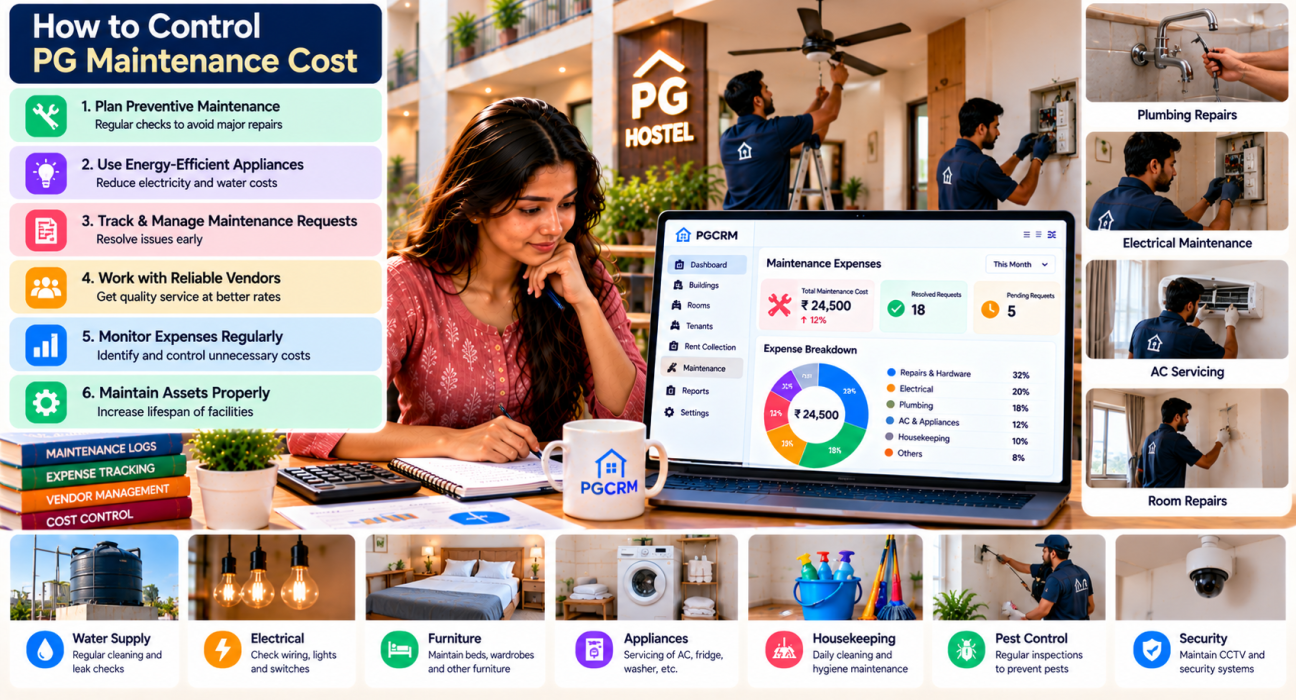
A tap washer here, a fan capacitor there, a mattress that needs replacing, a geyser that has died for the third time this year. None of these repairs looks big on its own. Add them up at the end of the year and PG maintenance cost is often one of the largest expenses after rent and salaries, and also the least tracked.
The good news is that you can bring it under control without cutting corners or annoying tenants. This guide covers where the money usually leaks, eight practical ways to spend less on upkeep, and a simple rule for deciding when to repair and when to replace. A notebook will do to start, and PG and hostel management software can help once your records outgrow it.
What Counts as PG Maintenance Cost?
PG maintenance cost is everything you spend to keep the property safe, clean and rentable, excluding rent, salaries and food. It covers routine upkeep, repairs, replacements and preventive work such as servicing and pest control. Tracking it by category shows you which costs are normal and which are leaking money.
Most owners find it helps to split it into four types:
- Routine upkeep: cleaning supplies, bulbs, small fixes
- Preventive maintenance: servicing motors, geysers and ACs, pest control, repainting on schedule
- Corrective repairs: things that broke and need fixing now
- Replacements: beds, mattresses, fans, water heaters, furniture at end of life
Each type behaves differently. Preventive work is planned and usually cheap. Emergency repairs are unplanned and usually expensive. Controlling cost mostly means moving spending from the second group to the first.
Why PG Maintenance Costs Creep Up
Before fixing it, understand why it grows.
- Small problems are ignored until they become big ones
- Nobody records repairs, so the same fault gets paid for repeatedly
- One vendor does everything, and nobody checks the price
- Staff approve spending without limits
- Cheap fittings are bought and replaced often
- Tenant damage isn’t documented, so you can’t recover the cost
- Leaks and electrical faults quietly raise utility bills
If three or four of those sound familiar, you’re not alone. They’re normal in PGs that grew faster than their systems.
How to Control PG Maintenance Cost: 8 Practical Steps
1. Find Out Where the Money Actually Goes
You can’t control what you don’t measure. Go through the last six to twelve months of receipts, bank entries and notes, and sort every maintenance expense by:
- Category (plumbing, electrical, furniture, painting, appliances)
- Building and room
- Vendor
- Month
You’ll probably spot a pattern within an hour. One room with repeated leaks. One building with constant electrical calls. One appliance type that keeps failing. A simple maintenance log keeps this data clean from here on.
2. Move From Fixing to Preventing
Waiting for things to break is the most expensive way to maintain a building. Build a short preventive schedule.
Weekly: check the water tank and motor, common lights and drainage.
Monthly: look at geysers, fans, locks, beds and the Wi-Fi router.
Quarterly or yearly: have wiring and switchboards checked, schedule pest control and plan paint touch-ups.
Servicing a motor is cheaper than replacing a burnt one. Clearing a drain is cheaper than repairing a damp wall. The routine costs little because it catches faults early.
3. Set Priorities and a Repair-or-Replace Rule
Not every problem needs an immediate response. Sort issues into high (safety, no water, no power, broken locks), medium (comfort) and low (cosmetic). Handle the first group at once and batch the rest, so a vendor visits once for several jobs instead of three separate times.
For repeat failures, a simple rule helps.
| Situation | Suggested action |
|---|---|
| Repair costs well under half the price of a new item and it’s the first fault | Repair |
| Same item has failed more than once this year | Consider replacing |
| Repair cost approaches the replacement price | Replace |
| Item is unsafe (old wiring, damaged heater) | Replace or repair professionally, don’t delay |
This is a rule of thumb, not a law. Adjust it for the item’s age and how critical it is.
An illustrative example: a geyser is repaired four times in a year at ₹800 each, ₹3,200 in total, and still fails. A new one might cost around ₹9,000 and last for years. The repeated repairs weren’t the cheap option. They were a slow way to pay for a new geyser while tenants went without hot water. (These figures are examples, not market prices.)
4. Get Your Vendors in Order
One vendor you’ve never questioned is a risk. Aim for:
- Two or three reliable vendors for plumbing, electrical and carpentry
- A written quote for any job above a limit you choose
- A rate record so you know what a normal job costs
- Spare parts bought directly when possible, not marked up through a contractor
Don’t chase the lowest price blindly. A cheap repair that fails in two weeks costs more than a fair one that lasts. Your maintenance log will show which vendors’ work holds up.
5. Put a Spending Limit on Approvals
Decide how much your caretaker or manager can spend without asking you. Perhaps small fixes up to a set amount are fine, and anything above needs approval. Write it down and tell staff.
This isn’t about distrust. It protects your staff too, because everyone knows the rules, and it stops small unrecorded purchases from piling up.
6. Reduce Tenant-Caused Damage
Some repair bills come from misuse, and you can reduce or recover those costs.
- Note the room’s condition on move-in, with photos if possible
- Share clear house rules about appliances, walls and furniture
- Inspect the room again when the tenant leaves
- Document any damage and compare it against the move-in notes
- Deduct fair charges from the deposit, with a written breakdown
Fair, documented deductions are far easier to settle than arguments over memory. If you’re unsure about the legal side of deposit deductions in your area, ask a lawyer or check your rental agreement terms.
7. Cut Utility Waste
Some of what looks like normal electricity and water cost is really a maintenance problem.
- Fix dripping taps and running toilets quickly
- Check the water tank overflow regularly
- Replace old bulbs with efficient ones as they fail
- Put common-area lights on a schedule or sensors if practical
- Service geysers and ACs so they run efficiently
- Ask tenants to report leaks and flickering lights
These aren’t dramatic changes, but they remove steady drains that otherwise go unnoticed for months.
8. Buy for Durability
The cheapest bed, tap or switch often costs the most over three years. For items that take heavy daily use, such as bed frames, mattresses, taps and door locks, spend a little more on sturdier versions and buy in bulk when you need several. Keep a short list of what you’ve bought, from whom and how long it lasted. That record turns buying from guesswork into a decision.
A Simple Quarterly Maintenance Cost Review
Once a quarter, put the numbers in a table like this one. The figures below are made up to show the format.
| Category | Q1 spend | Q2 spend | What it tells you |
|---|---|---|---|
| Plumbing | ₹6,500 | ₹4,200 | Dropping after tank repair |
| Electrical | ₹3,000 | ₹5,800 | Look for a faulty wiring point |
| Furniture and beds | ₹4,500 | ₹2,000 | One-off mattress purchase in Q1 |
| Appliances | ₹7,200 | ₹3,100 | Geyser replaced, fewer repairs |
| Painting and cleaning | ₹2,500 | ₹3,000 | Seasonal touch-ups |
| Total | ₹23,700 | ₹18,100 |
You don’t need perfect numbers. You need honest ones. When a category jumps, ask why. When one drops, find out what worked and repeat it.
Common Mistakes to Avoid
- Cutting maintenance to save money. Delayed repairs usually cost more later and hurt tenant retention.
- Not recording small expenses. Fifty and hundred-rupee jobs add up.
- Relying on one vendor. There’s nobody to compare against.
- Skipping the preventive schedule. It’s the cheapest part of maintenance.
- Paying repeatedly for the same repair. Look at the root cause.
- Having no budget. Without a number, every bill feels like an emergency.
Budgeting deserves a line of its own. Look at your last year’s maintenance spend, add the big items you know are coming, and keep a small buffer. If you build an annual plan for your PG, make maintenance its own line, not a leftover.
How PG Management Software Supports Cost Control
Controlling PG maintenance cost starts with knowing what happened, where and how much it cost. If complaints live in WhatsApp messages and expenses in a notebook, that’s hard to see.
PGCRM, for example, lets you log tenant complaints with a priority and a clear status trail, so open issues don’t get forgotten. You can record expenses by category and building, which makes your quarterly review quicker, and view income and expense reports. It also lets you give managers their own logins with limited access, and shows beds as full, free or under repair, so you can see which beds are out of use. Details are on the PGCRM features page.
The software doesn’t fix a pipe or negotiate with your plumber. It just makes sure you have the records to spot patterns and make better decisions.
Frequently Asked Questions
What is included in PG maintenance cost?
It includes routine upkeep, repairs, replacements and preventive work such as servicing, pest control and repainting. It typically excludes rent, salaries and food. Splitting it into routine, preventive, corrective and replacement costs makes it easier to see which spending is planned and which is reactive.
How can I reduce PG maintenance costs?
Track every expense by category and room, follow a preventive schedule, set priorities and a repair-or-replace rule, use two or three reliable vendors and set an approval limit for staff. Also document tenant damage and fix leaks quickly. Most savings come from avoiding emergencies, not from cutting quality.
How much should I budget for PG maintenance?
There’s no standard figure, because it depends on the building’s age, size and condition. Start with your own spending over the last 12 months, add known upcoming replacements and include a small buffer. Review the budget every quarter and adjust. A number based on your own data is more reliable than a generic rule.
Is preventive maintenance worth it for a PG?
Usually yes. Regular checks and servicing catch small faults before they become expensive failures, and they reduce emergency calls and tenant complaints. The routine itself costs little. Start with simple weekly and monthly checks of water, electrical points, beds and appliances, and expand as needed.
When should I replace instead of repair?
Replace when the same item keeps failing, when the repair cost is close to the price of a new one or when the item is unsafe. A single minor fault on a fairly new item is usually worth repairing. Track repairs in a log so you can see when an item has become a repeat cost.
How do I stop tenants from damaging the property?
Record the room’s condition at move-in, share clear house rules, inspect again at move-out and document any damage with a written breakdown of charges. Prompt repairs also help, since small faults left alone tend to get worse. Clear expectations from day one prevent most arguments over deductions.
Conclusion
PG maintenance cost isn’t something you cut by being stingy. You control it by knowing where the money goes, preventing problems before they grow, buying and repairing sensibly and putting simple rules around who spends what. A quarterly review keeps the whole thing honest.
The better your records, the easier all of this gets. PG management software such as PGCRM keeps complaints, expenses and room status in one place, so patterns are easier to spot. Explore PGCRM to simplify your PG and hostel management.