

The short answer: the development quote is rarely the full price of a mobile app. Hidden mobile app development costs usually include discovery and planning, third-party services, app store requirements, security and compliance, testing across devices, post-launch maintenance, and ongoing marketing and support. Many businesses end up spending more every year to run an app than they spent to build the first version.
If you are a founder, product manager, or business owner, this matters before you sign a contract. A budget built only on the agency’s estimate can leave you with a half-finished product, a delayed launch, or an app that works but can’t grow. This guide covers where the extra costs come from, how to estimate them, and how to ask better questions when you compare development partners.
Why Do Mobile App Budgets Go Over?
Most overruns come from three things:
- Incomplete scope. Early estimates are based on a feature list, not on the real work behind each feature.
- Changing requirements. Once users and stakeholders see a working product, they ask for changes.
- Costs outside the build. Infrastructure, licenses, legal work, and support often sit outside the development contract.
None of this means your agency is being dishonest. A quote covers what was defined. The hidden costs are what nobody defined yet.
The Most Common Hidden Mobile App Development Costs
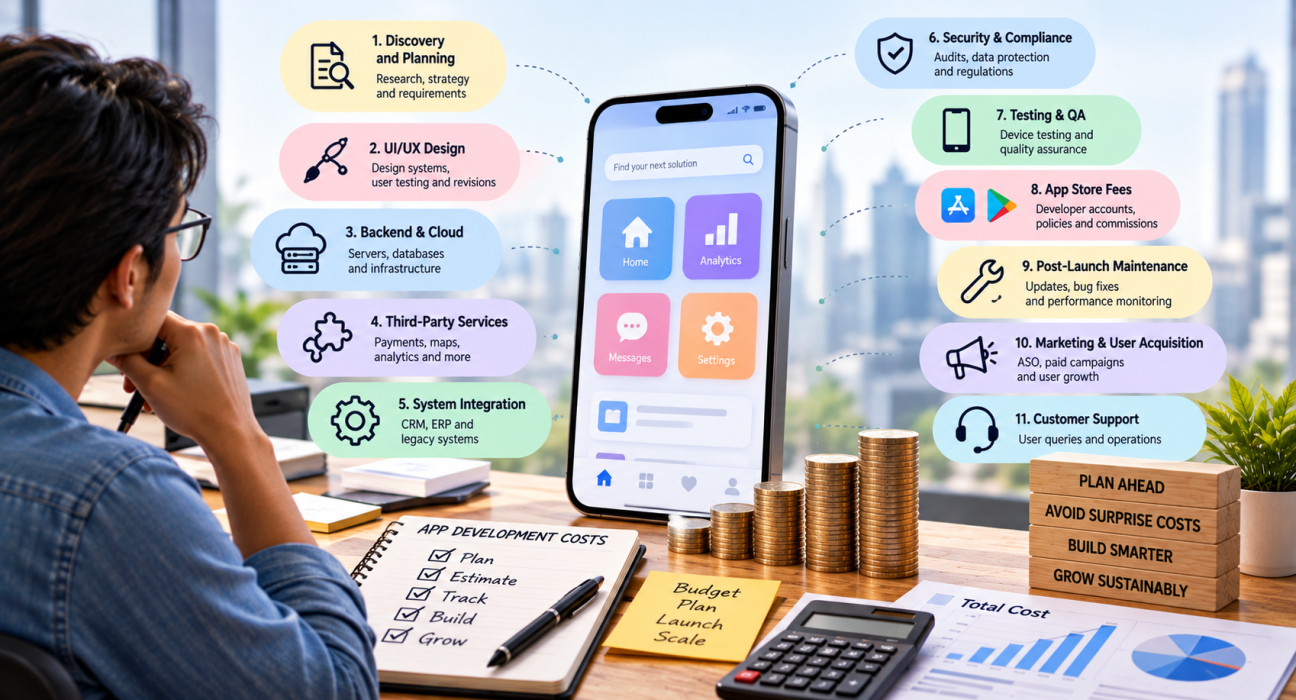
1. Discovery and Planning
Before any code is written, someone has to research users, map flows, define requirements, and decide on the technical approach. Some agencies include this in the quote, and others bill it as a separate phase. Skipping it usually costs more later, because unclear requirements lead to rework.
2. UI/UX Design Beyond the First Draft
Basic screens are one thing. Design systems, user testing, accessibility improvements, animations, and design revisions after feedback are another. If your quote lists “UI/UX design” as a single line, ask how many revision rounds it covers.
3. Backend, APIs, and Cloud Infrastructure
Many apps need a server side: databases, user accounts, push notifications, file storage, and admin dashboards. These bring recurring hosting costs that grow with your user base. A small pilot and a growing app can have very different cloud bills.
4. Third-Party Services and Licences
Apps often depend on outside services, such as:
- Payment gateways (transaction fees apply)
- Maps and location services
- SMS, email, and push notification providers
- Analytics and crash-reporting tools
- Chat, video, or AI features
- Identity verification services
Many charge based on usage, so costs rise as your app succeeds. Check each provider’s current pricing before finalising your budget.
5. Integration With Existing Systems
If your app needs to connect to a CRM, ERP, inventory system, or legacy software, integration can take far longer than expected. Older systems may lack clean APIs or documentation, which pushes up both time and cost.
6. Security and Compliance
Security is not optional, and it is rarely cheap to retrofit. Depending on your industry and the regions you serve, you may need security audits, penetration testing, data encryption, and compliance work related to privacy or industry regulations. Requirements differ by country and sector, so confirm the details with a qualified legal or compliance professional before launch.
7. Quality Assurance and Device Testing
Your app has to work across many phone models, screen sizes, and operating system versions. Thorough QA, including regression testing after every update, takes real time. Cutting this budget often leads to bad reviews and emergency fixes after launch.
8. App Store Fees and Review Requirements
Both major app stores have developer account fees, policies, and review processes. Rejected submissions mean fixes and resubmission delays. If your app includes in-app purchases or subscriptions, the platforms may also take a commission. Verify current fees and policies directly on the Apple and Google developer sites before you plan.
9. Post-Launch Maintenance
This is the biggest hidden cost for most businesses. After launch, you will need to:
- Fix bugs reported by real users
- Update the app for new OS releases
- Update or replace outdated libraries
- Monitor performance and uptime
- Add small improvements based on feedback
Many teams budget a yearly percentage of the original build cost for maintenance. The right figure depends on your app’s complexity, so ask your development partner for an estimate rather than relying on a generic rule.
10. Marketing and User Acquisition
A published app doesn’t find users on its own. App store optimisation, paid campaigns, content, partnerships, and onboarding improvements all cost money. A good product with no acquisition budget often stalls.
11. Customer Support and Operations
Someone has to answer user questions, handle refunds, moderate content (if relevant), and manage accounts. For some businesses this means hiring or training staff, or paying for a support platform.
12. Change Requests and Scope Creep
Even well-planned projects see changes. Every new feature or revised flow affects design, development, and testing. Agree on a change-request process early so extra work is priced and approved before it starts.
Quick Reference: Where Costs Hide
| Cost Area | When It Appears | Often Missed Because |
|---|---|---|
| Discovery and planning | Before development | Assumed to be part of the build |
| Cloud and backend | Launch and ongoing | Billed separately from the agency |
| Third-party services | Ongoing, usage-based | Free tiers hide future costs |
| Security and compliance | Pre-launch and ongoing | Treated as a final-step task |
| Maintenance | After launch, every year | Not part of the original quote |
| Marketing | Launch and ongoing | Seen as separate from the app budget |
How Do You Estimate Hidden Mobile App Development Costs?
Use this step-by-step approach:
- List every feature, then note what each one needs behind the scenes (servers, third-party tools, integrations).
- Separate one-time costs from recurring costs. Build, design, and launch are one-time. Hosting, licences, maintenance, and marketing recur.
- Ask for a detailed breakdown from each agency instead of a single total.
- Add a contingency buffer. Many teams reserve extra budget for unexpected work. The right size depends on how clear your requirements are, so discuss it with your development partner.
- Plan the first 12 months, not just the build period.
- Review the plan after discovery, when estimates become more reliable.
Questions to Ask Before You Sign
When you evaluate development partners, ask:
- What does your quote include and exclude?
- How many design and revision rounds are covered?
- Who pays for cloud hosting and third-party tools?
- What does testing cover, and on which devices?
- Is post-launch support included, and for how long?
- How do you handle change requests?
- Who owns the source code and accounts?
Clear, specific answers are a good sign. Vague ones often point to costs that will appear later.
How to Find a Development Partner Who Quotes Honestly
The partner you choose affects your budget as much as the technology does. Compare several mobile app development companies, look at their past work and client feedback, and request itemised proposals. A platform like GoFirms can help you research and compare technology and service providers in one place, so you can shortlist companies and ask the questions above before committing.
Practical Example: A Retail Startup
Imagine a small retailer building a shopping app. The agency quotes for design, development, and testing. What the retailer didn’t plan for: payment gateway fees, a cloud server that scales with traffic, push notification tools, an inventory system integration, store review delays, and a small monthly support budget. None of these items is unusual. Together, they changed the first-year cost significantly. Planning them from day one would have avoided the surprise.
Frequently Asked Questions
What are hidden mobile app development costs? They are expenses that sit outside the main development quote. Common examples include cloud hosting, third-party services, security and compliance work, app store requirements, maintenance, marketing, and customer support. They often recur, so they affect your total cost of ownership well beyond launch.
How much should I budget for app maintenance? It varies by app complexity, user base, and update frequency. Many businesses plan for maintenance as an ongoing yearly cost that can be a meaningful share of the original build. Ask your development partner for an estimate based on your specific features and infrastructure.
Why do mobile app projects go over budget? Usually because of unclear scope, changing requirements, underestimated integrations, and costs that were never part of the quote. A thorough discovery phase and a clear change-request process reduce the risk significantly.
Are app store fees the biggest hidden cost? No. Store fees are real but usually small compared with maintenance, cloud infrastructure, and marketing. Check the current fee structure on the official developer pages, since policies can change.
How can I reduce hidden costs without cutting quality? Start with a minimum viable product, prioritise features by business value, invest in discovery, and agree on a clear scope. Compare itemised proposals from multiple companies, and plan recurring costs from the start.
Should I plan for costs after the app launches? Yes. Post-launch work often forms a large part of the total spend. Plan for maintenance, updates, support, and marketing for at least the first year.
Do third-party services add to the cost? Often, yes. Payments, maps, messaging, analytics, and AI features usually charge by usage or subscription. Review each provider’s current pricing and estimate costs at different user volumes.
Conclusion
Hidden mobile app development costs are less about bad surprises and more about incomplete planning. If you account for discovery, infrastructure, third-party tools, security, testing, store requirements, maintenance, and marketing from the start, your budget will reflect what the app really needs over its first year. Ask for itemised quotes, set up a change-request process, and keep a buffer for the unexpected. When you are ready to compare mobile app development companies, you can research and shortlist providers on GoFirms and ask each one the questions above.