

Sales Beat Management: How to Improve Daily Market Coverage
Your sales team has a beat plan on paper. Whether reps actually visit every outlet on it, in the right order, on the right day, is a different question.
That gap between plan and reality is where market coverage is lost. Sales beat management software closes it by giving managers one view of planned versus actual visits. This guide explains what beat management is, why coverage slips, and how to fix it step by step.
What Is Sales Beat Management?
Sales beat management is the process of planning, assigning and monitoring the fixed routes (beats) that sales representatives follow to visit retailers, distributors or customers on a regular schedule.
A beat is a defined set of outlets in a specific area, visited on a set day and frequency. A rep might cover one beat on Mondays, another on Tuesdays, and repeat the cycle weekly or fortnightly.
Good beat management covers:
- Dividing territories into logical beats
- Assigning outlets and visit frequency
- Sequencing routes so reps don’t backtrack
- Tracking whether visits happened
- Measuring what each visit achieved
This is common in FMCG, consumer durables, pharma and retail distribution, where regular outlet visits drive sales.
What Does “Market Coverage” Mean?
Market coverage is the share of target outlets your team visits and serves within a given period.
Daily market coverage is about consistency: are the right outlets being visited, as planned, every day? High coverage means fewer missed outlets, fewer stock-outs and more chances to place orders.
Teams commonly track coverage with these metrics:
| Metric | What It Tells You |
|---|---|
| Beat adherence | How closely reps follow the planned route and schedule |
| Outlet coverage | Percentage of planned outlets actually visited |
| Productive calls | Visits that resulted in an order or a defined outcome |
| Strike rate | Productive calls as a share of total visits |
| Visits per rep per day | Daily throughput of each rep |
Why Daily Market Coverage Slips
Most coverage problems are visibility problems. Managers can’t fix what they can’t see.
Beat plans live in spreadsheets
Plans built in Excel are hard to update, and reps often get them over WhatsApp or a printout. When an outlet is added or a rep goes on leave, the plan quietly goes out of date.
Reps don’t follow the planned sequence
Without route guidance, reps visit outlets in whatever order feels convenient. Easy or high-volume outlets get repeat visits, while distant or low-volume ones get skipped.
There is no proof a visit happened
A rep says “I visited.” The manager has no location stamp, photo or signature to confirm it. This weakens trust and makes coaching harder.
Travel time eats selling time
Poorly sequenced routes mean more time on the road and fewer calls. Even small inefficiencies add up across a team and across a month.
Reports arrive too late
If you only learn about missed outlets from the end-of-day or end-of-week report, the sales opportunity is already gone.
How to Improve Daily Market Coverage: A Step-by-Step Process
Here is a practical process any sales team can follow.
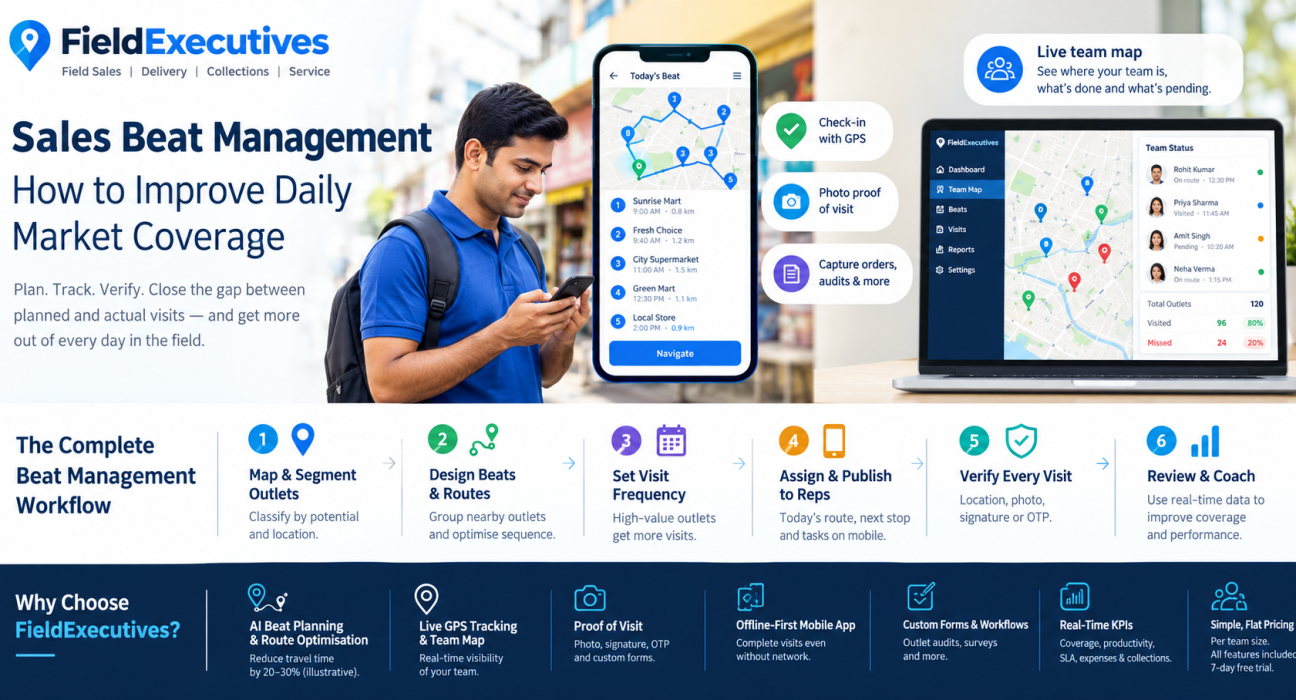
- Map your outlets and segment them. List every outlet with its location and classify it by potential (for example A, B and C), so high-value outlets get more frequent visits.
- Design beats by geography and workload. Group nearby outlets into beats a rep can realistically complete in a day, rather than overloading one rep and underloading another.
- Set visit frequency per outlet class. A high-potential outlet might need a weekly visit, while a smaller one may need one every two weeks.
- Sequence each beat for the shortest practical route. Order stops to reduce backtracking and travel time.
- Assign beats and publish them to reps’ phones. Each rep should see today’s route, next stop and tasks without asking anyone.
- Verify every visit. Use location-stamped check-ins and photo or signature proof so every visit is on record.
- Review coverage daily, not monthly. Look at planned versus actual visits, missed outlets and productive calls while there is still time to act.
- Coach using the data. Use beat adherence and strike rate to see who needs support and which beats need to be redesigned.
How Sales Beat Management Software Helps
Software turns the process above from a manual routine into a system that runs daily. The main benefits are:
- Central beat plans. Managers create and update beats in one place, and reps get changes instantly.
- Route guidance. Reps see the planned stops in order, with navigation to the next outlet.
- Live visibility. Managers see where the team is and which visits are done, in progress or pending.
- Verified visits. Location and proof capture replace “trust me” reporting.
- Faster data. Dashboards show coverage and productivity the same day.
- Less admin. Attendance, expenses and collections can sit in the same system as visits.
This is why many teams move from spreadsheets and chat groups to dedicated field sales management software once they pass a handful of reps.
What to Look for in Sales Beat Management Software
Not every tool is built for beat-based selling. Use this checklist when evaluating options:
- Beat and route planning with optimized stop sequencing
- Live GPS tracking and team map view
- Geofenced check-ins so visits are tied to the actual outlet location
- Proof of visit such as photo, signature or OTP
- Offline-first mobile app, since network coverage varies in many markets
- Custom forms for outlet audits, orders or surveys
- Real-time reports and KPIs for coverage and productivity
- Attendance and expense tracking to reduce admin overhead
- Flexible pricing that doesn’t punish you for adding reps
How FieldExecutives Supports Beat Management and Market Coverage
Businesses looking to simplify these processes can use field force management software such as FieldExecutives. It is built for India’s sales, delivery, collections and service teams, and it covers the parts of the beat workflow described above.
According to the FieldExecutives website, the platform includes:
- AI beat-plan and route optimisation, with distance and ETA per stop and one-tap navigation in Google Maps. The company states that optimised plans can reduce travel time by 20-30% (figures are illustrative, not guaranteed).
- A live team map showing rep locations, status and a GPS trail of where each rep went.
- Proof of visit, with photo, signature, OTP and checklist capture before a job can be closed.
- Geofenced attendance, using server-time punch-ins and mock-location detection.
- Offline-first mobile apps, so reps can complete visits without a network and sync later.
- Custom forms and workflows, so outlet audits and visit checklists can match your process.
- Real-time KPIs, SLA tracking, expenses and collections in the same platform.
Pricing is a flat monthly plan by team size, with all features on every plan and a 7-day free trial.
Example: a typical day with beat management software
Here is how this could look for an FMCG sales team:
- Morning: The rep punches in with geofenced attendance and sees today’s optimised beat.
- During the day: The rep moves from outlet to outlet, checks in at each one and captures photo proof and any required form data.
- Real time: The manager sees completed, pending and missed visits on the live map.
- Evening: The team’s coverage and visit data is ready for review, with no manual consolidation.
This is an illustrative workflow, not a customer case study.
Best Practices for Better Market Coverage
- Review beats regularly. Markets change, so outlets open, close and shift in potential.
- Don’t overload beats. A beat that can’t be completed in a day guarantees skipped outlets.
- Track outcomes, not only visits. A visit count tells you little without productive calls and strike rate.
- Use data for coaching. Share beat adherence with reps as a support tool, not only as a control mechanism.
- Be transparent about tracking. Make clear that location tracking applies to on-duty hours and requires the rep’s permission.
- Start with one team. Pilot the software with a single region, refine beats, then scale.
Conclusion
Strong daily market coverage depends on three things: a good plan, consistent execution and fast feedback. Spreadsheets and chat groups struggle with all three. Sales beat management software brings them together, so managers can see which outlets were visited, which were missed and where reps are losing time.
For teams ready to move beyond manual tracking, FieldExecutives offers beat planning, live tracking, proof of visit and real-time reporting in one platform.