


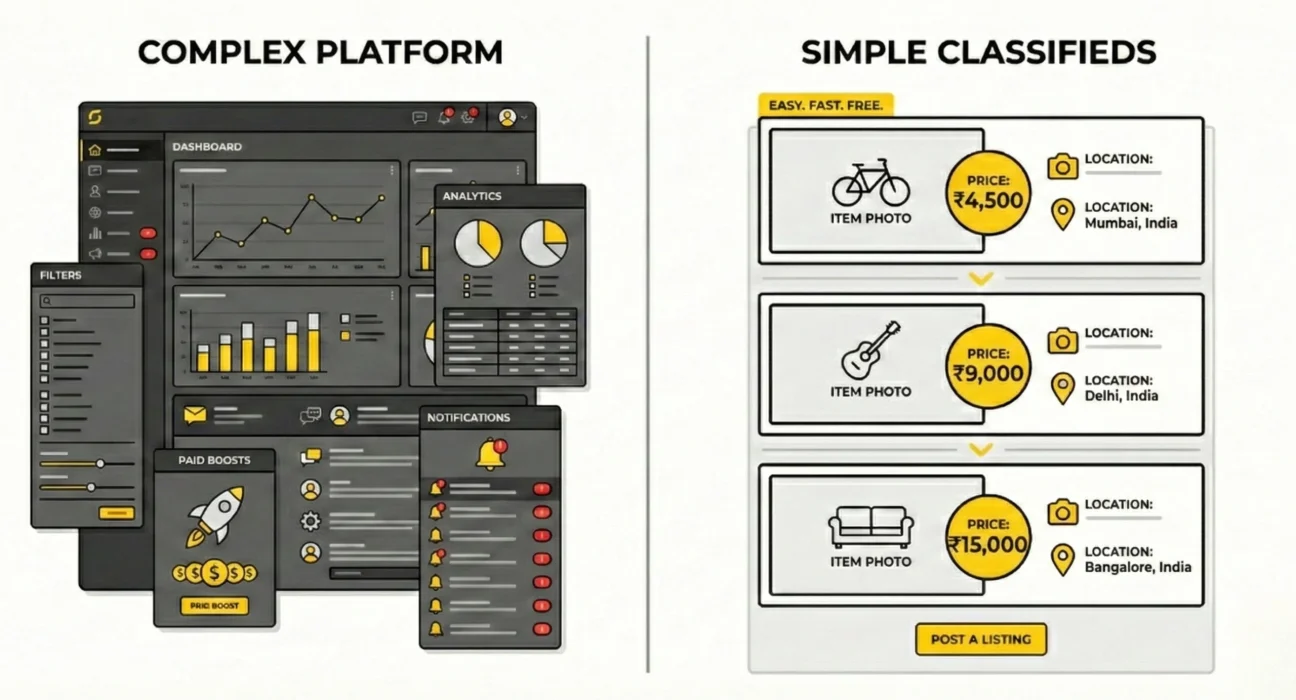
You download a popular marketplace app to sell your old phone. Before you can even post a listing, you need to verify your email, upload an ID, link a payment method, complete a seller tutorial, and agree to three different sets of terms.
Twenty minutes later, you’re still not done setting up your account.
Meanwhile, a simpler platform lets you post your phone in under two minutes—just photos, description, price, and location. Done.
Which one do you actually use?
Across India, people trying to buy and sell locally are choosing straightforward platforms over feature-heavy ones. Not because they’re anti-technology, but because complexity doesn’t add value when all you want is to sell a study table or find an affordable fridge nearby.
On simple classifieds like Sympl, this focus on ease over features is exactly why people come back and transactions actually happen.
The Problem With Over-Complicated Platforms
More features sound better in theory. In practice, they create friction.
Too many steps to post a listing:
Account verification, category selection with dozens of sub-categories, mandatory fields for information you don’t have, photo requirements with specific dimensions by the time you’re done, you’re exhausted.
Overwhelming interfaces:
Buttons, tabs, notifications, recommendations, ads, promotional banners you can’t find the basic “post listing” or “search items” functions buried under all the noise.
Hidden costs and fees:
Free to list, but you need to pay for visibility. Free to sell, but fees get deducted. Subscription tiers, premium placements, featured listings suddenly selling a ₹5,000 item costs you ₹500 in platform fees.
Unnecessary verification and rules:
Proving your identity makes sense for some transactions, but when you’re selling a used book to someone in your neighborhood, elaborate KYC processes feel excessive.
Slow, multi-step transactions:
Instead of messaging a seller and meeting up, you have escrow systems, platform-managed payments, delivery coordination, and return windows. What should take two days takes two weeks.
For most people selling unused items or looking for local deals, these complications aren’t security they’re obstacles.
What Simple Platforms Get Right
Simplicity isn’t about having fewer features. It’s about having the right features and making them obvious.
Quick posting:
Upload photos, write a description, set a price, choose your location. That’s all you need. You live in minutes, not hours.
Clear navigation:
Search bar at the top, categories clearly labeled, recent listings visible immediately. No hunting through menus.
Direct communication:
The message button connects you straight to the seller or buyer. No intermediary systems, no platform-controlled chat with limited functionality.
Transparent costs:
What you see is what you pay. No surprise deductions, no premium tiers you didn’t know about, no mandatory insurance fees.
Focus on what matters:
The platform helps you connect with local buyers and sellers, then gets out of your way. It doesn’t try to manage every aspect of the transaction.
When you buy and sell locally through platforms like Sympl, this simplicity means you spend less time navigating the platform and more time actually completing transactions.
Why Complexity Doesn’t Equal Quality
Many platforms assume more features make them better. Users know differently.
Advanced filters most people never use:
Filtering by 15 different specifications might help someone shopping for a specific laptop model, but when you’re browsing second-hand furniture, it’s overkill.
AI recommendations nobody asked for:
“You might also like these items” wastes screen space when you know exactly what you’re searching for.
Verification that doesn’t prevent scams:
Elaborate seller verification gives false security. Scammers find workarounds, while honest sellers get frustrated with the process.
Multiple payment integrations:
When local transactions involve meeting in person and paying cash or via instant UPI transfer, built-in payment gateways with transaction fees are unnecessary.
Analytics and dashboards for casual sellers:
If you’re selling three items from your home, you don’t need graphs showing your “seller performance” or “listing engagement metrics.”
These features exist to serve the platform’s business model, not to help you sell items fast or find good deals.
Sympl classifieds skip all this because they understand their users aren’t running businesses they’re just regular people exchanging goods locally.
How Simplicity Speeds Up Transactions
Every extra step between “I want to sell this” and “Item sold” is a chance for people to give up.
Faster listing creation:
Simple platforms let you post in minutes. Complex ones take 20-30 minutes between account setup and live listing. That time difference matters when you’re busy.
Quicker buyer decisions:
When listings are straightforward clear photos, honest descriptions, visible prices—buyers decide fast. They’re not decoding complicated product specs or wondering about hidden costs.
Immediate communication:
Direct messaging means buyers contact sellers right away. No waiting for the platform to verify the message or release contact information after certain conditions are met.
Simpler meetup coordination:
“Can we meet tomorrow at 6 PM near the metro station?” works perfectly. You don’t need platform-managed booking systems or location verification.
Cash transactions stay simple:
Meeting in person and exchanging cash or UPI transfer is instant. Platform-managed payments add days of processing and potential holds on funds.
On Sympl and similar simple classifieds, this efficiency is built in. The platform assumes you’re capable of having a direct conversation and completing a straightforward exchange.
Real Examples: Simple vs Complex Platforms
Selling a bicycle:
Complex platform experience:
- Create account: 5 minutes
- Verify email and phone: 3 minutes
- Upload ID for seller verification: 2 minutes
- Navigate to correct sub-category (Bicycles > Hybrid Bikes > Adult): 2 minutes
- Fill mandatory fields (frame size, brake type, gear count, wheel size): 5 minutes
- Upload photos meeting dimension requirements: 3 minutes
- Choose paid promotion options: 2 minutes
- Total time to post: 22 minutes
- Platform takes 5% commission on sale
Simple platform experience:
- Open app, tap “Post”
- Upload photos: 1 minute
- Write description: “Firefox bike, 21-speed, 2 years old, good condition”: 1 minute
- Set price: ₹8,000
- Post
- Total time: 3 minutes
- No commission
The bike sells either way, but one process respects your time and the other doesn’t.
Why Local Buyers Prefer Simple Platforms
When browsing for items nearby, buyers want clarity and speed.
Easy searching:
Type what you need, add your location, see results. That’s it. Filters for brand or price range help, but 20 filter options create decision paralysis.
Quick scanning:
Simple listings with clear titles, main photo, and price let you evaluate dozens of options in minutes. Detailed product pages with multiple tabs slow you down.
Instant contact:
See something you like, message the seller immediately. No creating wishlists, no adding to cart, no checkout process for setting up a viewing.
Straightforward information:
You want to know: What is it? What condition? How much? Where? Simple platforms answer these questions upfront. Complex ones bury details across multiple sections.
No pressure tactics:
Simple classifieds don’t have countdown timers, “only 2 left” warnings, or “X people are viewing this” notifications pushing you to decide faster than you want.
When you’re looking for low-cost buying options in your area, a straightforward platform gets you what you need without games or manipulation.
Cost Benefits of Platform Simplicity
Simple platforms usually cost less to use and that savings goes to you.
No listing fees:
Complex platforms often charge to post or to keep listings active. Sympl classifieds are typically free to use.
No commission on sales:
Selling a ₹20,000 laptop means you actually get ₹20,000, not ₹19,000 after platform cuts.
No pressure to pay for visibility:
Simple platforms don’t hide your listing unless you pay for promotion. Your post appears in search results based on relevance and recency, not payment.
No subscription requirements:
You don’t need to pay monthly fees to unlock basic features like messaging or posting multiple items.
These savings matter for budget-conscious sellers and buyers. When platforms don’t take a cut, both parties get better value from the transaction.
Time Savings That Actually Matter
Time is money, especially when you’re juggling work, family, and daily responsibilities.
Minutes to post instead of half an hour:
When selling multiple items while clearing out your home, those saved minutes per listing add up to hours saved overall.
Faster learning curve:
Simple platforms require no tutorial. You figure out how to use them in one or two attempts. Complex ones need dedicated time to understand all the features.
Less maintenance:
No checking analytics, updating premium listings, or managing complicated seller dashboards. Post, respond to messages, sell, done.
Quicker problem resolution:
If something goes wrong, simple platforms have simpler support. No navigating through multiple departments or understanding which policy applies to your situation.
For working professionals, students, and families, this time efficiency makes the difference between actually using a platform and giving up on selling items altogether.
Who Benefits Most From Simple Platforms
Students selling textbooks and gadgets:
You don’t have extra money for platform fees, and you don’t have time for complicated posting processes. Simple platforms match your needs perfectly.
Families clearing out children’s items:
When you’re selling a crib, some toys, and baby clothes, elaborate product catalogs and verification systems are overkill. Quick posting and local buyers are enough.
Working professionals upgrading electronics:
You want your old laptop sold in a week, not managed like a business listing with analytics and promotional campaigns.
First-time sellers:
Complex platforms intimidate people new to online selling. Simple ones encourage participation because there’s nothing confusing to figure out.
Occasional users:
If you sell something once every few months, you don’t want to relearn a complicated system each time. Simple interfaces work immediately, even after months away.
Anyone who values straightforward transactions over platform features benefits from simplicity. Sympl is designed exactly for these users, regular people, not professional sellers.
Why Simple Platforms Build Lasting Communities
Complex platforms treat users as metrics. Simple ones treat them as people.
Lower barrier to entry:
When posting is easy and free, more people participate. This creates a thriving local marketplace instead of a few power sellers dominating.
Trust through transparency:
Simple platforms don’t hide fees in fine print or change rules frequently. What you see is what you get, which builds long-term trust.
Less platform interference:
When the platform facilitates connection rather than controlling the transaction, users feel empowered, not managed.
Consistent experience:
Simple platforms change less frequently because they’re already doing what they need to do. You’re not constantly adapting to redesigns or new mandatory features.
Word-of-mouth growth:
People recommend simple platforms to friends because they’re easy to explain and easy to use. Complex platforms require disclaimers and warnings.
These factors create communities where people return repeatedly, building the density of listings and buyers that makes local marketplaces actually work.
What Simplicity Doesn’t Mean
Choosing simple platforms doesn’t mean accepting inferior quality or missing essential features.
Simple doesn’t mean unprofessional:
Clean design, reliable messaging, and working search functions aren’t complicated—they’re basic expectations that simple platforms meet.
Simple doesn’t mean insecure:
You can have straightforward user experience while still protecting against obvious scams through basic safeguards like reporting mechanisms.
Simple doesn’t mean limited selection:
Platforms can be simple and still have thousands of active listings. Simplicity is about interface, not inventory.
Simple doesn’t mean no support:
Basic help documentation and responsive support teams work fine without elaborate help centers and AI chatbots.
Simplicity is about removing unnecessary complexity, not removing necessary functionality.
The Long-Term Pattern: Simplicity Wins
Look at which platforms people actually use consistently over years:
They solve one problem well:
Instead of trying to be everything marketplace, social network, payment processor, logistics coordinator they focus on connecting local buyers and sellers.
They load fast:
No heavy apps with 100MB downloads. Simple platforms are lightweight and work even on slower internet connections common across India.
They’re predictable:
Users know what to expect. The core experience doesn’t change every few months chasing trends.
They respect user autonomy:
The platform facilitates, but users control their own transactions, pricing, and communication.
They don’t exploit their position:
As they grow, they don’t start extracting more fees or limiting free features to push premium subscriptions.
Sympl and similar simple classifieds follow this pattern. They do one thing help people buy and sell locally and do it well without unnecessary complications.
Practical Advantages of Sticking With Simple Platforms
Easier to explain to others:
“Just post your item with photos and price, then message with buyers” is all anyone needs to know.
Works for all age groups:
From teenagers selling old phones to retirees clearing out furniture, simple interfaces don’t require tech expertise.
Consistent across devices:
Whether on phone, tablet, or computer, simple platforms maintain the same straightforward experience.
Reliable for important transactions:
When you need to sell quickly moving cities, urgent money needs a platform that just works, not one that might confuse you.
Less likely to shut down features:
Complex platforms frequently deprecate features or change policies. Simple platforms have less to change.
These practical benefits accumulate over time, making simple platforms the default choice for anyone who just wants to sell items fast without drama.
Conclusion
Simplicity wins long-term because it respects what users actually need: quick posting, clear communication, local connections, and straightforward transactions.
Complex platforms add features that serve the platform’s interests monetization, data collection, user engagement metrics not yours.
When you just want to sell a sofa or find an affordable bike nearby, you don’t need algorithms, analytics, or artificial intelligence. You need photos, descriptions, prices, and direct messaging.
Sympl and similar simple classifieds understand this. They make local buying and selling easy by keeping everything straightforward.
No learning curve, no hidden costs, no unnecessary steps. Just people connecting locally to exchange items they don’t need for items they do.
That’s why simplicity works and why it lasts.