


Introduction
A leaking tap, a broken fan, a geyser that stopped working- these small issues pile up fast in a PG, and how quickly they get resolved shapes whether tenants stay or leave. PG maintenance management is the process of tracking, prioritising, and resolving these day-to-day complaints in an organised way, rather than reacting to each one as it comes in. This article covers how to build a reliable maintenance and complaint-handling system, common mistakes that slow down resolution, and how owners can stay on top of recurring issues across a property. Many owners eventually turn to PGCRM, a PG and hostel management software, to keep complaints and maintenance records organised alongside tenant and rent data.
What Is PG Maintenance Management?
PG maintenance management covers everything involved in keeping a property in good working condition: logging tenant complaints, assigning repairs, tracking resolution status, and identifying recurring issues before they become bigger problems. It includes both reactive work, fixing what breaks, and preventive work, catching small issues before they escalate.
For a small PG, this might mean a notebook by the front desk. For larger properties or multiple locations, it usually requires a more structured system to avoid complaints slipping through unnoticed.
Why Maintenance Complaints Are Easy to Mishandle
A few factors make PG maintenance harder to manage well than it first appears:
- Complaints arrive through different channels – phone calls, WhatsApp messages, in-person requests, and notes left at the front desk all need to reach the same tracking system.
- Urgency varies widely – a broken lock needs same-day attention, while a squeaky door hinge doesn’t.
- Multiple people may handle repairs – a caretaker, an external electrician, or a plumber, each needing clear instructions and follow-up.
- Recurring issues get lost – without records, owners can’t easily spot a pattern, like the same geyser breaking down every few months.
- Tenants expect updates – a complaint with no visible progress damages trust, even if it’s eventually fixed.
Building a Reliable Complaint-Handling System
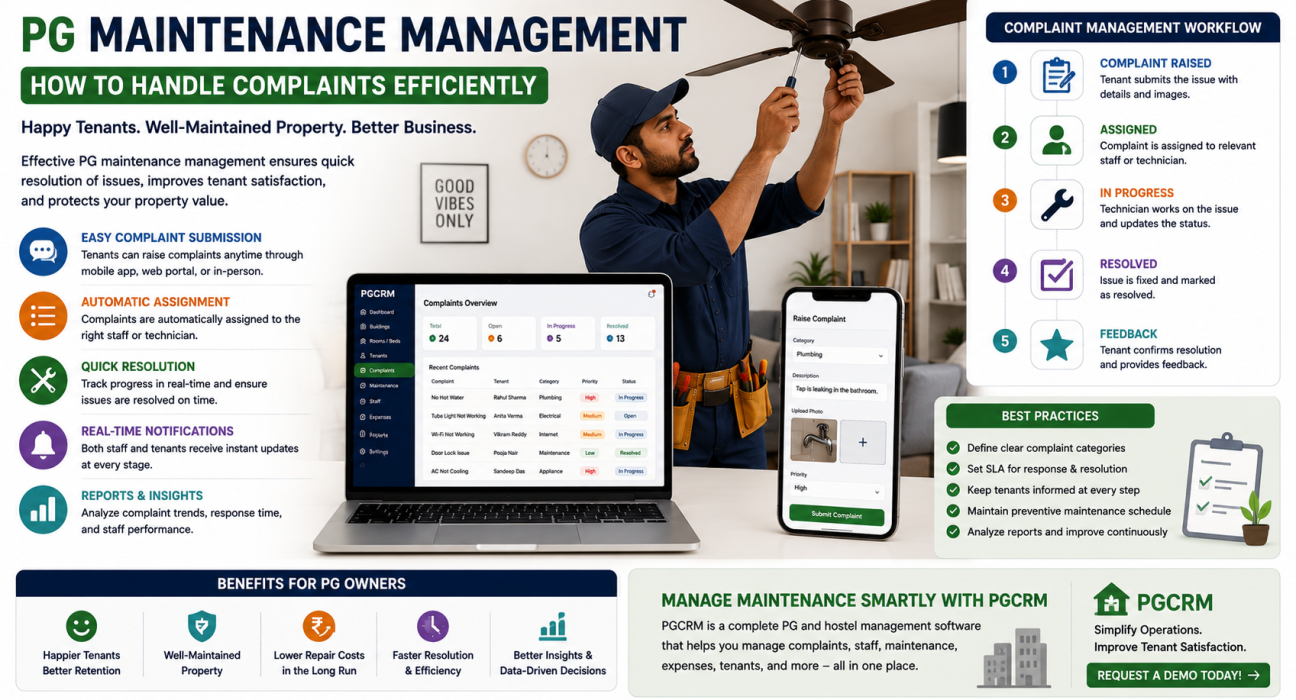
1. Centralise How Complaints Come In
The first step in effective PG maintenance management is making sure every complaint lands in one place, regardless of how a tenant reports it. If complaints scatter across phone calls, texts, and verbal requests, some inevitably get forgotten.
A simple fix: designate one channel, a WhatsApp number, a shared form, or a dedicated app, as the official way to report issues, and log every complaint there even if it originally arrived elsewhere.
2. Categorise and Prioritise by Urgency
Not every complaint needs the same response time. A useful way to categorise incoming issues:
- Urgent – safety or security issues (broken locks, exposed wiring, water leaks near electrical points).
- High priority – issues affecting daily comfort (no water, broken fan or AC, non-functional geyser).
- Standard – minor repairs that don’t significantly affect daily life (a loose cabinet hinge, a squeaky door).
- Cosmetic – appearance-related issues with no functional impact (chipped paint, minor scuffs).
Sorting complaints this way helps staff address what matters most first, instead of handling issues purely in the order they arrive.
3. Assign Ownership Clearly
Every logged complaint should have a clear owner, whether that’s an in-house caretaker or an external contractor. Ambiguity about who’s responsible is one of the most common reasons complaints stall without resolution.
4. Set Expected Resolution Timeframes
Giving each priority level a rough resolution window, for example, urgent issues within 24 hours and standard issues within a week, sets clear expectations for both staff and tenants. This also makes it easier to spot when something is falling behind schedule.
5. Update Tenants on Progress
Even a brief update, “the electrician is scheduled for tomorrow”, reduces tenant frustration significantly. Silence after a complaint is filed is one of the fastest ways to erode trust, even when the underlying issue eventually gets resolved.
Manual vs Software-Based Complaint Tracking
| Aspect | Manual Tracking (Notebook/Chats) | Software-Based Tracking |
|---|---|---|
| Visibility | Scattered across channels | Centralised in one system |
| Prioritization | Informal, based on memory | Structured by urgency category |
| Assignment clarity | Often verbal, easy to lose track of | Logged against a specific person |
| Tenant updates | Inconsistent | Easier to track and communicate |
| Recurring issue detection | Difficult without records | Visible through complaint history |
| Scalability | Manageable for small PGs | Works consistently at any occupancy level |
Both approaches can work for very small properties, but as tenant count and complaint volume grow, manual tracking becomes harder to sustain without dedicated staff time.
Common Mistakes in PG Maintenance Management
- Treating every complaint the same way – an urgent safety issue and a cosmetic scuff shouldn’t compete for the same attention level.
- Not confirming resolution with the tenant – a repair marked “done” internally isn’t the same as a tenant confirming the issue is actually fixed.
- Losing track of recurring problems – if the same appliance keeps failing, that’s a signal to replace it, not keep repairing it repeatedly.
- No clear escalation path – when a repair takes longer than expected, tenants need a way to escalate, rather than simply waiting indefinitely.
- Ignoring preventive maintenance – regular checks on wiring, plumbing, and appliances catch problems before they become emergencies.
Preventive Maintenance: Reducing Complaints Before They Happen
Reactive complaint handling matters, but preventive maintenance reduces how often complaints happen in the first place. A basic preventive schedule might include:
- Monthly checks on common-area lighting, fans, and locks.
- Quarterly checks on plumbing fixtures and water heaters.
- Seasonal checks before monsoon or summer, covering waterproofing, drainage, and cooling appliances.
- Annual electrical inspections to catch wiring issues before they cause safety problems.
Owners who build in preventive checks typically see fewer urgent complaints over time, since small issues get caught and fixed before they escalate into bigger, more disruptive problems.
How PG Management Software Supports Maintenance Tracking
Manually running the full process above- logging complaints, assigning them, tracking timeframes, and following up with tenants, takes consistent effort every week. This is the specific gap that PG management platforms help close.
Using PG and hostel management software such as PGCRM allows owners to:
- Log tenant complaints in a centralised system rather than across scattered channels
- Track complaint status from submission through resolution
- Maintain a history of maintenance issues per room or property
- Keep complaint records alongside tenant, rent, and occupancy data
Having complaint history tied to the same system as tenant and rent records makes it easier to spot recurring issues tied to a specific room, appliance, or building patterns that are much harder to catch when records live in separate notebooks or chat threads.
Frequently Asked Questions
What is PG maintenance management?
PG maintenance management is the process of logging, prioritising, and resolving tenant complaints and property upkeep tasks in an organised way. It covers both reactive repairs, fixing what breaks, and preventive checks that catch issues before they become bigger problems, helping owners keep the property in good condition.
How should PG owners prioritise maintenance complaints?
Prioritise by urgency and impact. Safety-related issues like broken locks or exposed wiring need same-day attention, followed by comfort-affecting problems like no water or a broken fan. Minor and cosmetic issues can wait longer, as long as tenants know roughly when to expect a fix.
How can PG owners reduce recurring maintenance complaints?
Preventive maintenance helps significantly. Regular checks on wiring, plumbing, and appliances catch small issues before they escalate, and tracking complaint history helps identify patterns, like a specific appliance failing repeatedly, so owners can replace it instead of repeatedly repairing it.
What’s the best way to track maintenance complaints in a PG?
A centralised system works best, whether that’s a structured spreadsheet or dedicated software. The key is ensuring every complaint, regardless of how it’s reported, lands in one place with a clear priority level, assigned owner, and expected resolution time.
How quickly should a PG owner respond to maintenance complaints?
Response time should match urgency. Safety issues generally need same-day attention, comfort-related problems within a day or two, and minor issues within a week. Setting these expectations clearly for both staff and tenants reduces frustration, even when a repair takes a little longer than expected.
Does maintenance management affect tenant retention?
Yes, significantly. Tenants who feel their complaints get addressed promptly and communicated clearly are far more likely to renew or stay longer. Slow, poorly communicated maintenance response is a common reason tenants cite for leaving a PG, even when rent and location otherwise suit them.
Conclusion
Effective PG maintenance management comes down to structure: centralising how complaints arrive, prioritising by urgency, assigning clear ownership, and keeping tenants updated along the way. Preventive checks reduce how often issues occur in the first place, and tracking complaint history helps catch recurring problems before they become bigger headaches.
For owners managing a growing number of tenants or properties, PGCRM helps keep complaints organised alongside rent and tenant records. Explore PGCRM to simplify your PG and hostel management, from maintenance tracking to day-to-day tenant operations.