


The conversation that keeps coming up
Somewhere in the last few months, this question has probably surfaced in a planning meeting or a technology review: Do we actually need a native mobile app, or would a Progressive Web App do the job?
It is a reasonable question. PWAs have matured considerably. They are faster to build, cheaper to maintain, and do not require users to visit an app store. On paper, they sound like the obvious choice for any organisation that wants to move quickly and spend less.
But “on paper” and “in practice” are very different things in enterprise. The organisations that make this decision based on a vendor’s recommendation or a quick Google search without thinking through their specific context are the ones that end up rebuilding eighteen months later.
This article is about how to think through that decision properly. Not as a technology question, but as a programme and strategy question. Because that is what it really is.
First, let us be clear about what each option actually is
There is a lot of loose language around both native apps and PWAs in the industry. Before you can make a good decision, it helps to understand what you are actually comparing.
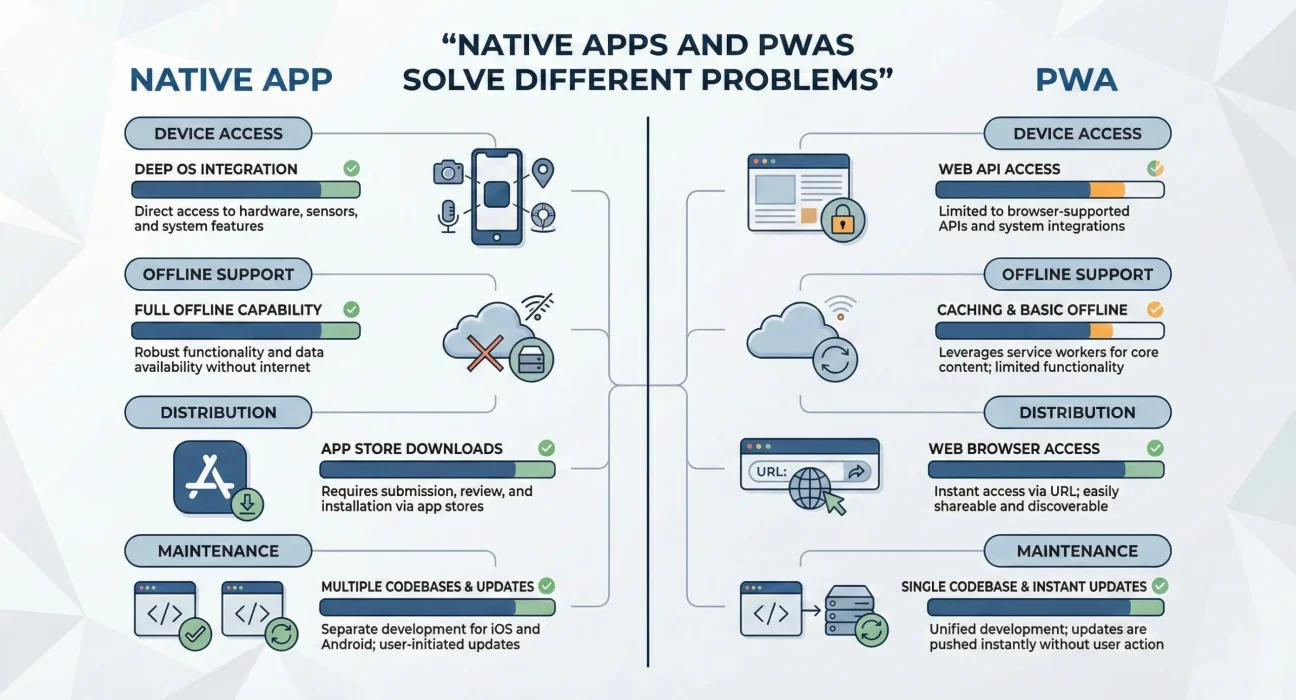
A native mobile app is built specifically for a device’s operating system iOS or Android or both. It is downloaded from an app store, installed on the device, and runs natively on the hardware. It has full access to the device’s capabilities: the camera, GPS, biometrics, push notifications, background processing, and more.
A Progressive Web App is a website that behaves like an app. It runs in a browser but can be added to the home screen, work offline to a degree, and send push notifications. It does not need to go through an app store. It is built using web technologies HTML, CSS, and JavaScript and it works across platforms without separate versions.
Both are legitimate approaches. Neither is inherently better. The right choice depends entirely on what your organisation actually needs the application to do, who will use it, and what the long-term plan looks like.
The questions that actually matter
Most organisations frame this as a technology decision. It is not. It is a business decision with technology implications. The right way to approach it is to start with the questions that your business cares about and let the answers guide the choice.
What do your users actually need to do?
This is the single most important question. If your users need to scan documents, take photographs in the field, use biometric login, or work reliably with no internet connection for hours at a time a native app is almost certainly the better fit. These are capabilities that PWAs either cannot match or can only approximate.
If your users primarily need to access data, fill in forms, view dashboards, or complete workflows that are not heavily dependent on device hardware a PWA may be perfectly adequate. And in some cases, it may be the smarter choice.
The mistake organisations make is answering this question based on what the app might do someday, rather than what it needs to do now. Scope creep is expensive. Build for the present, with a clear plan for the future.
Who are your users, and how will they get the app?
In enterprise, this question matters more than most people realise. If your users are employees, you can push an app to their devices through an MDM (Mobile Device Management) system with no app store required, even for native apps. If your users are customers or external partners, distribution becomes a different conversation entirely.
A PWA has a natural advantage here: there is no installation friction. Users open a browser, access a URL, and they are in. For organisations serving a large, dispersed user base customers, agents, or partners across India this can meaningfully affect adoption.
A native app, on the other hand, has the advantage of a more polished, integrated experience once installed. But getting users to install it and to keep it updated is an ongoing effort that organisations consistently underestimate.
What does your security and compliance landscape look like?
This is where many organisations stop short of asking hard questions. Both native apps and PWAs can be built securely. But the security posture is different, and in regulated industries banking, insurance, healthcare, government the implications are significant.
Native apps offer tighter control over data storage, can enforce stricter authentication policies, and are generally easier to audit and certify. They also integrate more cleanly with enterprise MDM and security frameworks.
PWAs run in a browser environment, which introduces its own set of considerations particularly around data caching, cross-site scripting, and the varying security behaviour of different browsers. This does not make them insecure. It means the security architecture has to be thought through differently.
If your organisation operates under frameworks like RBI guidelines, GDPR, ISO 27001, or similar, this conversation needs to happen early, not after the technology choice has already been made.
What is your long-term sustainability plan?
This is the question that most organisations answer last, if they answer it at all. But it is one of the most consequential.
A native app is a product that lives on a platform Apple’s or Google’s. When those platforms change their policies, update their operating systems, or deprecate APIs, your app has to change with them. This is a real, ongoing cost. It is not a problem that goes away after launch.
A PWA lives on the web. It is more portable, and changes to browser engines are generally more predictable and less disruptive. But PWAs are also more dependent on browser support and browser capabilities vary, particularly on iOS, where Apple has historically been more restrictive about what PWAs can do.
The right answer depends on your user base, your platform mix, and your willingness to absorb ongoing platform-specific maintenance costs.
Where organisations get this decision wrong
Having seen a fair number of enterprise mobile programmes go through this exact debate, there are a few patterns that come up again and again.
Choosing based on cost alone. Yes, a PWA is generally cheaper to build and maintain. But if it cannot do what your users need or if it creates security complications in a regulated environment the cheaper option is not actually cheaper. It is a false saving that turns into an expensive rebuild.
Choosing based on technology hype. PWAs were heavily promoted as the future of mobile, particularly a few years ago. Some organisations jumped in on that basis alone, without a clear assessment of whether PWAs fit their specific use case. The result, in several cases, was an app that looked impressive in a demo but fell short in production particularly on iOS devices, where PWA support has been inconsistent.
Ignoring the user experience gap. On Android, the gap between a native app and a well-built PWA has narrowed considerably. On iOS, it has not not to the same degree. If a significant portion of your user base is on iPhones, this is not a minor technical detail. It is a user experience decision that affects adoption.
Making the decision in isolation. In large organisations, the mobile app decision is often made by one team, usually IT or digital, without adequate input from the business units that will actually use it, the security team that has to approve it, or the support team that has to maintain it. This leads to choices that are technically sound but organisationally incomplete.
A practical framework for making the decision
Rather than picking a side and defending it, the better approach is to evaluate both options against your specific context. Here is a simple way to structure that thinking.
Start by mapping your core requirements. What are the top five to ten things the app needs to do? For each one, assess whether it requires native device capabilities, camera, GPS, biometrics, deep offline support or whether it can be achieved through a browser-based experience.
Next, evaluate your user base. Where are your users? What devices are they on? How will they discover and access the app? What is their tolerance for installation friction?
Then, run the security and compliance check. What are your organisation’s regulatory obligations? What does your security team need in order to approve the application for production use? Have you consulted with them before the technology choice is made?
Finally, think about the three-year horizon. Which option is easier to maintain, extend, and scale? Which one creates less platform dependency? Which one gives you more flexibility as your requirements evolve?
In many cases, this exercise will point clearly in one direction. In some cases, it will point toward a hybrid a native shell with web-based content, for example, or a PWA for the initial rollout with a native app planned for a later phase.
The key is that the decision is made deliberately, with input from the right people, and with a clear understanding of the trade-offs.
The hybrid path when it makes sense
There is a third option that does not get discussed enough: building a native app that uses web technologies for its core content, while preserving native access to device capabilities where needed. This is sometimes called a hybrid app, though the term is used loosely.
Done well, this approach gives you the best of both worlds. You get the distribution and installation experience of a native app. You get the flexibility and portability of web-based development. And you retain access to native features: camera, GPS, push notifications when the use case demands it.
Done poorly, it gives you the worst of both worlds. A sluggish experience that feels neither like a proper app nor a proper website, with maintenance challenges on both the native and web sides.
The success of a hybrid approach depends heavily on the technical architecture and the team’s experience with both platforms. It is not a shortcut. It is a more complex path that requires more discipline to execute well.
What this means for enterprise programme leaders
If you are a CIO, CTO, or CDO evaluating this decision, here is what matters most.
Do not let this become a purely technical debate within your engineering team. It is a business decision. The business requirements, the user context, the security posture, and the long-term strategy should all inform the choice, not just the technology preference of whoever is building it.
Do not let a vendor make this decision for you. A good delivery partner will present both options honestly, lay out the trade-offs clearly, and help you arrive at the right answer for your organisation. If a vendor is pushing strongly for one option without a thorough assessment of your context, that is a red flag.
Do not assume that the cheaper option is the safer option. In enterprise, the cost of getting it wrong in terms of rework, adoption failure, or security incidents – is almost always higher than the cost of choosing the right approach from the start.
Organisations that have navigated this well particularly in the Indian enterprise context, where connectivity, device diversity, and regulatory requirements add complexity have typically done so by investing early in a proper discovery and scoping exercise, and by working with delivery partners who understand programme execution, not just development. Partners like Ozrit, who approach these decisions as programme and governance questions rather than purely technical ones, tend to ask the harder questions before the easy ones.
The decision is not permanent but it is consequential
One thing worth remembering: the choice between a native app and a PWA is not carved in stone. Organisations do change course. Some start with a PWA and move to a native app as their requirements mature. Others do the reverse, as their user base shifts or their platform strategy evolves.
What is consequential is not the initial choice itself, but the quality of thinking that goes into it. A well-reasoned PWA that meets your needs today with a clear plan for what happens next is a far better starting point than a native app built on assumptions that have not been tested.
The organisations that get enterprise mobile right are not the ones that pick the most impressive technology. They are the ones that ask the right questions first, involve the right people, and build with clarity about what they are actually trying to achieve.
That discipline in scoping, in governance, in execution is what separates the programmes that deliver from the ones that drift.