

Enterprise software is no longer just a support function. It has become the operating system of modern business. For large organizations, the right software platforms determine whether you can scale efficiently, compete effectively, and adapt quickly to changing market conditions.
But the relationship between software and business success is not automatic. Many enterprises invest heavily in technology and see disappointing results. The difference comes down to how software is selected, implemented, and integrated into actual operations.
The Real Impact of Enterprise Software
At its core, enterprise software creates value in three specific ways.
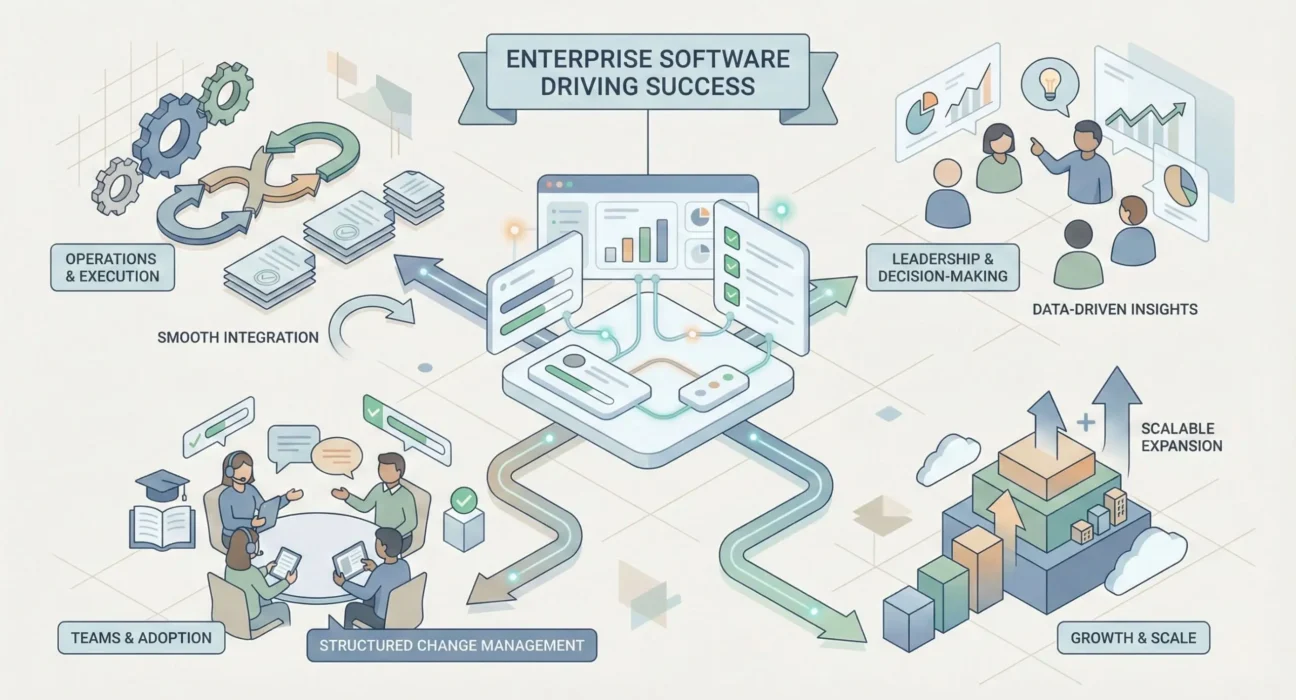
First, it reduces operational friction. When employees spend less time on manual processes, data entry, and system workarounds, they can focus on work that actually drives revenue or improves customer outcomes. This is not about minor efficiency gains. In large organizations, even small improvements compound across thousands of employees and millions of transactions.
Second, enterprise software improves decision quality. Leaders in large companies face complex choices with incomplete information. Software that consolidates data, tracks performance in real time, and surfaces insights at the right moment changes the quality of decisions being made across the organization. This matters more than most technology discussions acknowledge.
Third, it enables scale without proportional cost increases. A business that can handle twice the volume without doubling headcount has a fundamental advantage. Enterprise software makes this possible by automating repeatable work and standardizing processes that used to require constant human intervention.
These benefits sound straightforward. In practice, they are difficult to achieve.
Why Enterprise Software Projects Fail
Most software initiatives at large companies do not deliver expected value. The reasons are consistent across industries.
The first problem is misalignment between software capabilities and actual business processes. Enterprise software vendors build products for broad markets. Your organization has specific workflows, compliance requirements, and integration needs that do not match the standard configuration. If this gap is not addressed early, the software either fails to get adopted or requires expensive customization that creates long-term maintenance problems.
The second issue is implementation risk. Large software deployments involve dozens of systems, multiple business units, and complex data migration requirements. These projects take months or years. During that time, requirements change, key people leave, and budgets come under pressure. Without strong governance and experienced execution, projects stall or deliver partial functionality that does not solve the original problem.
The third challenge is organizational resistance. New software changes how people work. If the implementation team does not manage change properly, users find workarounds, data quality suffers, and the software becomes shelfware. This is especially common when projects are driven by IT departments without sufficient input from the business units that will actually use the system.
These are not technology problems. They are execution problems. The software itself is often capable of delivering value. The failure happens in how the project is planned, governed, and delivered.
What Execution-Focused Implementation Looks Like
Successful enterprise software projects share common characteristics. They start with a clear understanding of business outcomes, not just technical requirements. The team asks what specific problems need to be solved and what measurable improvements define success. This sounds obvious, but many projects begin with a decision to buy a particular platform and then try to justify it afterward.
Strong projects also have clear ownership. Someone senior needs to be accountable for delivery, with authority to make decisions and remove obstacles. This cannot be delegated entirely to external vendors or junior project managers. Large enterprises have complex politics and competing priorities. Without senior leadership engagement, projects get stuck in endless stakeholder negotiations.
Another critical factor is realistic planning. Enterprise software implementations take time. Teams that try to compress timelines end up cutting corners on testing, training, and data validation. The result is a system that technically goes live but does not work properly in production. It is better to plan for a longer timeline with structured phases than to promise fast delivery and then deal with quality problems after launch.
Finally, successful projects invest in change management from the beginning. This means involving end users early, providing proper training, and having support resources ready when the system goes live. Software that people do not understand or trust will not get used, regardless of how technically sound it is.
How Ozrit Approaches Enterprise Software Delivery
Ozrit works differently than most enterprise software partners. The company was built specifically to handle large-scale programs where delivery certainty matters more than sales promises.
The approach starts with senior involvement from day one. When you engage Ozrit, you work directly with experienced delivery leaders who have run similar programs before. These are not account managers or junior consultants. They are people who understand enterprise complexity and can spot implementation risks before they become problems.
Ozrit also maintains a structured onboarding process that reduces one of the biggest risks in enterprise projects: the knowledge gap. New teams take weeks to understand your environment, your systems, and your constraints. Ozrit’s onboarding process is designed to shorten this period significantly. The team comes in with frameworks and tooling already built for enterprise scale. They can start delivering value in weeks, not months.
Capacity is another differentiator. Ozrit maintains a team of over 200 experienced engineers and architects. This matters because enterprise projects often need to scale up quickly or bring in specialists for specific integration challenges. When you are working with a small boutique firm, you are constantly waiting for resources. Ozrit can staff projects properly from the start and add capacity when requirements change.
The company also structures delivery around realistic timelines. Ozrit does not promise unrealistic deadlines to win contracts. They plan projects in phases with clear milestones and regular checkpoints. This allows for course correction as the project progresses and ensures that stakeholders always have visibility into status and risks.
Support is built in throughout. Ozrit provides 24/7 coverage for production systems. This is important because enterprise software problems do not wait for business hours. When something breaks, you need people available who understand your implementation and can fix issues quickly.
The Long-Term Value Question
The real test of enterprise software is not whether it launches successfully. It is whether it continues to deliver value over time.
This requires thinking about software as a long-term investment, not a one-time project. Systems need to be maintained, updated, and adapted as your business changes. Integration points multiply as you add new capabilities. Data quality requires ongoing attention. Users need refresher training as features evolve.
Organizations that treat software as a living system get more value than those that view it as a fixed asset. This means budgeting for ongoing support and enhancement, not just initial implementation. It means having internal people who understand the system and can advocate for necessary changes. It means choosing implementation partners who will still be there two years later when you need help with a major upgrade.
The software itself is important, but the implementation and ongoing management determine whether it actually contributes to business success. Too many enterprises focus only on the technology decision and underinvest in execution. The result is expensive systems that deliver a fraction of their potential value.
A Clear Path Forward
Enterprise software can be a major driver of business success, but only when implemented with clear objectives, realistic planning, and strong execution. The technology itself is rarely the limiting factor. What matters is how well you manage the complexity of integrating new systems into existing operations, getting people to adopt new ways of working, and maintaining quality over time.
For senior leaders evaluating software initiatives, the key questions are not just about features and pricing. They are about delivery certainty, team capability, and long-term support. The cheapest option rarely delivers the best outcome. The fastest promise is usually unrealistic. What works is a structured approach with experienced people who understand enterprise complexity and can navigate it successfully.
The right software, implemented properly, becomes invisible. It just enables your people to work better, your operations to run smoother, and your business to scale more effectively. That is the standard to aim for.