


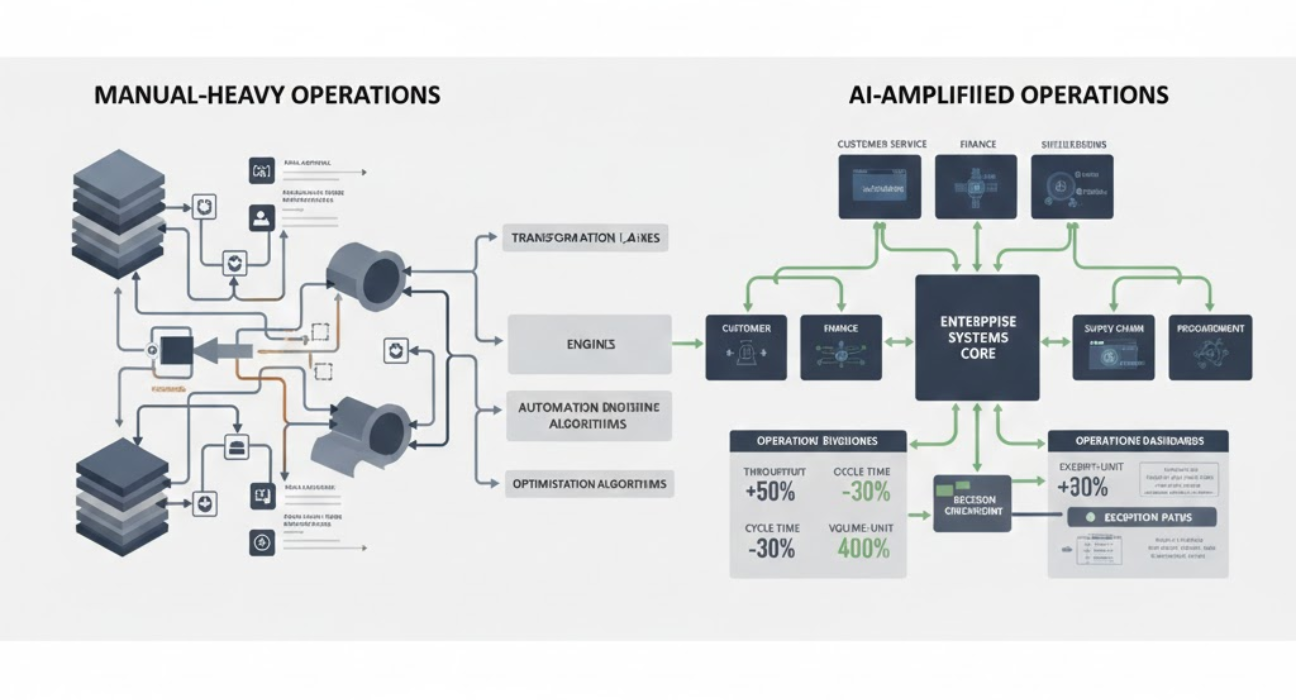
The term force multiplier comes from military strategy. It describes capabilities that dramatically increase the effectiveness of existing resources without requiring proportional increases in those resources. A small unit with superior communications can coordinate better and accomplish more than a larger unit without them. Better intelligence allows forces to position themselves more effectively and achieve objectives with fewer people.
AI functions as a force multiplier in enterprise operations in the same way. It allows the same operational teams to handle significantly higher volumes, make better decisions, resolve issues faster, and deliver superior outcomes. The organisation does not need to double the headcount to double the capacity. The existing team becomes more effective because AI eliminates bottlenecks, automates routine work, and provides intelligence that improves human decision-making.
This concept matters now because most enterprises face pressure to improve operational performance without proportionally increasing costs. Customer expectations rise while margin pressure intensifies. Volume grows while budgets stay flat or decline. Operational efficiency is no longer about incremental improvement. It requires fundamental changes in how operations function and how effectively resources are deployed.
What Force Multiplication Looks Like in Operations
The clearest examples of AI force multiplication appear in high-volume operational processes where small improvements per transaction compound into a major impact.
Consider customer service operations handling thousands of inquiries daily. Without AI, every inquiry requires human attention. Volume increases mean hiring more agents. Response times depend on how quickly agents can assess situations and determine appropriate actions. Quality varies based on individual agent knowledge and judgment.
With AI as a force multiplier, the same team handles far more volume. The AI categorises incoming inquiries and routes them to agents with relevant expertise. It provides agents with customer history, relevant knowledge base articles, and suggested responses based on similar past situations. It handles straightforward inquiries automatically through conversational interfaces. Agents focus their time on complex situations where human judgment matters. The result is higher throughput, faster response times, better consistency, and improved customer satisfaction without proportional increases in team size.
Similar patterns appear across enterprise operations. In procurement, AI can evaluate routine purchase requests automatically against policy and budget constraints, routing only exceptions or high-value purchases to human buyers. The procurement team handles much higher volumes while focusing its expertise on complex negotiations and strategic sourcing.
In financial operations, AI can process standard transactions, identify anomalies that need investigation, and flag compliance issues. Controllers and analysts spend less time on routine processing and more time on judgment calls, strategic analysis, and exception resolution.
In supply chain operations, AI can optimise inventory levels based on demand patterns, predict potential disruptions, and recommend mitigation actions. Operations teams make better decisions faster with less manual analysis.
The multiplication effect comes from three sources. First, AI eliminates work that humans should not be doing in the first place. Second, it makes the work humans need to do more efficient by providing better information and tools. Third, it allows organisations to reallocate human capability to where it creates the most value.
Why This Approach Differs From Simple Automation
Traditional automation replaces human work with technology. It takes a process that people performed manually and has software execute it instead. This creates efficiency but requires the process to be well-defined, stable, and relatively simple. Complex processes with many exceptions do not automate easily.
AI force multiplication is different. It does not require a perfect process definition. It learns from how work actually happens, including exceptions and variations. It augments human capability rather than simply replacing human activity. It adapts as conditions change rather than breaking when circumstances deviate from programmed logic.
The operational model changes fundamentally. Traditional automation creates a division between automated processes and manual processes. Some work gets automated and runs without human involvement. Everything else remains fully manual. This creates inflexibility because moving work between these categories requires significant reengineering.
AI force multiplication creates a spectrum. Some work is fully automated. Some work is AI-assisted with humans in control. Some work is primarily human, but with AI providing intelligence and support. The system can adjust where on this spectrum different types of work fall based on circumstances, risk levels, and performance.
This flexibility means the organisation can respond to changing conditions without reengineering processes. As AI learns and improves, more work can shift toward automation. When new situations emerge that AI has not encountered, work shifts toward human involvement until the AI learns these patterns. The system adapts rather than requiring redesign.
The Challenges That Prevent Most Organisations From Achieving This
Despite clear benefits, most enterprises struggle to implement AI as an effective force multiplier. Several common obstacles prevent success.
The first is treating AI as a technology layer added to existing operations rather than rethinking how operations should function. Teams implement AI tools but do not redesign workflows to capitalise on AI capabilities. The AI provides recommendations, but people must manually transfer them into operational systems. The potential force multiplication never materialises because operations still function the old way with AI as an add-on.
The second obstacle is inadequate integration between AI and operational systems. The AI exists in a separate platform and cannot access real-time operational data or feed decisions directly into workflows. This creates latency and manual handoffs that eliminate efficiency gains. Force multiplication requires tight integration where AI functions as operational infrastructure, not a separate tool.
The third challenge is poor change management. People resist working differently even when AI makes their jobs easier. They do not trust AI recommendations, or they worry about being replaced. Without effective transition support, the AI gets worked around or ignored. The technology works, but delivers no operational benefit because adoption fails.
The fourth issue is a lack of appropriate governance and oversight. AI that makes consequential decisions without proper controls creates risk. But excessive oversight that requires human review of every AI action eliminates the force multiplication benefit. Finding the right balance requires thoughtful design and continuous adjustment based on experience.
The final obstacle is insufficient operational capability to maintain AI systems. AI requires monitoring, occasional retraining, and intervention when performance degrades. Many organisations implement AI without building the capability to keep it working reliably. Performance deteriorates over time, and the force multiplication effect disappears.
How Ozrit Delivers Force Multiplication in Practice
Ozrit designs operations platforms with AI force multiplication as a fundamental architectural principle. The company was founded by people who understood that competitive operations require getting more capability from existing resources, and that AI provides the mechanism to achieve this if implemented correctly.
The platform architecture integrates AI directly into operational workflows rather than positioning it as a separate layer. Intelligent routing happens in-line as work enters the system. AI-driven decisions flow immediately into process execution. Recommendations appear in context where humans are making decisions. Monitoring and alerting incorporate AI pattern recognition. The AI is an operational infrastructure, not a tool users must actively invoke.
For high-volume transaction processing, the platform uses AI to handle routine cases end-to-end while identifying complex cases that need human attention. The classification is not static. The system learns which characteristics indicate complexity and adjusts routing as it gains experience. This allows the organisation to automate more over time without changing the underlying architecture.
For decision support, the AI provides humans with relevant context, historical patterns, and recommended approaches based on similar situations. The human maintains control but makes better decisions faster because the AI has done the analytical work. This multiplies the effectiveness of skilled decision-makers who can now handle higher volumes while improving consistency.
For exception management, the AI identifies exceptions early, categorises them, and either resolves routine exceptions automatically or routes complex exceptions to appropriate specialists with diagnosis already complete. This prevents exceptions from disrupting normal workflow and reduces the time specialists spend diagnosing issues.
For capacity management, the AI predicts volume patterns and proactively adjusts resource allocation. Operations teams know when to expect a higher load and can prepare accordingly. The system automatically scales technical resources to match demand. This prevents bottlenecks that would otherwise limit throughput.
The monitoring capabilities track force multiplication effects directly. The platform measures how much volume each person handles, how that changes over time, how AI affects cycle times and accuracy, and where human intervention is most valuable. These metrics show whether force multiplication is actually occurring and identify opportunities for further improvement.
Implementation That Delivers Measurable Results
Ozrit structures force multiplication programs to demonstrate value quickly while building toward comprehensive capability. The approach begins with operational analysis, typically four to six weeks, that identifies where force multiplication would create the most value based on current bottlenecks, volume patterns, and resource constraints.
The implementation follows a phased approach targeting the highest-impact operational areas first. The first phase typically focuses on one process that handles high volume and consumes significant resources. Implementing AI force multiplication there produces a visible improvement that validates the approach and generates savings that can fund subsequent phases.
Each phase includes careful measurement of force multiplication effects. How much did volume per person increase? How did cycle times change? What happened to quality and accuracy? What proportion of work now requires human attention versus running automatically? These metrics demonstrate impact and inform decisions about where to apply AI next.
A realistic timeline for meaningful force multiplication is 6 to 12 months for focused implementations in specific operational areas, or 12 to 18 months for comprehensive force multiplication across major operations. These timelines assume reasonable data infrastructure and organisational readiness. Results become visible within the first few months as initial capabilities deploy.
Ozrit assigns senior AI architects to force multiplication programs because the decisions about where to apply AI, how much automation is appropriate, and how to balance efficiency with control require both technical expertise and operational judgment. These architects have implemented similar capabilities before and know what actually works at enterprise scale.
Managing the Organisational Dimension
Force multiplication changes how people work and how the organisation thinks about operational capacity. This creates both opportunities and challenges that require deliberate management.
The positive side is that AI typically makes jobs better by eliminating tedious work and allowing people to focus on situations where their expertise and judgment matter. Customer service agents spend less time on routine inquiries and more time helping customers with complex needs. Financial analysts spend less time pulling data and more time on analysis that informs strategy. Operations specialists spend less time firefighting routine issues and more time improving processes.
The challenge is that people worry about being displaced. If AI allows the team to handle twice the volume, does that mean half the team gets eliminated? Without clear communication about how the organisation intends to use increased capacity, force multiplication creates anxiety that undermines adoption.
Most organisations find that increased capacity gets absorbed by growth, allowing them to handle more volume without adding headcount rather than reducing existing teams. The force multiplication creates operational leverage that improves margins and competitiveness. Explaining this clearly and consistently helps people understand that AI is making them more valuable, not making them redundant.
Training focuses on working effectively with AI rather than replacing existing skills. People need to understand what the AI is doing, when to trust its recommendations, when to investigate further, and how to provide feedback that improves AI performance. This training happens before go-live and continues as people gain experience with AI-augmented operations.
The Economics of Force Multiplication
Implementing AI force multiplication requires upfront investment in platform capabilities, integration work, and organisational change. For meaningful force multiplication across significant operational areas, total investment typically reaches millions over the implementation period.
The return comes from operational capacity that scales without proportional cost increases. An operation that previously required adding 20 people to handle 50 percent volume growth might now handle that growth with 5 additional people. Over time, this difference compounds. The organisation grows operational capacity faster than operational costs, improving margins and creating strategic flexibility.
The payback period typically runs 12 to 24 months, depending on operational scale and the degree of force multiplication achieved. After payback, the operational leverage continues delivering value. The organisation that implements force multiplication effectively builds sustainable competitive advantage because its operational economics are structurally better than competitors still relying on linear scaling.
Support for Sustained Performance
Force multiplication requires ongoing operational support to maintain performance as conditions change. Ozrit provides 24/7 support with access to AI engineers who understand both the technical implementation and the operational context. When issues arise, response comes from people who can diagnose whether the problem is in the AI models, the integration layer, the operational systems, or elsewhere.
The platform evolves as operations evolve. New products or services require AI to learn new patterns. Process changes require adjustment to how AI routes work or supports decisions. Volume shifts require rebalancing of automation thresholds. Ozrit structures engagements to include this ongoing development and tuning as part of sustained operations rather than treating implementation as a project that ends.
Regular operational reviews assess whether force multiplication is meeting expectations and identify opportunities for improvement. These reviews examine operational metrics, resource utilisation, quality outcomes, and areas where additional AI capability would create value. The goal is continuous improvement in operational effectiveness rather than one-time implementation.
The Strategic Advantage
AI force multiplication creates operational capabilities that competitors struggle to match. The organisation that achieves it can grow faster, serve customers better, and operate more profitably. These advantages accumulate over time. The force multiplier effect means that investment in operational capability generates returns that compound rather than staying linear. This is not about having impressive technology. It is about making operations work fundamentally better in ways that create material and sustained competitive advantage.