

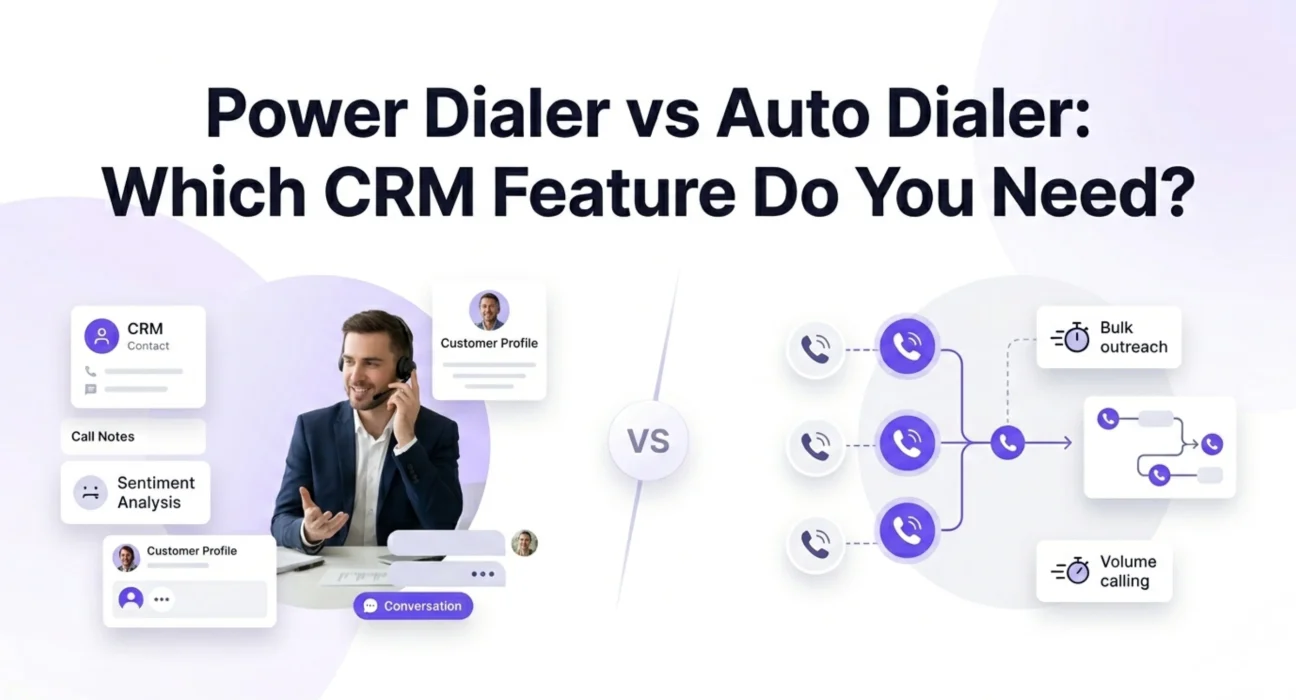
Power Dialer vs Auto Dialer is one of the most common comparisons sales teams make when choosing a CRM dialer. If your sales team is spending more time dialing numbers than actually talking to customers, something is off. The good news is that CRM dialers can fix this. But when you start looking at options, you will quickly run into two terms that sound similar but work very differently: power dialers and auto dialers.
So what is the real difference? And more importantly, which one is right for your team? Let us break it down in plain language.
What Is an Auto Dialer?
An auto dialer is a system that automatically dials a list of phone numbers one after another. It does not wait for your agent to be ready. It just keeps calling.
When a call connects, the system either plays a pre recorded message or transfers the call to an available agent. If no agent is free, the connected customer might hear silence or get disconnected. This is what the industry calls an “abandoned call,” and it is a common complaint with auto dialers.
Auto dialers are built for high volume. Think of large outbound call centers where the goal is to reach as many people as possible in the shortest time. The logic is simple: dial more, connect more.
There are a few types of auto dialers you will come across:
Predictive Dialer: This one uses algorithms to predict when an agent will finish their current call and dials the next number in advance. It tries to keep agents talking almost non-stop.
Progressive Dialer: This dials the next number only after an agent finishes a call. Slightly less aggressive than predictive, but still automated.
Preview Dialer: Before dialing, it shows the agent some information about the contact. The agent can then choose to call or skip.
What Is a Power Dialer?
A power dialer is also an automated dialing tool, but it works differently. It dials one number at a time and only after the agent is ready and waiting. There is always a live agent on standby before the call is placed.
So when the customer picks up, an agent is already there. No awkward silence. No pre recorded message. Just a real conversation from the very first second.
Power dialers are typically built for quality focused outbound calling. They are a favorite among B2B sales teams, account executives, and anyone doing consultative selling where every conversation matters.
If you are already looking at how power dialer vs auto dialer tools are reviewed by sales teams across industries, you will notice that power dialers consistently get higher marks for customer experience and call quality.
Power Dialer vs Auto Dialer: The Key Differences
Here is a simple side-by-side look at how the two compare across the areas that matter most:
| Feature | Power Dialer | Auto Dialer |
|---|---|---|
| Dialing method | One call at a time, agent-ready | Multiple calls simultaneously |
| Agent availability | Agent is always ready before dial | May connect before agent is available |
| Abandoned calls | Very low to none | Can be higher with predictive mode |
| Best for | B2B sales, complex deals | High-volume outbound, telecalling |
| Call quality | High | Moderate |
| Compliance risk | Lower | Higher (especially predictive) |
| CRM integration | Deep, with notes and context | Basic to moderate |
| Cost | Moderate to high | Generally lower |
When Does an Auto Dialer Make Sense?
Auto dialers shine in specific scenarios. If your team is making hundreds of calls a day for things like payment reminders, appointment confirmations, or mass outreach campaigns, an auto dialer will save a lot of time and manual effort.
Here are situations where an auto dialer is a strong fit:
The goal is volume. You need to reach a large number of people fast and personal relationship-building is not the priority.
Your calls follow a script. The conversation does not need to flex much based on who picks up.
You are running awareness or reminder campaigns. Pre-recorded message drops work well for notifications, alerts, or announcements.
Your team operates a large inbound or blended call center. The predictive dialer keeps agents busy without much downtime.
In India, many BFSI companies, insurance firms, and e-commerce brands use auto dialers for their collection and reminder calls. The sheer number of calls needed makes manual dialing impractical.
When Does a Power Dialer Make Sense?
Power dialers are built for teams where every conversation is an opportunity. If your sales process involves understanding the client’s pain points, building a relationship, and closing a deal over multiple touchpoints, a power dialer fits much better.
It makes sense for your team if:
You are doing B2B outbound sales where deals are high value. Every call matters and cold or disjointed openings can kill a deal.
You want your agents to be fully prepared before each call. Power dialers often pull up CRM data, previous conversation history, and contact details before the call connects.
You are concerned about TRAI regulations and abandoned call norms in India. Power dialers are far less likely to trigger compliance issues since a live agent is always on the line.
Your team is small but focused. A lean SDR team closing SaaS deals does not need the brute force of an auto dialer. They need precision.
You want better reporting and CRM sync. Power dialers typically have deeper integration with CRM platforms, logging calls, outcomes, and notes automatically.
How CRM Integration Changes Everything
Whether you go with a power dialer or an auto dialer, how it integrates with your CRM is what will make or break the experience for your team.
A good CRM dialer integration means:
Your agents can see contact history before the call starts. They know who they are calling, what was discussed last time, and what stage of the pipeline the lead is in.
Call outcomes get logged automatically. No manual entry means no missed data and no data entry fatigue for your agents.
Managers can track call performance, listen to recordings, and coach teams based on real data rather than guesses.
Follow-up tasks and reminders get created directly from the call without switching between tools.
Power dialers tend to have richer CRM integrations simply because they are designed for sales workflows. Auto dialers, especially older ones, may offer basic logging but not the deep sync that modern sales teams need.
The Compliance Angle: Something Indian Businesses Cannot Ignore
In India, the Telecom Regulatory Authority of India (TRAI) has strict guidelines on unsolicited commercial communication. There are rules around calling hours, the National Do Not Call (NDNC) registry, and how abandoned calls are treated.
Predictive auto dialers, if not configured carefully, can breach these rules. An abandoned call, where a customer picks up but no agent is available, is a serious issue both legally and for your brand reputation.
Power dialers largely sidestep this problem. Since an agent is always ready before the dial goes out, there are no abandoned calls to worry about.
If your business operates in a regulated space like insurance, banking, lending, or healthcare, the compliance benefits of a power dialer alone can justify the higher cost.
Cost vs Value: Which One Gives Better ROI?
Auto dialers are generally cheaper to set up and run. If you are a large call center with hundreds of agents and a simple outreach goal, the per agent cost of an auto dialer is hard to beat.
But if you are a sales team chasing qualified leads, the maths changes. A power dialer’s higher call quality, better CRM sync, and lower abandoned call rates can lead to more conversions per agent per day. Over time, that adds up to better revenue per seat.
The right question is not which dialer costs less, but which one produces more revenue per agent given your specific sales process.
A Quick Decision Guide
Still not sure? Here is a simple way to decide:
Go with a power dialer if your team does consultative sales, your average deal value is high, compliance is a concern, or you want deep CRM integration with full context before each call.
Go with an auto dialer if your primary goal is volume, your calls are short and scripted, you run large outbound campaigns, or your team handles reminders and notifications rather than sales conversations.
Some modern CRM platforms actually offer both modes and let you switch depending on the campaign. That kind of flexibility is worth looking for when you are evaluating tools.
Conclusion
The power dialer vs auto dialer debate does not have a universal answer. It depends entirely on what your sales team is trying to achieve.
Auto dialers are workhorses. They are great for scale and speed. Power dialers are precision tools. They are built for quality and compliance.
For most modern B2B sales teams and growing startups in India, a power dialer connected to a solid CRM is the smarter long-term investment. For large outbound telecalling operations where volume is the game, an auto dialer makes more operational sense.
Take a close look at your team size, your sales process, your compliance requirements, and your CRM setup. That combination will point you to the right choice faster than any feature checklist will.