

Auto Dialer for Call Centers has become one of the most important tools for improving productivity and efficiency in modern customer support and sales teams.
If you have ever worked in a call center, you already know how much time agents spend just dialing numbers. Pick up the phone, dial, wait, hear a busy tone, hang up, repeat. It sounds simple, but when you multiply this across a team of 50 agents making hundreds of calls a day, the wasted time adds up fast.
This is exactly where an auto dialer for call centers changes the game.
Auto dialers are not just a convenience tool. When connected with your CRM (Customer Relationship Management) system, they become the backbone of a well run call center operation. Let us look at why this combination matters so much.
What Is an Auto Dialer, Simply Put?
An auto dialer is software that automatically dials phone numbers from a list. Instead of an agent manually dialing each number, the system does it for them. When someone picks up, the call is connected to an available agent. If there is no answer or it goes to voicemail, the system moves on to the next number.
There are different types predictive dialers, progressive dialers, preview dialers but the core idea is the same: remove the manual work and let agents focus on talking to actual customers.
What Does CRM Have to Do With It?
Your CRM is where all your customer data lives. Names, contact numbers, purchase history, past conversations, open tickets, follow-up dates everything is in there.
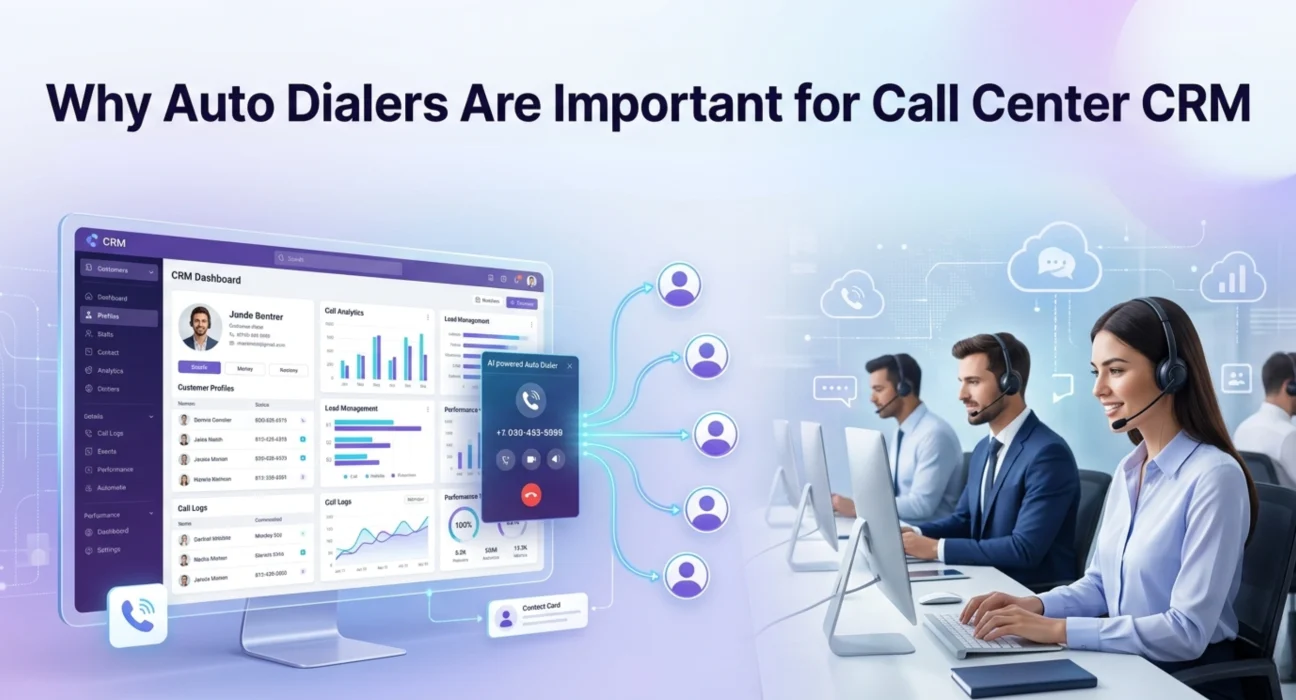
Now imagine your auto dialer pulling directly from that CRM. Instead of agents working from a random spreadsheet, they are calling the right people at the right time, with full context right in front of them before the call even connects.
That is the real power of combining an auto dialer for call centers with your CRM.
Why Auto Dialers Matter for Call Centre CRM
1. Agents Spend More Time Talking, Less Time Dialing
Studies in the call center industry consistently show that without automation, agents spend nearly 40 to 50 percent of their time on non-talk activities dialing, waiting, redialing. An auto dialer cuts that down significantly.
More talk time means more leads followed up, more customers helped, more sales closed. It is that straightforward.
2. Customer Data Is Always Right There
When the CRM and auto dialer work together, the moment a call connects, the agent can already see who they are talking to. The customer’s name, their last interaction, any notes from a previous agent, what product they bought all of it is visible on screen.
This removes the awkward “can you tell me your account number again” moment that customers hate. It also means agents can personalize the conversation from the very first second.
3. No Lead Falls Through the Cracks
Without a system, it is easy for follow-ups to get missed. An agent means to call someone back tomorrow, writes it on a sticky note, and it gets lost. Or two agents accidentally call the same customer on the same day.
With a CRM-integrated auto dialer, every lead has a status, every callback is scheduled, and the system ensures the right person gets called at the right time. Nothing slips through.
4. Managers Get Real Visibility
One of the biggest challenges for call center managers is knowing what is actually happening on the floor. How many calls went out today? How many connected? What is the average call duration? Which agents are performing well?
When your auto dialer for call centers feeds data back into your CRM, you get a live dashboard with all of this. No more guessing, no more chasing agents for reports. The data is there, clean and ready.
5. Compliance Becomes Easier to Handle
In India and globally, there are regulations around outbound calling do not call lists, calling hour restrictions, consent requirements. If your agents are dialing manually, it is very hard to enforce compliance at scale.
An integrated system can automatically skip numbers on the DNC list, restrict calls outside permitted hours, and maintain logs of every call made. This protects the business and keeps things above board.
6. The Customer Experience Actually Improves
This one surprises people. Auto dialers are often seen as cold and impersonal robots blasting calls at customers. But a well set up CRM integration does the opposite.
Because agents have full context before speaking, because follow-ups happen on time, because the customer is not being called five times about the same thing the experience feels more thoughtful, not less.
A Real World Example
Say you run an insurance company’s renewal team. You have 10,000 policies coming up for renewal next month. Without automation, your agents would spend half their day dialing numbers, many of which are wrong, inactive, or already renewed.
With an auto dialer for call centers connected to your CRM, the system filters out already renewed policies, skips inactive numbers, and only connects agents to live calls. Your team makes more meaningful conversations in a day than they used to make in a week.
Common Concerns People Have
“Will it feel too robotic to customers?”
Only if it is set up poorly. A good integration means the agent knows exactly who they are talking to. The automation handles the dialing; the human handles the conversation.
“Is it expensive to set up?”
Cloud-based options today are much more affordable than they used to be. Many CRM platforms have built-in dialer integrations or partner with dialer providers. The ROI in terms of agent productivity usually pays for it quickly.
“What about smaller teams?”
Even a team of 10 agents benefits. Fewer missed follow-ups, better data hygiene, and more organized workflows make a real difference even at smaller scale.
What to Look for When Choosing One
Not all auto dialers are built the same. Here is what actually matters when picking one for your call centre CRM setup:
- CRM compatibility – Does it natively integrate with your existing CRM, or will you need custom work?
- Dialer type – Predictive dialers work best for high-volume outbound. Preview dialers are better for complex B2B sales where agents need context first.
- Call recording and logging – Every call should be automatically logged in the CRM without agents having to do it manually.
- Reporting – You need clean, actionable reports. Not just call counts, but connection rates, drop rates, and outcome data.
- Compliance features – DNC list support and call time restrictions are non negotiable.
Conclusion
Auto dialers and CRM systems are two things that were always meant to work together. Separately, they both add value. Together, they transform how a call center operates agents are more productive, managers have better visibility, customers have a smoother experience, and the business grows faster.
If your team is still dialing manually or working with a dialer that does not connect to your CRM, it is worth taking a serious look at the gap that is costing you every single day.
Investing in the right auto dialer for call centers is not just a tech upgrade it is a decision that directly impacts your team’s efficiency, your customer relationships, and ultimately your bottom line.