


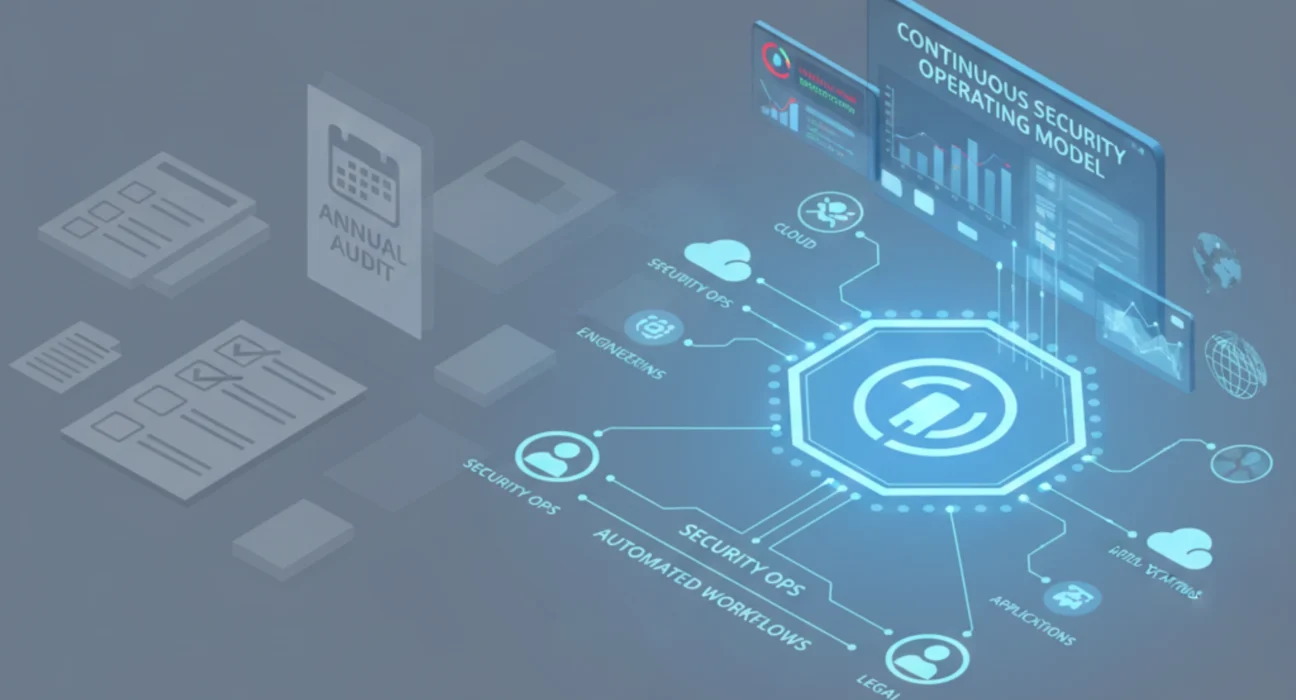
Most enterprises approach security the same way they approach compliance. They identify requirements, implement controls, document everything, and consider the work complete. A year later, they repeat the process during the next audit cycle. This checklist mentality works in stable environments where threats evolve slowly and systems remain unchanged. Neither of those conditions applies to modern enterprises.
Security at scale is not a project with a finish line. It is an operating model that runs continuously alongside the business. When enterprises treat security as a checklist, they create the illusion of protection while leaving gaps that only become visible after incidents occur. The real challenge is not implementing security controls. The challenge is maintaining them across changing systems, evolving threats, and growing organizational complexity.
Why Checklist Security Fails at Enterprise Scale
Checklist security assumes that implementing controls once is sufficient. Install firewalls, enforce password policies, train employees, document procedures, and move on. This approach works in small organizations where a single team can oversee all systems and everyone knows what security measures are in place.
At enterprise scale, this breaks down quickly. Systems change constantly. New applications get deployed. Cloud infrastructure expands. Third-party integrations multiply. Each change can affect security posture, but checklist security provides no mechanism for detecting or responding to these changes. Controls that were adequate six months ago may no longer be effective today.
The volume of systems creates blind spots. A large enterprise might operate thousands of applications across multiple cloud platforms, on-premises data centers, and hybrid environments. No single team has visibility into all of them. Different business units make their own technology decisions. Product teams move fast and sometimes bypass central security reviews. By the time security teams discover what has been deployed, systems are already in production serving customers.
Threat landscapes shift faster than annual review cycles. Attackers adapt their methods continuously. New vulnerabilities emerge. Supply chain risks increase. A security control that was considered best practice last year might be inadequate against current threats. Checklist security provides no way to respond to these changes between review cycles. Organizations remain protected against yesterday’s threats while being exposed to today’s.
The real problem is that checklist security optimizes for compliance, not for actual risk reduction. Teams focus on demonstrating that controls exist rather than ensuring those controls remain effective. Documentation becomes more important than outcomes. When auditors ask for evidence, teams can produce it. But evidence of implementation does not equal evidence of effectiveness.
What an Operating Model Approach Changes
Treating security as an operating model means embedding it into how work gets done rather than treating it as a separate activity. This changes everything about how security functions in an enterprise.
First, it makes security continuous rather than periodic. Instead of annual reviews, security monitoring happens constantly. Changes to systems trigger automatic assessments. New threats are evaluated as they emerge. Controls are tested regularly, not just before audits. This does not mean more manual work. It means building systems that provide ongoing visibility and enable rapid response.
Second, it distributes responsibility across the organization. Security cannot be the sole responsibility of a central team at enterprise scale. Product teams, infrastructure teams, and business units must own security for their domains. The central security organization provides frameworks, standards, and support, but execution happens locally. This requires clear ownership, standardized processes, and coordinated governance.
Third, it prioritizes effectiveness over documentation. An operating model focuses on whether controls actually reduce risk, not just whether they exist. This means testing controls under realistic conditions, measuring their impact, and adjusting them based on results. Documentation still matters, but it supports decision-making rather than serving as the primary objective.
Fourth, it treats security as integrated with business operations. Security decisions cannot be made in isolation from business context. A control that is technically sound might be operationally impractical. A risk that seems acceptable to security teams might be unacceptable to business leaders. An operating model ensures that security and business considerations are weighed together, with clear processes for making trade-offs when necessary.
This shift requires changes to people, processes, and technology. Teams need different skills. Instead of focusing primarily on policy and compliance, they need operational expertise in threat detection, incident response, and security engineering. Processes must support continuous improvement rather than periodic assessment. Technology must provide real-time visibility and enable automated responses at scale.
The Operational Challenges Enterprises Face
Moving from checklist security to an operating model is not a simple transition. Enterprises face significant operational challenges that cannot be solved with technology alone.
The first challenge is coordination across distributed teams. When security responsibility is distributed, consistency becomes difficult. Different teams may interpret standards differently. Some may prioritize security while others focus on speed. Without clear governance and shared tooling, the organization ends up with fragmented security postures that vary by business unit, product, or region.
The second challenge is maintaining visibility. Centralized security teams need to see what is happening across the enterprise without creating bottlenecks. This requires instrumentation, monitoring, and reporting systems that work across diverse technology stacks. Many enterprises have gaps in visibility simply because different parts of the organization use incompatible tools or do not share information effectively.
The third challenge is responding at speed. When security issues are identified, they need to be addressed quickly. But in large organizations, response often requires coordination between multiple teams, approvals from various stakeholders, and changes to systems that are owned by different groups. By the time everyone aligns, windows of vulnerability remain open far longer than necessary.
The fourth challenge is measuring effectiveness. Enterprises can easily measure whether controls exist. Measuring whether those controls actually prevent breaches or reduce risk is much harder. This requires realistic testing, analysis of near-miss incidents, and comparison against actual attack patterns. Most organizations lack the data and analytical capabilities to do this well.
These challenges explain why many enterprises continue using checklist approaches despite knowing they are inadequate. The operational complexity of doing security differently seems overwhelming. Teams worry that moving to an operating model will slow down the business or create unmanageable overhead. These concerns are valid, but they reflect implementation challenges, not fundamental problems with the approach.
How Ozrit Builds Security Operating Models for Enterprises
Ozrit works with enterprises that recognize checklist security is insufficient but need structured execution to build something better. These organizations have security teams, existing controls, and governance processes. What they lack is an operational framework that scales and senior expertise to lead the transition.
The approach starts with senior team involvement from day one. Building a security operating model requires decisions about governance, ownership, and trade-offs that cannot be delegated to junior resources. Ozrit’s senior team takes direct ownership of enterprise engagements, working with C-suite and security leadership to design operating models that fit the organization’s structure, risk appetite, and business objectives.
Onboarding focuses on understanding the current state before making changes. Ozrit assesses existing controls, identifies gaps in visibility, and maps how security work actually happens across the organization. This discovery phase uncovers where checklist approaches have created risk, where teams lack clarity on ownership, and where operational processes need strengthening. It also establishes realistic timelines based on the organization’s capacity for change.
Delivery happens in phases that build capability progressively. Ozrit does not try to transform security operations overnight. The first phase typically focuses on establishing visibility and governance. This means implementing monitoring that covers critical systems, creating clear ownership across distributed teams, and standardizing how security work gets tracked and reported. Once visibility exists, the next phase focuses on automation and response capabilities. This includes building workflows that enable rapid response, automating routine security tasks, and integrating security checks into existing development and deployment processes.
Throughout implementation, Ozrit maintains 24/7 support because security issues do not wait for business hours. When incidents occur, when new vulnerabilities emerge, or when questions arise about security decisions, enterprises need immediate access to expertise. This support model ensures that the operating model remains functional even as the organization learns to operate it.
The result is a security posture that adapts with the business. When new systems are deployed, security assessments happen automatically. When threats evolve, controls are updated without waiting for the next review cycle. When incidents occur, response happens quickly because processes and ownership are clear. And when auditors arrive, evidence exists because security work is documented as part of normal operations, not prepared specifically for audits.
Security as a Business Enabler
Enterprises that run security as an operating model gain advantages beyond risk reduction. They move faster because security does not create bottlenecks. They make better decisions because they have real-time visibility into security posture. And they spend less time on audit preparation because evidence exists continuously rather than being compiled annually.
More importantly, they can take on business opportunities that would otherwise be too risky. Launching products in new markets, acquiring companies, or adopting new technologies all introduce security risk. Organizations with strong security operating models can assess and manage these risks quickly, while those relying on checklist approaches must slow down or accept exposure.
The transition from checklist security to an operating model requires investment, but the cost of not making this change is higher. Every enterprise will eventually face a security incident that exposes gaps in their defenses. The question is whether those gaps exist because threats were unforeseeable or because the organization was operating with security approaches that were never designed to handle enterprise complexity at scale. Leadership teams that address this proactively control their own timeline and avoid learning these lessons under the worst possible circumstances.