

Large enterprise programs fail more often than most boards realise. Not catastrophically, but quietly. They drift past deadlines, budgets stretch, and scope becomes a moving target. By the time leadership recognises the problem, recovery costs have multiplied and business impact is already measurable.
The challenge is not that warning signs are absent. They are present, sometimes months before a program becomes formally distressed. The issue is that these signals are either misread, dismissed as temporary friction, or hidden beneath layers of reporting that reassure rather than inform.
The Gap Between Reporting and Reality
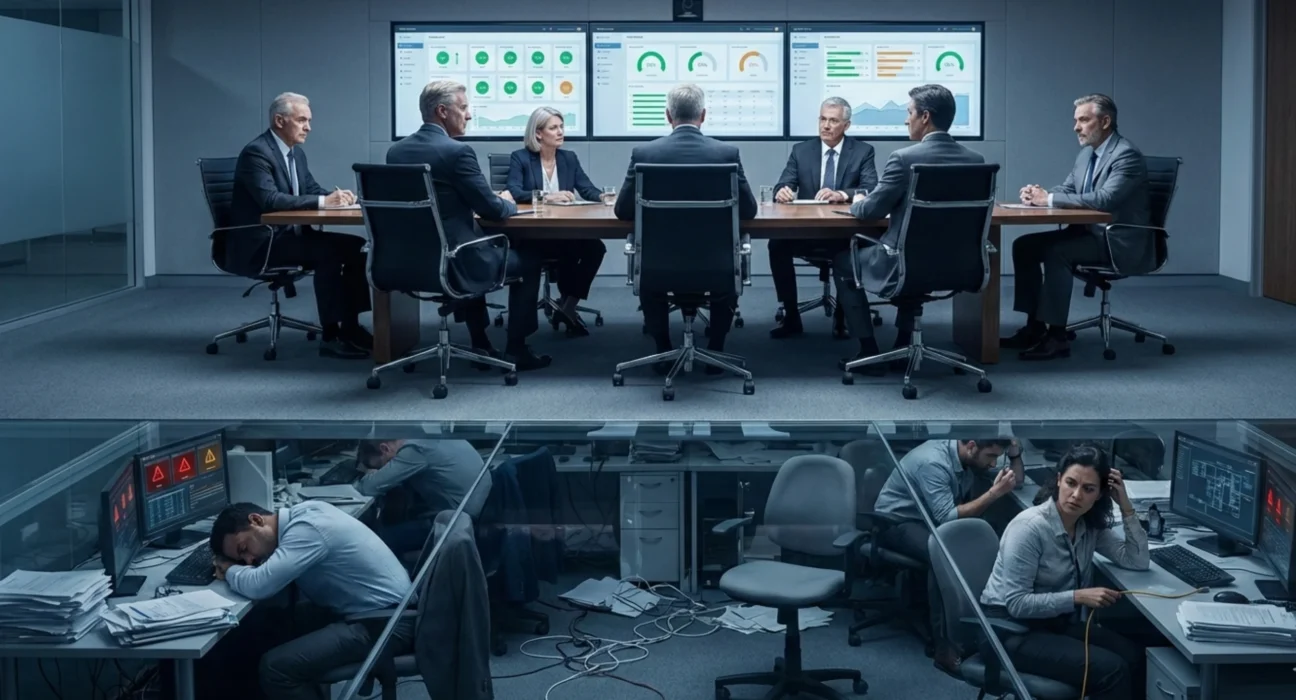
Most enterprise programs operate with structured governance. There are steering committees, status reports, RAG ratings, and milestone reviews. On paper, everything looks managed. Leaders see green and amber statuses, hear about minor delays being addressed, and receive assurances that teams are working through challenges.
What they do not see is the pattern. A vendor missing three minor milestones in a row is reported as isolated incidents. A key technical decision deferred twice becomes “under review.” A contractor departure is noted but not connected to two others who left the previous quarter. None of these alone triggers alarm. Together, they indicate a program losing structural integrity.
The problem is amplified by the way large programs are reported upward. Program managers face pressure to show control. Escalating problems early can be perceived as weakness or poor leadership. So issues are managed locally until they cannot be contained. By the time a problem reaches executive level, it has often crossed from recoverable to critical.
This is not about dishonesty. It is about incentive structures that reward optimism and penalise early escalation. In organisations where messengers are questioned more harshly than the issues they raise, silence becomes rational behaviour.
Structural Warning Signs That Precede Failure
Certain patterns appear consistently in programs that later require intervention. These are not technical failures or resourcing gaps. They are structural weaknesses that erode delivery capability over time.
One common pattern is decision latency. When key decisions take weeks instead of days, or when the same issue is discussed across multiple meetings without resolution, the program is losing momentum. This is rarely about complexity. It is about unclear ownership, conflicting priorities, or governance structures that diffuse accountability.
Another signal is dependency accumulation. Programs naturally have dependencies, but when unresolved dependencies begin stacking faster than they are cleared, the program is creating its own gridlock. Teams wait for other teams. Vendors wait for internal approvals. Testing waits for environments. Each delay is explainable individually. Collectively, they indicate that coordination has broken down.
A third indicator is scope creep disguised as clarification. Requirements are “refined” in ways that expand effort. Features are added because they seem small. Business stakeholders request adjustments that feel reasonable in isolation but accumulate into significant rework. When scope is changing faster than delivery, the program is not in control.
Then there is talent drain. Experienced people leaving a program is normal over long timelines. But when multiple senior contributors exit within a short period, especially if they move to other internal programs or cite similar reasons, that is a signal. Good people leave programs that feel unmanageable, poorly led, or destined to fail. Their departure is not random.
Why Scale Amplifies These Problems
Small programs can recover from these issues through informal coordination and direct communication. Large enterprise programs cannot. Scale introduces layers, handoffs, and coordination costs that turn small problems into systemic ones.
When a program involves multiple vendors, offshore teams, internal departments, and third-party integrations, there is no single point of control. Information flows through reporting layers. Decisions require alignment across stakeholders with competing priorities. A simple change can trigger impact assessments across six workstreams and three vendor contracts.
In this environment, problems that would be visible and fixable in smaller settings become obscured. A technical issue in one workstream might not surface in governance until it blocks another team weeks later. A resourcing gap in an offshore team might be reported as resolved when a replacement is hired, but the replacement lacks context and requires months to become effective.
This is where many leadership teams underestimate the nature of enterprise program risk. They see the individual components as manageable. What they miss is that the real risk is not in the components but in the coordination complexity between them. A program can have strong technical teams, adequate budget, and clear requirements, and still fail because the integration and coordination layer is fragile.
The Cost of Late Intervention
Most program rescues begin after the damage is visible. Budgets are overspent. Deadlines are missed. Stakeholder confidence is eroded. At this stage, recovery is possible but expensive.
The first cost is diagnostic. Before a rescue can begin, someone must determine what actually happened. This requires going beneath the reporting layer to understand real status, actual dependencies, and true capability of the delivery teams. It often reveals that formal reports were weeks or months behind reality.
The second cost is organisational. Rescue requires changing structures, accountabilities, and sometimes people. This creates disruption in programs that are already strained. Vendor contracts may need renegotiation. Teams may need restructuring. Governance may need simplification. Each of these carries cost and delay.
The third cost is opportunity. Time spent recovering a distressed program is time not spent delivering value. Features are delayed. Business benefits are deferred. In competitive markets, this delay has real consequences.
The hardest cost to quantify is credibility. When a major program is visibly rescued, it signals to the organisation that something went wrong. Even if recovery is successful, stakeholder confidence takes time to rebuild. Future programs face more scrutiny. Approval processes become more conservative.
A Different Approach to Enterprise Program Delivery
This is where Ozrit’s model differs from traditional enterprise delivery. We do not wait for programs to reach distress before applying structure and accountability. We build them into the engagement from the start.
When Ozrit takes on an enterprise program, senior involvement is not ceremonial. Directors and senior architects work directly on delivery. They do not hand off to junior teams after the first few weeks. This ensures that decisions are made by people with authority and experience, and that quality does not degrade over the program lifecycle.
Ownership is explicit. Every deliverable, every milestone, every dependency has a named owner. Not a team, not a role, but a person. This eliminates the diffusion of accountability that allows issues to fester. When something is delayed, there is no ambiguity about who is responsible for resolution.
Our onboarding process is designed to reduce delivery risk before work begins. We do not treat onboarding as a formality. We map dependencies, validate technical assumptions, confirm access and environments, and ensure alignment on scope and success criteria. This is done in the first two weeks, not discovered six weeks into delivery. It prevents the common pattern where teams start building before they fully understand what they are building or what they need to build it.
We staff with capacity for complexity. Enterprise programs are not predictable. Requirements clarify during delivery. Dependencies surface late. Integration challenges appear during testing. Teams that are staffed to theoretical efficiency have no margin for reality. We build in slack so that when these things happen, they do not become crises.
Our delivery model assumes that things will go wrong and plans for it. Not pessimistically, but practically. We identify risks early, create mitigation plans, and monitor them actively. When issues arise, they are escalated immediately, not after they have compounded. This is possible because we do not penalise early escalation. We expect it.
Support is structured as part of delivery, not as an afterthought. Enterprise systems do not end at go-live. They require ongoing maintenance, incident response, and optimization. We provide 24/7 support as a standard component of enterprise engagements because we know that downtime in production systems has material business impact. Our support teams have access to the same senior engineers who built the system, which means faster resolution and fewer escalations.
This approach is not faster or cheaper than traditional delivery models in the short term. It is more reliable. And in enterprise contexts, reliability has higher value than speed. A program that delivers six months later than planned but delivers what was promised is preferable to one that delivers on time but requires six months of rework.
What Leaders Should Watch For
If you are overseeing a large enterprise program, the warning signs to monitor are not in the status reports. They are in the patterns beneath them.
Watch decision velocity. Are key decisions being made promptly, or are they being discussed repeatedly without resolution? If the same issues appear in governance meetings across multiple months, something is broken in the decision-making structure.
Watch dependency clearance rates. Are dependencies being resolved faster than new ones are being identified? If your dependency log is growing week over week, coordination is failing.
Watch talent stability. Are experienced people leaving the program? If yes, find out why. Exit interviews are less useful than conversations with people who have chosen to leave. They will tell you what is actually wrong.
Watch scope against delivery. Is the backlog shrinking or growing? If features are being added faster than they are being completed, the program is not converging on an end state.
Most importantly, watch whether bad news reaches you quickly. If you only hear about problems after they have become critical, your reporting structure is filtering rather than informing. That is a governance failure, not a delivery failure.
Enterprise programs succeed when problems are visible early and addressed structurally. They fail when warning signs are ignored, dismissed, or hidden until intervention becomes rescue. The difference between the two is not luck. It is leadership willingness to look past the reporting layer and see the program as it actually is.