

Most enterprise transformation programs don’t fail because of technology. They fail because of execution.
If you’re a C-level executive who has sat through multiple transformation initiatives, you already know this. The PowerPoint decks look perfect. The vendor promises sound convincing. The business case gets approved. Then six months in, you’re managing scope creep, cost overruns, and a team that’s struggling to deliver even the first milestone.
This isn’t about picking the wrong technology stack. It’s about picking the wrong delivery approach and more often, the wrong partner who doesn’t understand what enterprise-scale execution actually demands.
Let’s talk about what really works when you’re running large-scale programs across geographies, legacy systems, compliance frameworks, and dozens of stakeholders who all have different priorities.
Why Most Global Delivery Models Break Down at Enterprise Scale
The typical offshore or distributed delivery model works well for startups and mid-sized companies with straightforward requirements. But enterprises operate in a different reality altogether.
You’re not building a single product. You’re orchestrating multiple workstreams across ERP systems, customer-facing platforms, data migration, compliance updates, and integration with decades-old legacy infrastructure. You have stakeholders across business units, geographies, and reporting lines. And you need everything to work without disrupting operations that generate millions in revenue every day.
Here’s where most delivery models collapse:
Accountability becomes diffused. When you have multiple vendors, offshore teams, and internal stakeholders, it becomes nearly impossible to pinpoint who owns what. Everyone is responsible, which means no one is accountable. When timelines slip or quality suffers, you spend more time in blame-shifting meetings than actually solving problems.
Governance turns into overhead. Large programs need structure, but many delivery partners respond by adding layers of process that slow everything down. You end up with weekly status meetings, fortnightly steering committees, and monthly governance reviews, none of which actually move the program forward.
Communication gaps multiply. Distributed teams across time zones sound efficient on paper. In reality, critical decisions get delayed, requirements get misunderstood, and technical debt accumulates because no one has the full picture. The offshore team builds what they think you need. Your internal team discovers the gap three months later.
Risk management becomes reactive. Most delivery models don’t identify risks early enough. By the time a vendor flags an integration issue or a compliance gap, you’ve already burned through budget and timeline. Then you’re making compromised decisions under pressure instead of addressing root causes.
These aren’t one-off problems. They’re systemic issues that show up in almost every large enterprise program unless you consciously design your delivery model to prevent them.
What Enterprise-Scale Delivery Actually Requires
If you’ve managed enough transformation programs, you know that success comes down to a few non-negotiable principles. Technology matters, but execution discipline matters more.
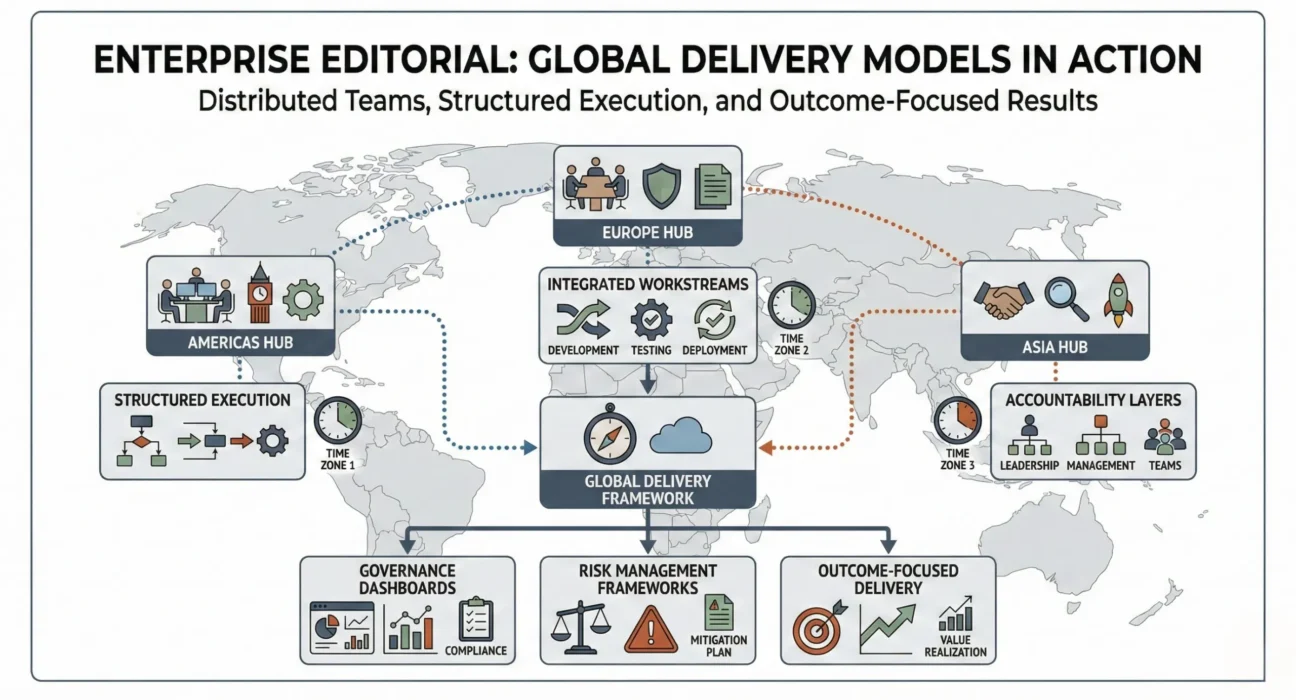
Single-threaded ownership at every level. Someone needs to wake up every morning thinking about their program and nothing else. Not a vendor juggling ten clients. Not an internal team splitting time between BAU and transformation. You need a delivery partner who assigns dedicated leadership to your program and holds them accountable for outcomes, not just activities.
Integrated teams, not siloed vendors. The best delivery models don’t treat your internal team and external partners as separate entities. They build integrated squads where business analysts, architects, developers, and testers work as one unit. This eliminates handoff delays and ensures everyone understands the context behind every decision.
Governance that enables, not restricts. Good governance isn’t about adding checkpoints. It’s about creating visibility and fast decision-making. You need real-time dashboards that show actual progress, not vanity metrics. You need escalation paths that resolve blockers in hours, not weeks. And you need a governance structure light enough that teams spend more time delivering than reporting.
Proactive risk management. The difference between a program that delivers on time and one that spirals out of control often comes down to how early you spot risks. Mature delivery partners don’t wait for problems to surface. They run parallel workstreams to validate assumptions, build proofs of concept for high-risk integrations, and stress-test architecture decisions before committing to full-scale development.
Deep understanding of enterprise context. This is where most vendors fall short. They know how to write code, but they don’t understand procurement cycles, compliance requirements, change management across large organizations, or how to work within the constraints of legacy systems that can’t be replaced. Enterprise delivery requires people who have lived through these challenges, not just read about them.
How to Choose a Delivery Partner That Gets Enterprise Realities
Choosing the right partner for large-scale programs is one of the hardest decisions you’ll make. The stakes are high, and the evaluation process is rarely straightforward.
Here’s what to look for beyond the standard RFP criteria:
Ask about their governance model in detail. Don’t settle for generic answers about “agile methodology” or “weekly standups.” Dig into how they handle scope changes, who makes architecture decisions, how they escalate risks, and what happens when timelines are at risk. If they can’t describe their governance model clearly, they probably don’t have one that works at scale.
Understand their team structure. Will you get dedicated resources or shared capacity? Who is the single point of accountability? How do they handle knowledge transfer if key people leave? The best partners assign senior delivery leaders who stay with your program from start to finish, not just during the sales cycle.
Evaluate their approach to legacy systems. Most enterprises have decades-old infrastructure that can’t be ripped out. Ask how they’ve handled similar situations before. Do they have experience with phased migrations, parallel run strategies, and maintaining uptime during transitions? If their only answer is “rebuild everything from scratch,” they don’t understand enterprise constraints.
Look for evidence of long-term thinking. Mature delivery partners don’t just focus on launch day. They think about what happens six months, one year, three years after go-live. How will the system scale? How will your internal team take over operations? What does the support and enhancement model look like? These questions separate partners who care about sustainable success from those chasing short-term revenue.
Check their approach to risk. Ask for examples of programs where things went wrong and how they recovered. Every large program hits obstacles. What matters is how quickly they identify issues, how transparently they communicate them, and how effectively they course-correct. If a vendor claims they’ve never had a program go off track, they’re either lying or haven’t done enough complex work.
This is where partners like Ozrit stand out. Companies that have built their reputation on enterprise program execution understand that delivery maturity isn’t just about technical capability, it’s about navigating organizational complexity, managing stakeholder expectations, and maintaining accountability when things get difficult.
The Role of Leadership in Making Delivery Models Work
Even the best delivery model will fail without strong leadership on both sides, yours and your partner’s.
As a C-level executive, your role isn’t to manage day-to-day execution. It’s to set clear priorities, remove organizational blockers, and ensure alignment across business units. When transformation programs stall, it’s often because internal politics or conflicting priorities prevent teams from making progress.
You need to create an environment where your delivery partner can succeed. That means:
Empowering decision-makers. If every technical decision needs three layers of approval, you’ll never move fast enough. Delegate authority to people who understand the details and trust them to escalate when necessary.
Protecting the program from scope creep. Every business unit will want additional features. Every stakeholder will have “one small request.” Your job is to hold the line on scope and ensure the program delivers its core objectives before adding nice-to-haves.
Being honest about constraints. If your organization has budget limits, regulatory requirements, or legacy dependencies that will impact the program, surface them early. Delivery partners can work around constraints if they know about them upfront. They can’t tell if they discover them mid-execution.
On the partner side, you need leadership that takes ownership seriously. Not people who point to contracts when things go wrong, but people who treat your program’s success as their success. Look for delivery leaders who speak in terms of outcomes, not just deliverables and who are willing to have difficult conversations when course correction is needed.
What Success Actually Looks Like in Enterprise Programs
Successful enterprise transformation isn’t marked by a big launch event. It’s measured by whether the system is still running smoothly six months later, whether your internal team can manage it independently, and whether the business outcomes you targeted are being achieved.
Here’s what good execution delivers:
Predictable timelines. Not perfect adherence to the original plan, enterprise programs are too complex for that, but early identification of delays and transparent communication about revised timelines. You’re never blindsided by schedule slips because your delivery partner flags risks weeks before they impact milestones.
Controlled costs. Budget overruns happen when scope changes or technical complexity is underestimated. Mature delivery models prevent this through rigorous discovery, phased delivery, and clear change control processes. You know what you’re paying for and why.
Quality that lasts. The system doesn’t just work on launch day. It handles production load, integrates cleanly with other systems, and can be enhanced without major rework. This comes from architectural discipline and code quality standards that don’t get compromised under deadline pressure.
Knowledge transfer that sticks. Your internal team isn’t dependent on external consultants forever. They understand the system architecture, can troubleshoot issues independently, and have documentation that’s actually useful. Good delivery partners treat knowledge transfer as a core deliverable, not an afterthought.
Sustainable operations. The program sets you up for long-term success, not just short-term wins. You have monitoring in place, support processes defined, and a clear roadmap for future enhancements. The system becomes an asset, not a liability.
Moving Forward: Execution Over Everything
Technology will continue to evolve. Cloud platforms, AI capabilities, and development frameworks will keep changing. But the fundamentals of enterprise delivery won’t.
What separates successful transformation programs from failed ones isn’t access to cutting-edge technology. It’s execution discipline, accountability, and a delivery partner who understands that enterprise programs are won or lost in the details.
If you’re evaluating delivery models or partners for your next large-scale initiative, focus less on the technology stack and more on the delivery maturity. Ask hard questions about governance, risk management, and how they’ve handled complex programs before.
Look for partners like Ozrit who have built their reputation on enterprise execution, not just development capability. Partners who understand that your success is measured not by lines of code delivered, but by business outcomes achieved and sustained over time.
The right delivery model, backed by the right partner and strong executive leadership, turns transformation programs from high-risk gambles into predictable, successful outcomes.
That’s what actually works at enterprise scale.