


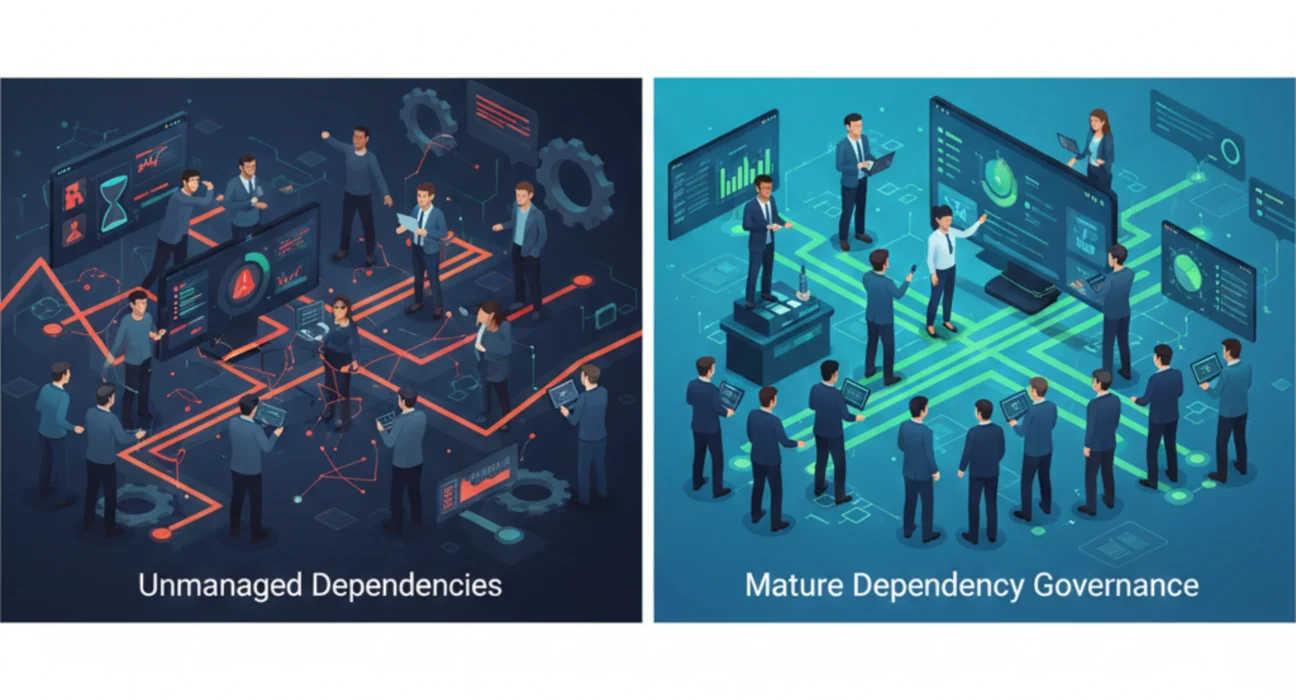
Every CTO knows the feeling. You’re three months into a major digital transformation. The roadmap looked solid. The vendors seemed capable. The business case was approved. But now, Team A is waiting on Team B. Team B says they never received the API specs. The offshore team is blocked because the legacy system owner is on leave. And the go-live date you committed to the board? It’s starting to look optimistic.
This isn’t a technology problem. It’s a dependency problem.
In large enterprises, especially those operating across multiple locations in India and globally, dependencies are where timelines go to die. They’re also where cost overruns begin, where quality suffers, and where accountability becomes a blame game instead of a delivery rhythm.
The question isn’t whether you’ll have dependencies. In any program touching multiple teams, geographies, systems, or vendors, dependencies are inevitable. The real question is: do you have a mature way of managing them?
Why Dependencies Become Critical Issues in Enterprise Programs
Small teams can coordinate over lunch. Large, distributed engineering organizations cannot.
When you’re running a program with 15 teams across Bangalore, Pune, Hyderabad, and perhaps a couple of global delivery centres, the surface area for failure expands dramatically. A delayed API integration doesn’t just affect one sprint. It cascades. The mobile team stalls. The testing cycle shifts. The compliance review gets pushed. Suddenly, a two-week delay becomes two months.
Most enterprise leaders underestimate this ripple effect. They see dependencies as line items in a project plan. But dependencies are actually commitments between people, teams, and organizations. And commitments, unlike tasks, require trust, clarity, and continuous communication.
What makes this harder in Indian enterprises is the typical operating model. You often have:
- Core teams managed internally
- One or more outsourced vendors handling specific modules
- A legacy system team that operates separately, sometimes in a different business unit
- Cloud or infrastructure managed by yet another group
- Business stakeholders who control access to critical data or approvals
Each handoff is a dependency. Each dependency is a risk.
What Actually Goes Wrong
Let’s be specific about what breaks.
Unclear ownership. Team A thinks Team B is building the integration layer. Team B assumes it’s Team A’s job. Three weeks later, someone realizes nothing has started. There’s no RACI matrix that actually works, or if there is one, it was created in a workshop six months ago and hasn’t been updated since.
Siloed communication. The vendor sends updates in their weekly report. The internal team uses Jira. The infrastructure team prefers email. The business unit has their own tracker. Nobody has a single source of truth, so nobody knows what’s actually blocking what.
Hidden assumptions. One team assumes the data migration will be complete before UAT begins. Another team assumes UAT will help validate what needs to be migrated. Both assumptions are wrong, but no one surfaced them early enough.
Lack of escalation paths. When a dependency is at risk, there’s no clear way to escalate. Middle management tries to solve it locally. By the time it reaches senior leadership, the delay is baked in.
Asynchronous execution across time zones. If your teams span India, Europe, and the US, a clarification that takes five minutes in a room can take two days over email. Multiply that across dozens of dependencies, and you’ve added weeks to your program.
The common thread? These aren’t technical failures. They’re execution and governance failures.
What Mature Dependency Management Actually Looks Like
Successful enterprise programs don’t avoid dependencies. They make them visible, manageable, and resolvable.
Here’s what that means in practice.
You have a living dependency map, not a static document. This isn’t a Gantt chart printed for a steering committee. It’s a real-time view of what each team needs from whom, by when, and what’s at risk. It gets updated at least weekly. It’s accessible to everyone who needs it.
Ownership is explicit and non-negotiable. Every dependency has a clear owner on both sides. The provider knows they’re on the hook. The consumer knows who to follow up with. If there’s ambiguity, it gets resolved immediately, not in the next retrospective.
You run dependency reviews, not just status meetings. Status meetings report what happened. Dependency reviews focus on what’s coming and what might break. They’re forward-looking. They ask: what do you need next week? What could block you? Who hasn’t responded?
Escalation is built into the process. If a dependency is red for more than 48 hours, it automatically surfaces to program leadership. Not to assign blame, but to unblock. This requires psychological safety and a culture that values delivery over optics.
You design around dependencies where possible. Mature teams don’t just manage dependencies; they architect to minimize them. Can this module be decoupled? Can we deliver this feature independently? Can we use a temporary stub while we wait for the real integration? These questions get asked early, not after the dependency becomes critical.
Vendors are managed as partners, not outsourced risks. If you’ve outsourced significant portions of delivery, you can’t manage those vendors as black boxes. You need embed points. You need shared tooling. You need their dependencies visible in your overall map. Many Indian enterprises treat vendor management as a procurement function. In reality, it’s a delivery function.
This is where partners like Ozrit come in. Companies that understand enterprise program execution don’t just build software, they help you manage the connective tissue between teams, vendors, and systems. They understand that delivery maturity isn’t about velocity in isolation; it’s about coordinated velocity across a complex system.
The Governance Layer: Where Leadership Makes the Difference
Technology teams can build great dependency tracking tools. But tools don’t resolve dependencies. People do. And that requires leadership.
At the executive level, your role isn’t to manage every dependency. It’s to create the conditions where dependencies can be managed effectively.
That means:
Empowering program managers with real authority. If your program manager can’t make a call that affects two teams under different VPs, they’re not really managing the program. Dependency management requires decision rights, not just coordination duties.
Aligning incentives across teams. If Team A’s bonus depends on their module shipping on time, but Team B isn’t measured on how well they support Team A, you’ve built a conflict. Enterprise incentive structures often reward local optimization at the expense of program success.
Investing in integration and DevOps maturity. Dependencies hurt most when integration is manual, fragile, and late. If you’re still doing “integration testing” as a phase that happens three weeks before go-live, you’re courting disaster. Continuous integration, automated testing, and early integration reduce dependency risk dramatically.
Being honest about capacity and priorities. Many dependency failures stem from over-commitment. Teams say yes because they don’t want to disappoint. But if Team B is already at 100% capacity, adding one more commitment means something else will slip. Better to surface that constraint early than discover it when it’s too late.
Creating a culture where escalation is normal, not failure. In many Indian enterprises, escalating an issue is seen as admitting you couldn’t handle it. That culture kills programs. Escalation should be routine, fast, and blameless.
The Cost of Getting This Wrong
Let’s talk numbers, because that’s what CFOs and CEOs care about.
A six-month delay on a critical digital transformation doesn’t just cost you six months of timeline. It costs you:
- The revenue or efficiency gains you expected to realize in that period
- The cost of keeping extended teams engaged longer than planned
- The opportunity cost of tying up leadership attention and budget
- The credibility cost with your board, your customers, or your market
- The compounding cost of technical debt if you cut corners to recover time
In a large program, a seemingly small dependency issue say, a two-week delay in getting test data—can cascade into a multi-crore impact. Especially if it’s on the critical path. Especially if it affects compliance timelines or regulatory commitments.
Most post-mortems of failed enterprise programs point to scope creep, vendor issues, or changing requirements. But if you dig deeper, the root cause is often unmanaged dependencies. The scope changed because a dependency wasn’t ready. The vendor missed the deadline because they were waiting on you. The requirements shifted because no one clarified the integration assumptions early enough.
Choosing the Right Execution Partner
If you’re embarking on a large-scale transformation, one of the most important decisions you’ll make is who you partner with.
Not every technology partner understands enterprise execution. Many are excellent engineers but lack the program maturity to manage dependencies across a distributed, multi-vendor, legacy-heavy environment.
What should you look for?
Experience with complex delivery, not just development. Can they show you how they’ve managed programs with 10+ teams, multiple vendors, and legacy integration constraints? Do they have a methodology for dependency management, or do they just promise to “stay aligned”?
Transparency and communication discipline. In the early conversations, do they ask hard questions about your current governance, your vendor landscape, your risk areas? Or do they just pitch their technical capabilities?
Willingness to integrate into your ways of working. Some vendors want to impose their process. The best partners adapt. They use your tools if that’s what works. They attend your standups. They surface risks in your language, at your cadence.
Accountability for outcomes, not just outputs. Are they accountable for delivery, or just for completing tasks? If a dependency breaks, will they help solve it even if it’s not technically their code?
This is the difference between a vendor and a partner. At Ozrit, for instance, the approach has always been to treat enterprise programs as joint accountability. If the client’s legacy team is behind, that’s not someone else’s problem it’s a program risk that needs to be surfaced, escalated, and solved together.
Practical Steps You Can Take This Quarter
If you’re reading this as a CTO, CIO, or program sponsor, here’s what you can do in the next 30 days:
Audit your current dependency management. Do you have a real-time view of critical dependencies? If not, start there. Pick your highest-risk program and map its dependencies manually. You’ll learn a lot.
Run a dependency review this week. Don’t wait for the next steering committee. Bring your key teams together and ask: what are you waiting on? What’s blocking you? What do you need by next week?
Clarify ownership. For your top 10 dependencies, write down who owns the provider side and who owns the consumer side. If there’s ambiguity, resolve it now.
Set up an escalation channel. Create a simple way for teams to flag blocked dependencies. It could be a Slack channel, a daily standup slot, or a dedicated program manager inbox. Make it low-friction.
Review your vendor contracts and engagement models. Are your vendors incentivized to collaborate across the program, or just to deliver their slice? If needed, adjust the model to align with program success, not just task completion.
Invest in your integration infrastructure. If integration is still a manual, late-stage activity, prioritize automation and continuous integration. This is one of the highest-ROI investments you can make.
Final Thoughts: Execution Maturity Is a Differentiator
Large enterprises in India and globally are under immense pressure to modernize, digitize, and compete with more agile players. Technology is abundant. Talent is available. Capital is accessible.
What’s scarce is execution maturity.
The ability to deliver complex programs on time, on budget, and with quality isn’t about tools or frameworks. It’s about disciplined dependency management, strong governance, clear ownership, and a culture that values delivery over appearances.
If you’re leading a major transformation, the dependency challenges you’re facing aren’t unique. But how you address them will determine whether your program succeeds or becomes another cautionary tale.
The good news? This is fixable. It requires discipline, transparency, and leadership commitment. But it’s fixable.
And if you’re looking for partners who understand this reality who’ve managed these challenges across industries and geographies there are firms built specifically for this. Partners who bring not just engineering capability, but delivery maturity.
Because in the end, enterprise transformation isn’t won in architecture diagrams or vendor presentations. It’s won in the day-to-day grind of unblocking dependencies, aligning teams, and shipping outcomes.
That’s where the real work happens. And that’s where great companies separate themselves from the rest.