


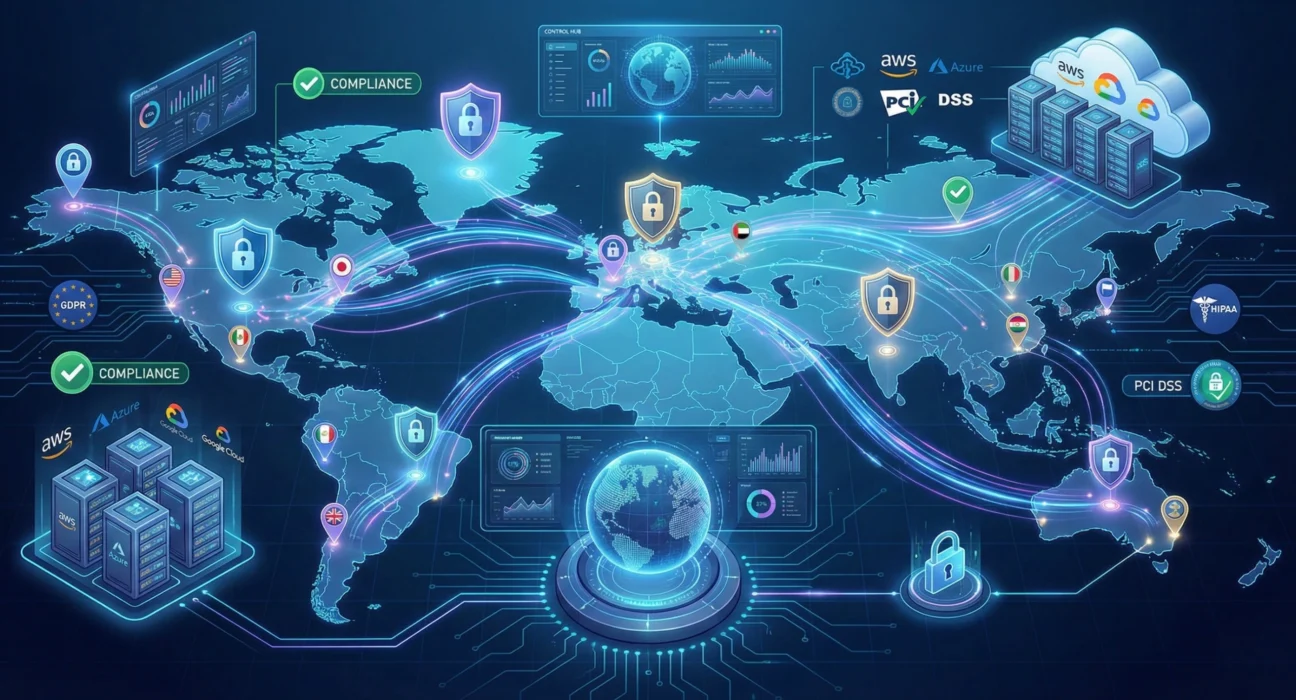
Global enterprises face a problem that did not exist two decades ago: their data crosses borders constantly, yet laws governing that data remain stubbornly local.
An Indian bank processes customer transactions in Mumbai, stores backups in Singapore, uses a CRM hosted in Ireland, and routes customer service requests through a contact centre in the Philippines. At each step, data moves sometimes within milliseconds across regulatory jurisdictions with different privacy laws, different security standards, and different enforcement regimes.
The technology makes this seamless. The law does not.
For C-level executives overseeing enterprise software delivery or large-scale digital transformation, data privacy and security are not just IT concerns. They are business risks that shape what you can build, where you can operate, and how quickly you can scale.
The enterprises that manage this complexity well do not rely on technology alone. They rely on disciplined execution, clear governance, and partners who understand that global data operations are as much about accountability as they are about architecture.
Why Data Privacy Has Become a Strategic Challenge
Data privacy was once a niche concern. A compliance box to tick. A clause in the terms and conditions that legal teams reviewed and everyone else ignored.
That era is over.
India’s Digital Personal Data Protection Act, Europe’s GDPR, California’s CCPA, and China’s Personal Information Protection Law have fundamentally shifted the regulatory landscape. Privacy is no longer optional. It is enforced, audited, and penalised.
For global enterprises, this creates several layers of complexity.
Different laws in different markets. An enterprise operating across India, Europe, and the United States must comply with multiple, sometimes conflicting, regulatory frameworks. What is permissible data processing in one jurisdiction may violate the law in another. There is no single global standard. You must design for the most restrictive requirement or build region-specific implementations.
Data residency and localisation requirements. Many countries now mandate that certain categories of data, such as financial records, health information, and citizen data, must be stored within national borders. This restricts architectural choices. Cloud providers with global infrastructure may not meet these requirements. Enterprises must invest in local data centres, private clouds, or hybrid architectures that isolate regulated data.
Consent is no longer assumed. Privacy regulations increasingly require explicit, informed, granular consent before collecting or processing personal data. Users must understand what data is collected, why, and for how long. They must be able to withdraw consent. Implementing this at scale across millions of customers, dozens of systems, and multiple consent purposes is not a UI challenge. It is a data architecture and governance challenge.
Third-party dependencies multiply risk. Modern enterprise applications rarely operate in isolation. They integrate with payment gateways, marketing platforms, analytics tools, customer support systems, and dozens of other third-party services. Each integration is a data flow. Each data flow is a potential privacy exposure. When a third party mishandles data, your enterprise inherits the liability.
Legacy systems were not built for privacy. Many global enterprises operate systems that are decades old. These systems collect data without a clear purpose, store it indefinitely, and lack granular access controls. They were designed when privacy meant keeping data secure, not limiting what you collect or how long you keep it. Modernising these systems while maintaining operational continuity is one of the hardest challenges in enterprise IT transformation.
What Actually Goes Wrong in Global Data Programs
Large-scale enterprise programs struggle with data privacy and security for predictable reasons. These are not technology failures most of the required technology exists. They are execution failures.
Privacy requirements are discovered too late. Programs often start with functional requirements of what the system should do. Privacy and security requirements are treated as constraints to be validated later. By the time legal or compliance teams review the design, core architectural decisions are locked. Changing data flows, storage locations, or processing logic at that stage means significant rework.
Data governance is poorly defined. In many enterprises, it is unclear who owns data privacy. Is it the Chief Data Officer? The Chief Information Security Officer? The Chief Legal Officer? Business units collect data. IT builds systems. Legal writes policies. When accountability is diffused, no one is truly accountable. Privacy incidents happen, and everyone points elsewhere.
Vendor contracts do not reflect data responsibilities. Enterprises rely heavily on external partners for system development, platform services, and infrastructure. Contracts mention data protection, but rarely with the specificity required. Who is the data controller? Who is the processor? What happens when a data subject requests deletion? What are the vendor’s obligations when regulations change? These questions are answered in crisis, not upfront.
Cross-border data flows are poorly mapped. Many enterprises do not have a complete picture of how data moves across their systems and geographies. Data collected in one country for one purpose gets replicated in another country for a different purpose. Backup processes copy data to cloud regions that the enterprise is barely aware of. Without clear data flow maps, privacy compliance becomes guesswork.
Consent mechanisms are fragmented. Enterprises often implement a consent management system by system, channel by channel. A customer who consents to marketing emails through the website may have a different consent status in the mobile app. Consent given to one business unit is not visible to another. This fragmentation creates compliance risk and poor customer experience.
Incident response is reactive, not planned. Despite best efforts, data breaches and privacy incidents happen. What separates mature enterprises from the rest is preparedness. Most organisations discover their incident response plan is inadequate only when they need it. Notification timelines, escalation procedures, and communication protocols should be tested and refined before an incident, not during one.
The Hidden Costs of Poor Privacy and Security Practices
When data privacy and security are mishandled, the costs are not always immediate. They accumulate.
Regulatory penalties are the obvious risk. GDPR fines can reach 4% of global revenue. India’s data protection law includes significant penalties for non-compliance. But fines are rarely the highest cost.
Operational disruption is often more expensive. A privacy incident that requires halting a system, investigating data flows, and remediating controls can cost far more than any fine. Revenue stops. Customers cannot transact. Partners lose confidence. The cost is measured in business continuity, not just penalty amounts.
Reputation damage is hard to quantify but real. Enterprises that mishandle customer data lose trust. Trust, once lost, takes years to rebuild. Customers switch providers. Partners reconsider relationships. Regulators scrutinise more closely. The long-term impact on brand value and market position can dwarf immediate costs.
Technical debt compounds over time. Privacy and security fixes done under pressure are rarely elegant. They are patches, exceptions, and workarounds. Each one makes the system harder to maintain, harder to scale, and harder to evolve. Future programs inherit this complexity.
Executive attention is diverted. When privacy incidents occur, C-level executives spend weeks managing crisis response instead of driving strategy. Board meetings shift from growth discussions to damage control. Investor confidence erodes. The opportunity cost is substantial.
What Separates Success from Failure
Enterprises that manage data privacy and security well across global operations share certain characteristics. They are not always the ones with the largest budgets or the most advanced technology. They are the ones with disciplined execution and clear accountability.
Privacy is a design input, not a compliance gate. In well-run programs, data privacy requirements shape architecture from the beginning. Before choosing a cloud provider, you map data residency requirements. Before designing a data model, you define retention policies. Before building integrations, you assess cross-border data flows. Privacy is not something you validate at the end, it is something you design throughout.
Data governance is explicit and enforced. Successful enterprises appoint clear owners for data privacy outcomes. They establish data governance councils with decision-making authority. They create RACI frameworks that specify who is responsible, accountable, consulted, and informed for every category of data and every processing activity. Ambiguity is removed through structure.
Vendors are treated as partners in privacy, not just suppliers. The best enterprise delivery partners understand that data privacy is a shared responsibility. When working with firms like Ozrit on complex digital transformation programs, privacy obligations are explicit in contracts, measured in performance reviews, and validated throughout delivery. Vendors do not just build what you specify, they challenge incomplete privacy requirements and flag risks proactively.
Data flows are mapped and maintained. Mature enterprises maintain current, accurate data flow diagrams that show what data is collected, where it is stored, how it is processed, where it is sent, and when it is deleted. These are not point-in-time documents. They are living artefacts that evolve as the system evolves. They are reviewed regularly and used to assess compliance, identify risks, and plan changes.
Consent is centralised and consistent. Leading enterprises implement enterprise-wide consent management platforms that provide a single source of truth for customer preferences. Consent captured in any channel is visible across all systems. Consent changes propagate automatically. This creates both compliance and customer experience benefits.
Privacy by design is institutionalised. Privacy is not a special initiative for high-risk projects. It is embedded in standard delivery methodologies. Design templates include privacy considerations. Code review checklists include privacy checks. Testing plans include privacy validation. Every team, on every program, follows the same privacy-first approach.
Incident response is tested and refined. The best enterprises do not wait for a real incident to discover gaps in their response plan. They conduct simulations and tabletop exercises that walk through breach scenarios, test notification procedures, and validate escalation paths. These exercises reveal weaknesses that can be fixed before they matter.
The Role of Leadership in Data Privacy
Technology enables privacy. Governance enforces it. But leadership sets the tone.
When a CEO or CIO signals that data privacy is a priority not just in presentations, but in resource allocation, in decision-making, and in accountability, the organisation responds.
This means making hard choices. Saying no to business initiatives that cannot be executed in a privacy-compliant manner. Delaying launches to fix privacy gaps rather than accepting risk. Investing in privacy infrastructure even when the ROI is not immediate.
It also means asking the right questions in governance forums.
Not just “are we compliant?” but “how do we know we are compliant?”
Not just “what data do we collect?” but “why do we collect it, and do we still need it?”
Not just “do we have consent?” but “is our consent mechanism auditable, granular, and user-friendly?”
Leadership also means recognising that data privacy is not purely a defensive posture. Enterprises known for strong data practices attract customers who value privacy. They form partnerships more easily. They enter new markets faster. Privacy maturity can be a competitive advantage, not just a compliance obligation.
Building Privacy into Global Enterprise Systems
For an enterprise embarking on a global system build or modernisation, how do you embed data privacy and security from the start?
Start with a privacy impact assessment. Before design begins, assess the privacy implications of what you are building. What personal data will the system process? For what purposes? Under what legal basis? What are the risks? This assessment shapes architecture, not just documentation.
Map your regulatory landscape. Identify every jurisdiction where you operate or plan to operate. Document the privacy laws that apply. Where laws conflict, identify the most restrictive requirement and design to that standard, or plan for region-specific implementations.
Define data residency and localisation requirements early. If regulated data must stay within specific borders, this constrains your infrastructure choices. Make these decisions during architecture design, not during deployment, when changing cloud regions or data centres is disruptive and expensive.
Design data minimisation into your data model. Collect only the data you need, for clearly defined purposes, for as long as necessary. This is not just good practice, it is a legal requirement in most privacy frameworks. Data models should include retention policies, not just field definitions.
Build consent management as a platform capability. Do not implement the consent system by system. Build or buy a consent management platform that serves as a single source of truth. Integrate it with every customer-facing channel and every data processing system. Make consent auditable and reportable.
Classify data and apply controls accordingly. Not all data is equally sensitive. Classify data based on sensitivity and regulatory requirements. Apply access controls, encryption standards, and monitoring based on classification. Automate these controls where possible to reduce human error.
Implement privacy-preserving technologies where appropriate. Techniques like data masking, anonymisation, pseudonymisation, and differential privacy allow you to derive value from data while reducing privacy risk. Evaluate these technologies for use cases like analytics, testing, and third-party sharing.
Establish cross-border data transfer mechanisms. If data must move across borders, ensure you have appropriate legal mechanisms, standard contractual clauses, binding corporate rules, adequacy decisions, or other instruments recognised by relevant regulators. These are not one-time agreements. They require ongoing monitoring and renewal.
Build audit trails into every data operation. Privacy compliance requires demonstrating what you did with data, not just claiming you did the right thing. Log access, processing, sharing, and deletion. Make logs immutable and auditable. Retain them for the period required by regulation.
Test privacy controls continuously. Do not wait for annual audits to validate privacy compliance. Automate privacy testing in your CI/CD pipeline. Conduct regular privacy reviews. Use penetration testing and red team exercises to identify weaknesses before regulators or attackers do.
Managing Third-Party Privacy Risk
Global enterprises rarely build everything in-house. They rely on vendors, partners, and service providers. Each relationship is a privacy dependency.
Managing third-party privacy risk requires discipline and visibility.
Conduct privacy due diligence before onboarding vendors. Evaluate potential partners for their privacy practices, not just their technical capabilities. What certifications do they hold? What is their incident history? How do they handle data subject requests? How do they manage sub-processors?
Specify privacy obligations in contracts. Clearly define who the data controller is and who the processor. Specify obligations for data protection, breach notification, data subject rights, and regulatory changes. Include audit rights and termination clauses if privacy obligations are not met.
Monitor vendor privacy performance. Privacy obligations do not end when the contract is signed. Monitor vendor compliance through regular reviews, audits, and attestations. Track how quickly they respond to data subject requests. Assess how they handle incidents.
Maintain a vendor data inventory. Know which vendors process what data, for what purposes, and in which geographies. This inventory is essential for privacy compliance, risk management, and incident response. Update it as vendor relationships change.
Have exit strategies. If a vendor relationship ends due to contract expiry, performance issues, or acquisition, you need a plan to retrieve, migrate, or delete data. Privacy regulations often require deleting data held by processors when the purpose is fulfilled. Plan for this upfront.
The Intersection of Privacy and Security
Privacy and security are related but distinct disciplines. Security protects data from unauthorised access. Privacy ensures data is used appropriately.
You can have strong security but poor privacy. Data is locked down, but you collect too much, keep it too long, and use it for purposes users did not consent to.
You can have strong privacy policies but weak security, you collect minimal data and have clear purposes, but the data is poorly protected and vulnerable to breaches.
Global enterprises need both.
Security enables privacy. You cannot honour privacy commitments if data is not secure. Encryption, access controls, network segmentation, and vulnerability management are foundational to privacy compliance.
Privacy shapes security requirements. Privacy regulations often specify security controls, encryption standards, access logging,and breach notification timelines. Privacy risk assessments identify what data needs the strongest protection.
Incident response bridges both. A data breach is both a security incident and a privacy incident. Response plans must address both dimensions of the breach, notifying regulators, informing data subjects, and assessing privacy impact.
The enterprises that excel treat privacy and security as integrated disciplines, governed together, executed together, and measured together.
Scaling Privacy Across Enterprise Complexity
As enterprises grow through expansion, acquisition, or diversification, privacy complexity increases exponentially.
New business units have different data practices. Acquired companies bring legacy systems with unknown privacy postures. New markets introduce new regulations. Product lines proliferate, each with unique data flows.
Scaling privacy across this complexity requires institutional capability, not just project-level compliance.
Standardise privacy practices. Develop enterprise-wide privacy standards, templates, and playbooks. Make privacy-by-design the default for every program, not a special requirement for regulated projects. This reduces variability and makes compliance repeatable.
Invest in privacy tooling. Manual privacy management does not scale. Invest in data catalogues, consent management platforms, privacy impact assessment tools, and automated compliance monitoring. Technology amplifies human capability.
Build a privacy centre of excellence. Centralise privacy expertise. Create a team that supports business units and programs with privacy guidance, reviews designs, conducts assessments, and monitors compliance. This centre of excellence ensures consistency and builds institutional knowledge.
Train broadly. Privacy is not just the responsibility of legal or compliance teams. Developers, architects, product managers, and business analysts all make decisions that impact privacy. Provide role-specific training that equips people to make privacy-conscious choices in their daily work.
Measure and report privacy performance. Establish privacy KPIs number of privacy impact assessments completed, time to resolve privacy findings, data subject request response times, privacy incidents detected and remediated. Report these metrics at the executive level. What gets measured gets managed.
Choosing Partners for Global Privacy and Security
For most global enterprises, delivering complex systems means working with external partners. The partner you choose significantly impacts your privacy and security posture.
When evaluating potential partners for enterprise program management or IT transformation strategy, privacy and security capabilities should be core criteria.
What is their track record in regulated industries? Partners who have delivered for financial services, healthcare, or government clients understand regulatory complexity. They have navigated multi-jurisdictional privacy requirements before. They do not learn from your program.
How do they embed privacy in their delivery methodology? Look for evidence. Privacy checkpoints in design reviews. Privacy-specific roles in delivery teams. Automated privacy testing in their CI/CD pipelines. Privacy impact assessments as standard deliverables.
Can they operate across jurisdictions? Global programs require partners who understand not just one regulatory framework, but many. They should have experience delivering in the markets where you operate and the markets where you plan to expand.
How do they handle data as a processor? If the partner will process your data during delivery or operations, assess their data protection practices. What certifications do they hold? How do they secure development environments? How do they manage access to production data?
What is their incident response capability? Ask about their breach notification procedures, security operations centre, and incident response team. In a global program, incidents can happen at any time, in any geography. Your partner’s response capability matters.
Trusted partners, such as Ozrit, who work with enterprises on large-scale digital transformation, understand that privacy and security are not add-ons. They are foundational to enterprise execution. These partners bring not just technical skills, but governance maturity and accountability that align with enterprise realities.
Privacy as a Long-Term Discipline
Enterprise systems operate for years, sometimes decades. Privacy is not a point-in-time deliverable. It is a long-term discipline.
Regulations evolve. Technologies change. Business models shift. Threat landscapes adapt. Privacy practices must evolve with them.
Plan for regulatory change. Assume that privacy laws will become more restrictive over time, not less. Design systems with flexibility to adapt. Externalise privacy rules where possible, making them configurable rather than hard-coded. Monitor regulatory developments and assess impact proactively.
Revisit privacy assessments regularly. A privacy impact assessment completed at system launch becomes outdated as the system evolves. New features add new data flows. New integrations introduce new third parties. Reassess privacy risk at regular intervals and after significant changes.
Maintain documentation and evidence. Privacy compliance requires demonstrating what you did, not just claiming compliance. Maintain design documentation, risk assessments, consent records, data processing agreements, and audit logs. Treat these as institutional assets, not project artefacts.
Invest in privacy culture. Privacy compliance is not achieved through policies alone. It requires a culture where people instinctively consider privacy in their decisions. Where asking “do we need this data?” is as natural as asking “will this feature work?” Building that culture takes time, leadership commitment, and consistent reinforcement.
Final Thoughts
Data privacy and security in global enterprise applications are not problems you solve once. They are disciplines you practice continuously.
The enterprises that navigate this complexity successfully do not rely on technology alone. They combine technology with governance, execution discipline, and institutional capability.
They design systems with privacy in mind from the beginning, not as an afterthought.
They establish clear accountability for privacy outcomes and enforce it through governance.
They work with partners who understand that enterprise execution is about delivering compliant, secure, sustainable outcomes, not just building features.
They invest in people, process, and tooling that make privacy scalable across growing complexity.
For C-level executives overseeing enterprise software delivery or managing complex IT programs, data privacy and security are strategic imperatives. They shape where you can operate, how quickly you can scale, and whether your customers trust you.
The cost of getting it wrong is high regulatory penalties, operational disruption, reputation damage, and lost opportunities.
The benefit of getting it right is significant customer trust, regulatory confidence, competitive advantage, and sustainable growth.
Because in global enterprise applications, privacy and security are not constraints to work around. They are foundations to build on.