

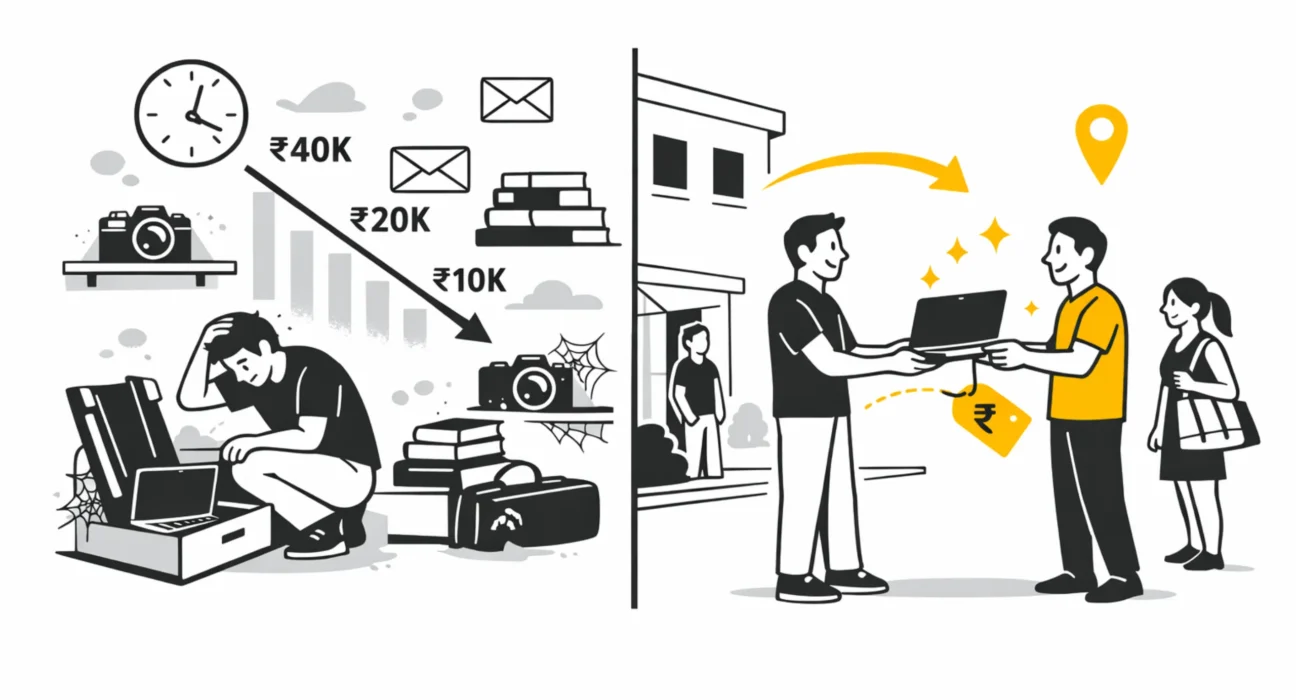
You paid forty thousand rupees for that laptop three years ago. It still works perfectly. The battery holds a charge. The screen is flawless. Keyboard responsive. Everything functions exactly as it should.
You check what it’s worth now. Trade-in offers? Eight thousand. Maybe ten if you’re lucky.
That’s not a fair price. That’s an insult.
So you don’t trade it in. You decide to sell it yourself. Get actual value. Except you never do. It sits in a drawer. Months pass. Now it’s worth less than those lowball offers you rejected.
Here’s the thing: your laptop didn’t lose value because it got worse. It lost value because you never actually sold it.
The gap between “I should sell this” and “I sold this” is where thousands of rupees disappear every single day. Not because items depreciate. Because platforms make selling harder than most people will tolerate.
Sympl exists to close that gap.
The Depreciation Clock Nobody Warns You About
Let’s talk about what happens to your stuff while you’re “planning to sell it eventually.”
Electronics depreciate fast. That phone is worth fifteen thousand today? Twelve thousand in three months. Nine thousand in six months. After a year, you’re looking at six or seven thousand.
You’re not losing value to wear and tear. The phone works the same. You’re losing value to time and newer models. Every month you wait for money to evaporate.
Textbooks are even worse. That competitive exam guide you bought for two thousand? Worth twelve hundred right after exams end. Worth eight hundred three months later when the next batch already has the updated edition. Worth almost nothing a year later.
Furniture and appliances hold value better, but they still decline. That sofa you’re not using? Styles change. Someone buying used wants the current aesthetic, not last decade’s trend. Wait too long and you’re selling dated furniture for scrap prices.
The brutal truth: every day you don’t sell is a day you’re choosing to lose money.
Not actively choosing. Passively choosing by not acting. But the result is the same. That laptop loses two hundred rupees of value every month you keep it in the drawer. Over a year? That’s real money gone.
Most people understand depreciation in theory. They don’t feel it in practice until they finally list something after a year of procrastination and realize it’s worth half what it was when they first thought about selling.
Why Good Intentions Don’t Convert to Sales
You genuinely mean to sell that camera. You’re not lying to yourself. You really will list it. Soon.
Except “soon” has rules. Soon means when you have time. When you’re not busy. When you feel motivated. When the stars align and you’ve got two free hours to deal with photos, descriptions, and platform nonsense.
That day never comes. Or it comes and something more urgent appears. Or it comes and you’re tired and decide to do it tomorrow.
This isn’t procrastination in the traditional sense. You’re not avoiding something difficult. You’re avoiding something annoying.
Difficult tasks with clear value get done. You’ll spend four hours assembling furniture because at the end you have furniture. You’ll spend an evening doing taxes because not doing them has consequences.
Annoying tasks with uncertain value get delayed indefinitely. Selling that camera might get you ten thousand rupees. Or it might get you weeks of frustration and flaky buyers and you end up selling for seven thousand. The uncertainty makes it easy to postpone.
Platform design creates this uncertainty. If you knew for sure that listing would take five minutes and you’d have a serious buyer within three days, you’d do it immediately. But you don’t know that. Past experience suggests it’ll be complicated and slow.
So you wait. And while you wait, the camera depreciates. And the longer it sits, the less motivated you become because now it’s worth even less.
Sympl breaks this cycle by removing the uncertainty. Simple listing process, local buyers, fast transactions. The outcome becomes predictable enough that taking action makes sense.
The Hidden Cost of Storage
Let’s do uncomfortable math.
You live in a city. Your rent or EMI covers a certain amount of space. That space costs money per square foot.
Now look at what’s occupying that space. The bike you don’t ride takes up maybe ten square feet. The boxes of books you’re “planning to sell” take up another five. The old furniture in the spare room? Fifteen square feet is easy.
Thirty square feet of your home is dedicated to things you don’t use but haven’t sold. In a metro city where rent is fifteen thousand per month for 500 square feet, you’re paying nine hundred rupees monthly to store stuff you don’t want.
Over a year? Almost eleven thousand rupees. To store items worth maybe twenty thousand total if you sold them today.
This isn’t counting the mental cost. Every time you see that bike, there’s a small guilt ping. “I should sell that.” Every time you move those boxes to get to something else, there’s frustration. “Why am I still keeping these?”
Small moments. They add up. Your environment affects your mental state more than you realize. Clutter isn’t just physical. It’s cognitive load.
You’re paying rent to store things that make you feel guilty about not selling them. That’s not a good deal.
What Platforms Get Wrong About Human Behavior
Most marketplaces assume sellers are rational economic actors who’ll jump through hoops for profit.
They’re wrong.
Humans aren’t rational. They’re busy, distracted, and operating with limited energy for tasks that aren’t critical. Selling used items falls into the “should do but not urgent” category for most people.
Platform designers don’t account for this. They build complex systems with multiple steps, assuming users will complete all of them because the reward is worth it.
But users don’t calculate that way. They calculate effort versus guaranteed outcome. Uncertain rewards for certain effort is a bad trade psychologically.
This is why simple platforms win. Not because their features are better. Because their user experience respects how humans actually make decisions.
When listing takes two minutes instead of twenty, the activation energy drops low enough that people follow through. When buyers are local instead of scattered nationwide, the probability of completing the sale is high enough to justify starting.
Sympl is designed around this understanding. Every unnecessary step removed is one less reason to procrastinate. Every source of friction eliminated is one more completed transaction.
The Tipping Point Between Selling and Storing
There’s a calculation happening in your head every time you consider selling something.
Item value minus effort required minus probability of failure equals whether you act.
Let’s say your old phone is worth twelve thousand. If selling it requires four hours of work and has a 50% chance of actually succeeding, the expected value is six thousand rupees for four hours of uncertain work.
That’s one thousand five hundred per hour if it works. Zero if it doesn’t. The average is seven hundred fifty per hour.
Suddenly it doesn’t feel worth it. So you don’t do it.
Now imagine the effort drops to thirty minutes and the success probability is 80%. Same twelve thousand rupee phone. Now its nine thousand six hundred expected value for half an hour.
That’s nineteen thousand rupees per hour. You’d do that immediately.
The phone didn’t change. The platform did. And that change flipped your decision from “not worth it” to “absolutely worth it.”
This is why platform choice matters more than people realize. The same item on two different platforms can be worth selling on one and not worth selling on the other. Not because the selling price changes, but because the effort and success rate change.
Sympl optimizes for low effort and high success rate. That combination pushes more items past the tipping point where selling makes sense.
What Local Actually Means in Practice
Everyone says they want local buyers. Few platforms actually deliver.
Real local means the person who messages you lives close enough to meet you today. Not this week. Not when they happen to be in your city. Today.
That proximity changes everything about the transaction.
Negotiation becomes reasonable. When someone’s standing in front of your bike, asking for a small discount because of a scratch you mentioned, that’s fair. When someone’s messaging from another city offering 60% of asking price without seeing the item, that’s insulting.
Logistics become simple. “Meet at the Starbucks near City Mall at 5 PM?” works when you’re both local. Coordinating courier pickup, packaging, shipping, delivery confirmation? That’s project management.
Trust develops naturally. You’re meeting face-to-face in a public place. Both of you have skin in the game. Compare that to sending money to a stranger and hoping the item arrives as described.
Deals close faster. Local buyer sees your listing Monday, messages Tuesday, meets Wednesday, buys Thursday. Done in three days. A distant buyer sees your listing, asks questions for a week, tries to negotiate shipping, might follow through eventually, probably doesn’t.
Sympl enforces local because local is the only model that consistently works for regular people selling used items. Not businesses. Not professional resellers. Regular people.
The Categories That Actually Move
Some items sell immediately on any platform. Some never sell no matter what you do. Most fall somewhere in between, where platform quality determines outcome.
Electronics sell if priced right. Phones, laptops, tablets, cameras, gaming consoles. People always need these and know their value. Price it fairly for the age and condition, and it moves.
Vehicles are surprisingly easy. Bikes, scooters, bicycles. People can test them on the spot. If it works and the price is reasonable, buyers commit quickly.
Furniture depends on timing. Someone’s furnishing a new place right now. Your desk is perfect for them today. Three months later? They’ve already bought something else. List furniture when you’re ready to let it go, not when you’re “thinking about it.”
Books and study materials are time-sensitive. List them right when exams end or semesters finish. That’s when the next batch is buying. Wait too long and you missed the window.
Kids’ items move fast in the right season. School supplies in June. Winter clothes in October. Toys before Diwali. Timing matters more than you’d think.
Appliances sell to people setting up homes. Someone just moved into a new apartment. They need a microwave, a mixer, and a fan. Yours works fine and costs half the new price. Easy sell.
The key insight: every item has a buyer somewhere. The question is whether the platform connects you with that buyer before you give up.
What Happens Without the Right Platform
Let’s follow what actually happens when you try to sell something on a complicated platform.
Day one: You spend forty-five minutes creating a listing. Photos, description, pricing research, choosing categories, filling mandatory fields. You’re already annoyed but you push through.
Day three: First message. “Is this available?” You reply yes. They never respond again. You’ve learned this is normal but it’s still frustrating.
Day five: Someone offers half your asking price. You counter reasonably. They counter with 55% of the asking price. You’re insulted and declined. They message three more times trying to negotiate. You stop responding.
Day seven: A serious buyer appears. They ask good questions. You answer thoroughly. They seem interested. They say they’ll “confirm by tomorrow.” They don’t.
Day ten: You wonder if your price is too high. You check similar listings. Yours is actually priced lower than most. So why isn’t it selling?
Day fourteen: Another lowball offer. Another “is this available” message that goes nowhere. You’re questioning whether this is worth your time.
Day twenty: You drop the price 15% just to get it sold. Immediately someone offers 70% of this new lower price. You realize dropping the price attracted bottom-feeders, not serious buyers.
Day thirty: The item is still unsold. You’ve wasted hours on messages that went nowhere. The thing has depreciated further while sitting unlisted. You’re considering giving up.
This isn’t an exaggeration. This is normal on most platforms. And this is why your stuff stays unsold.
The platform failed you. Not because it lacks features, but because it added so much friction that completing a simple transaction became genuinely difficult.
Why Sympl Works When Others Don’t
Sympl makes one big bet: that removing friction matters more than adding features.
Other platforms add verification to build trust. Sympl bets that local meetups and inspection before purchase build more trust than verification badges.
Other platforms add algorithms to surface listings. Sympl bets that showing local, recent listings to nearby buyers is better than algorithmic recommendations.
Other platforms add payment integration. Sympl bets that buyers and sellers can handle payment themselves without platform interference.
Other platforms add shipping logistics. Sympl bets that local pickup is simpler and works better for used items.
Every choice Sympl makes prioritizes completion over sophistication. The goal isn’t to be the most feature-rich platform. It’s to be the platform where the most transactions actually happen.
Because at the end of the day, that’s what matters. Did you sell the thing? Did you get fair value? Did it happen quickly? Did the process respect your time?
If yes, the platform succeeded. Everything else is decoration.
When Sympl Launches: What Changes
Sympl is coming soon. When it arrives, the calculation changes.
That laptop in your drawer? Finally worth selling because the effort dropped to minutes and the success probability jumped to likely.
That bike in storage? Finally it makes sense to list because local buyers mean serious interest, not time-wasters from distant cities.
Those textbooks on the shelf? Finally getting converted to cash because the platform doesn’t fight you with complexity.
This isn’t about motivation. It’s not about becoming a better seller or learning platform tricks. It’s about using a platform that actually works the way you need it to.
Your stuff has value. It always did. You’ve just been using platforms that made extracting that value harder than necessary.
Sympl fixes that. Simple listings. Local buyers. Fast transactions.