

The decision to implement an enterprise analytics platform is rarely about technology alone. For most C-level executives in mid-to-large organisations, it’s about managing risk, delivering on time, staying within budget, and ensuring the platform actually gets used across the business.
In India and globally, enterprises are dealing with distributed teams, legacy systems that nobody wants to touch, compliance requirements that change by region, and stakeholders who all have different ideas about what success looks like. The analytics platform becomes a microcosm of every challenge the organisation faces when trying to modernise.
This article is about what really happens when large enterprises try to scale analytics and what it takes to get it right.
Why Analytics Projects Fail at Scale
Most analytics initiatives don’t fail because of bad technology. They fail because of execution gaps.
A common pattern: the organisation starts with a pilot. The pilot works beautifully. Then comes the enterprise rollout, and everything slows down. Data governance becomes a battleground. IT and business teams stop talking to each other. Timelines slip by six months, then twelve. The budget doubles. Senior leadership loses patience.
Here’s what usually goes wrong:
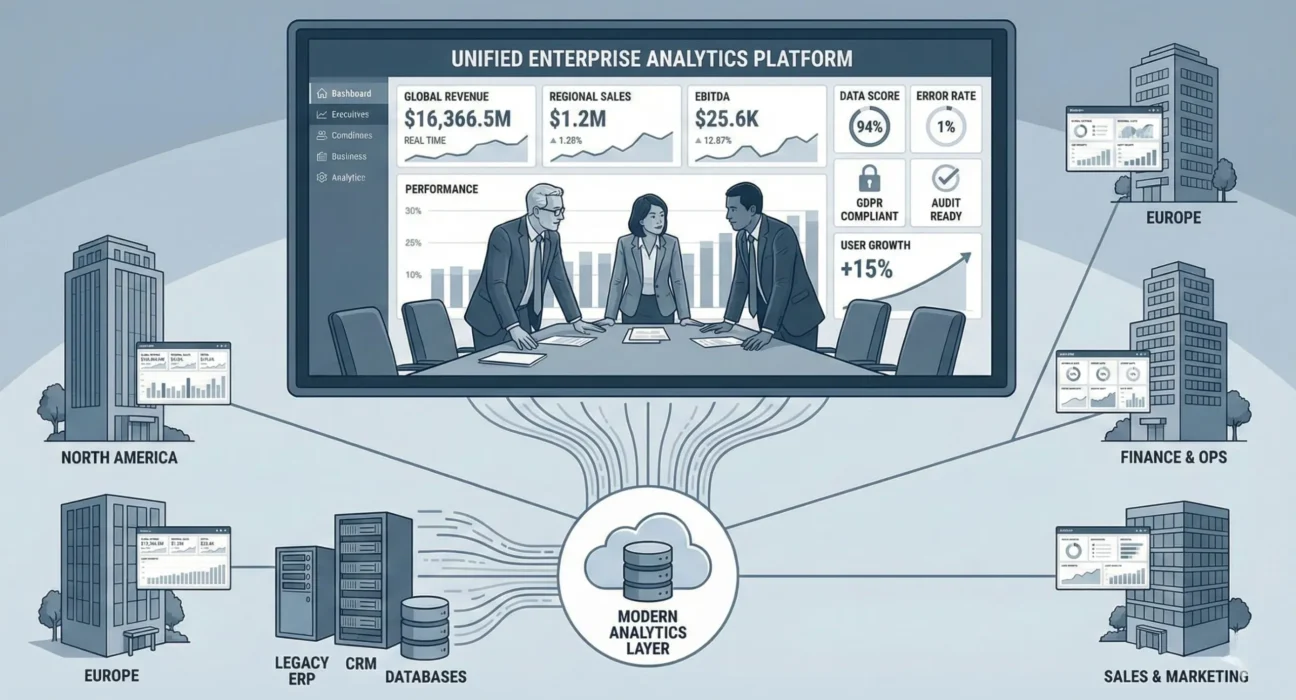
Underestimating data complexity. In large organisations, data lives everywhere ERP systems, CRM platforms, spreadsheets, databases that were built ten years ago and haven’t been documented since. Getting this data into one analytics platform isn’t a technical exercise. It’s a negotiation across departments, geographies, and legacy contracts.
Governance without ownership. Many enterprises create data governance frameworks on paper but never assign clear accountability. Who decides what data gets shared? Who owns data quality? Who resolves conflicts when two business units define the same metric differently? Without answers, the platform stalls.
Treating it as an IT project. Analytics platforms require business involvement from day one. If IT builds the platform in isolation and then hands it over, adoption fails. Business users don’t trust the data, don’t understand the tools, and eventually go back to their spreadsheets.
Vendor dependency without control. Enterprises often pick a big-name vendor, sign a large contract, and assume the vendor will handle everything. Then reality hits. The vendor delivers the software but doesn’t understand the organisation’s workflows, doesn’t integrate with legacy systems, and doesn’t stay around for the long implementation cycle. The enterprise is left managing a half-built platform with no clear path forward.
What Large Enterprises Actually Need
The technical requirements for an analytics platform are well understood: scalability, security, real-time processing, flexible reporting. But the real differentiators for large, distributed enterprises are different.
Execution maturity. Can the platform be delivered in phases, with clear milestones, realistic timelines, and accountability at every stage? Can the implementation partner handle the complexity of a distributed rollout different time zones, different regulatory environments, different levels of digital maturity across business units?
Integration with reality. Most enterprises aren’t starting fresh. They have SAP systems, Oracle databases, homegrown applications that run critical processes. The analytics platform has to integrate with all of this. The implementation partner needs to understand legacy systems, not just modern cloud architectures.
Governance that works in practice. Enterprises need data governance frameworks that can be enforced without slowing down the business. This means clear roles, automated controls where possible, and governance processes that people actually follow because they make sense, not because they’re mandated.
Change management at scale. Rolling out an analytics platform across a large organisation means training thousands of users, managing resistance, and ensuring that business leaders actually use the insights being generated. Technology is only half the challenge.
Long-term sustainability. What happens after the platform goes live? Who maintains it? Who handles upgrades? Who ensures data quality doesn’t degrade over time? Enterprises need partners who think beyond the initial implementation.
The Role of Leadership in Enterprise Analytics
C-level executives can’t outsource accountability for analytics transformation. The CEO, CIO, CTO, and CDO need to stay involved not in the technical details, but in the strategic decisions that determine success or failure.
Defining success clearly. What does the organisation actually want from the analytics platform? Faster decision-making? Cost reduction? Better customer insights? Regulatory compliance? If leadership doesn’t define this upfront, the project will drift.
Allocating ownership. Someone in the C-suite needs to own the analytics transformation. Not just sponsor it, but own it. This person becomes the tiebreaker when departments disagree, the escalation point when timelines slip, and the voice that keeps the organisation focused.
Managing stakeholder expectations. Large enterprises have dozens of stakeholders business heads, regional leaders, IT teams, compliance officers, external auditors. Leadership needs to align these stakeholders early and manage their expectations throughout the program. This isn’t a one-time conversation. It’s ongoing communication.
Investing in execution, not just technology. The platform itself might cost a few crores. But the real investment is in integration, change management, governance setup, and ongoing support. Leadership needs to budget for the full program, not just the software license.
Choosing the Right Partner
Technology vendors are good at selling platforms. But implementing an analytics platform at enterprise scale requires a different kind of partner one that understands program execution, not just product features.
Look for delivery track records. Has the partner delivered similar programs in large, distributed organisations? Can they show evidence of on-time, on-budget delivery? Do they have experience managing complex stakeholder environments?
Assess their understanding of legacy systems. If the partner only talks about cloud and modern architecture, but doesn’t understand how to integrate with SAP, Oracle, or older databases, there will be problems. Enterprise transformation happens in the messy middle between old and new.
Evaluate governance capabilities. Can the partner help design and implement data governance frameworks that actually work? Do they understand compliance requirements across different regions and industries?
Test their change management approach. Ask how they plan to drive adoption. If the answer is just “training sessions,” that’s not enough. Effective change management includes leadership alignment, communication planning, role-based training, and ongoing support.
Check for long-term commitment. The relationship doesn’t end when the platform goes live. The partner should be thinking about sustainability, knowledge transfer, and ongoing support from the beginning.
This is where organisations like Ozrit differentiate themselves not by selling technology, but by focusing on enterprise delivery and program execution. The emphasis is on understanding the client’s operational reality, managing the full lifecycle of implementation, and staying accountable for outcomes.
Common Pitfalls and How to Avoid Them
Even with the right platform and the right partner, enterprise analytics programs can go off track. Here are patterns that show up repeatedly:
Scope creep without governance. Stakeholders keep adding requirements. The platform keeps expanding. Timelines and budgets spiral. Solution: Lock scope for each phase. Additional requirements go into the next phase, not the current one.
Ignoring data quality until too late. The platform is ready, but the data is incomplete, inconsistent, or unreliable. Users lose trust immediately. Solution: Start data quality initiatives early, in parallel with platform development.
Underinvesting in user adoption. The platform is built, but users don’t change their behaviour. Adoption remains low. Solution: Treat adoption as a separate workstream with dedicated resources, not an afterthought.
Lack of ongoing ownership. The implementation team leaves. Nobody in the organisation knows how to maintain the platform or make changes. Solution: Insist on knowledge transfer and build internal capabilities from day one.
What Success Actually Looks Like
Successful enterprise analytics programs share certain characteristics. They’re delivered in phases, with each phase demonstrating clear business value. Governance is embedded from the start, not added later. Business users are involved throughout, not just at the end. And there’s a clear plan for long-term sustainability.
Success also means accepting that enterprise transformation is slow, complex, and requires persistence. There’s no shortcut. The organisations that succeed are the ones that commit to full journey leadership involvement, realistic timelines, adequate budgets, and strong execution discipline.
Final Thoughts
Building an analytics platform for a large, distributed enterprise is one of the most challenging programs a C-level executive will oversee. It touches every part of the organisation, exposes gaps in data governance, tests the organisation’s ability to execute complex programs, and requires sustained leadership attention.
Technology is important, but it’s not the hardest part. The hardest part is execution managing stakeholders, integrating with legacy systems, driving adoption, and ensuring long-term sustainability.
Enterprises that succeed are the ones that choose partners based on execution maturity, not just technical capability. They invest in governance and change management, not just software. They accept that transformation takes time and stay committed through the inevitable challenges.
For C-level executives evaluating analytics platforms, the question isn’t just “which platform?” but “who will help us deliver this successfully?” Partners like Ozrit, who focus on enterprise program execution rather than just development, understand that the real work begins after the contract is signed in the detailed planning, stakeholder management, integration challenges, and day-to-day execution that determines whether the platform delivers value or becomes another failed IT project.
The right approach, the right partner, and the right level of leadership commitment make the difference between an analytics platform that transforms the business and one that never quite lives up to its promise.